- Plants
- ›Vascular Plants
- ›flowering plants
- ›monocots
- ›grasses, sedges, cattails, and allies
- ›Sedges
- ›Cyperoideae
- ›Rhynchosporeae
- ›Rhynchospora
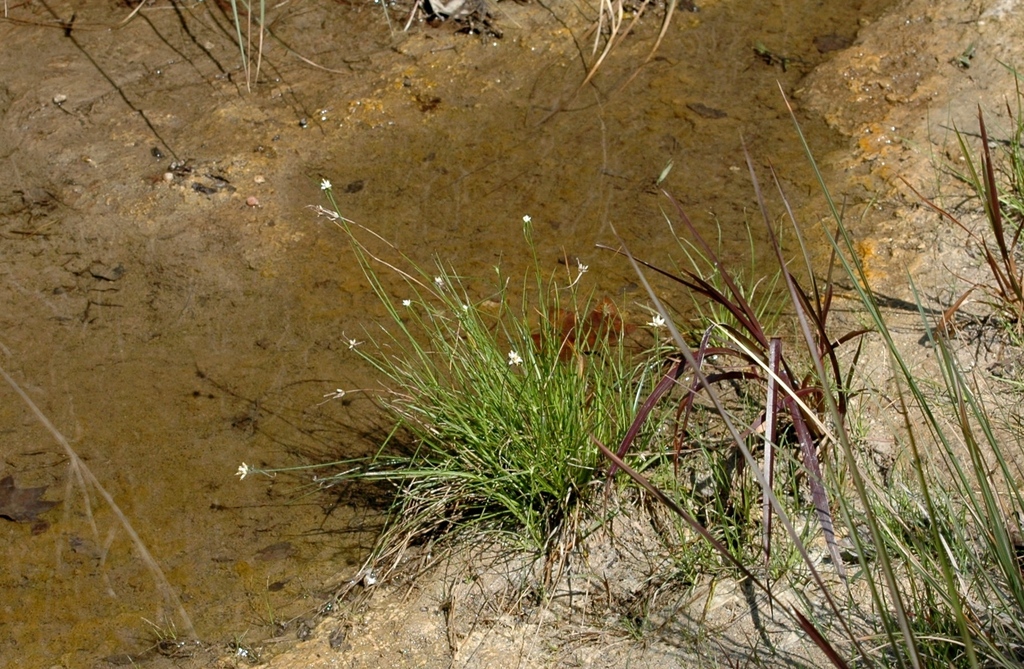
showy whitetop beaksedge
Rhynchospora nivea
Rhynchospora nivea, the showy whitetop beaksedge, is a particularly ornate member of the sedge family, the Cyperaceae.
From the article Rhynchospora nivea on Wikipedia (CC BY-SA), quoted section by section
Description
Of the nearly 400 accepted species of Rhynchospora, showy whitetop beaksedge, Rhynchospora nivea, is one of the most distinctive and easy to recognize. Within its limited area of distribution, in the field if you find a beaksedge with these field marks, you have a showy whitetop beaksedge:
The inflorescences' three to eleven teardrop-shaped flower spikelets are white. Leaf-like involucral bracts immediately below the white inflorescences are mostly 2–5 cm (3⁄4–2 in) long and exceedingly narrow, hairlike to 2 mm (3⁄32 in) wide; stem leaves are similarly unusually short and narrow. Beyond those key distinctions, here are other features to look for:
The plants are perennial and grow in wiry, dense tufts up to 40 cm (16 in) high, though usually they're shorter. Stems, or culms, are 3-cornered to flattened, with ribs. Stem leaves are very slender, at most 2 mm (3⁄32 in) wide. When flowering, styles extending beyond the white scales are deeply divided into 2 slender "stigmatic branches", not just indented. The one-seeded, achene-type fruits are very small, less than 0.8 mm (1⁄32 in) long and wide and their surfaces are transversely sharply wrinkled with wavy ridges. Hairlike bristles arising from the achene's base bear minute, pointed barbs along their sides directed upward toward the bristle's tip; at the bristles' bases the projections don't become feathery. Wherever showy whit …
Range & habitat
In the US, showy whitetop beaksedge is native to central and eastern Texas, especialy in the Edwards Plateau region, and southeastern and southern Oklahoma. In northeastern Mexico it occurs in Coahuila state.
Wikipedia: “Distribution”
What it does
Unlike most sedges, which are pollinated by wind, showy whitetop beaksedge is pollinated by insects attracted to the white flowers. The U.S. Army Corps of Engineers classes Rhynchospora nivea as a "facultative wetland hydrophyte", indicating that usually the species occurs in wetlands, but may occur in non-wetland environments. Rhynchospora nivea uses the C3 carbon fixation pathway.
Wikipedia: “Ecology”
In human culture
The genus name Rhynchospora is from the Greek rhynchos, meaning "snout", and spora, meaning "seed". Thus "snout-seed", nicely describing the one-seeded achene-type fruit, which looks like a seed with a pointed cap-like "tubercle" atop it, of a different texture and color from the achene, and which whimsically could be referred to as a snout. The species name nivea is the feminine form of the New Latin niveus, meaning "snow-white, snowy, of snow". This undoubtedly points to the most distinguishing feature of Rhynchospora nivea, its white spikelets.
== References ==
Wikipedia: “Etymology”
Where it lives
Recorded sightings
—
geo-referenced records in GBIF, from museums, herbaria and field observers.
Drag the globe to turn it. Dots are where records exist, not a range map; darker means more records.
In the stacks
Searching the stacks…
Every page naming Rhynchospora nivea in the Biodiversity Heritage Library →
This page is assembled live from iNaturalist, GBIF, Wikipedia, the Source Library and the Internet Archive. It is not yet part of the hand-edited codex. iNaturalist taxon 167887.