- Plants
- ›Vascular Plants
- ›flowering plants
- ›Dicots
- ›beeches, oaks, walnuts, and allies
- ›beech family
- ›Quercus
- ›Quercus
- ›Lobatae
- ›Phellos
- ›Quercus ilicifolia
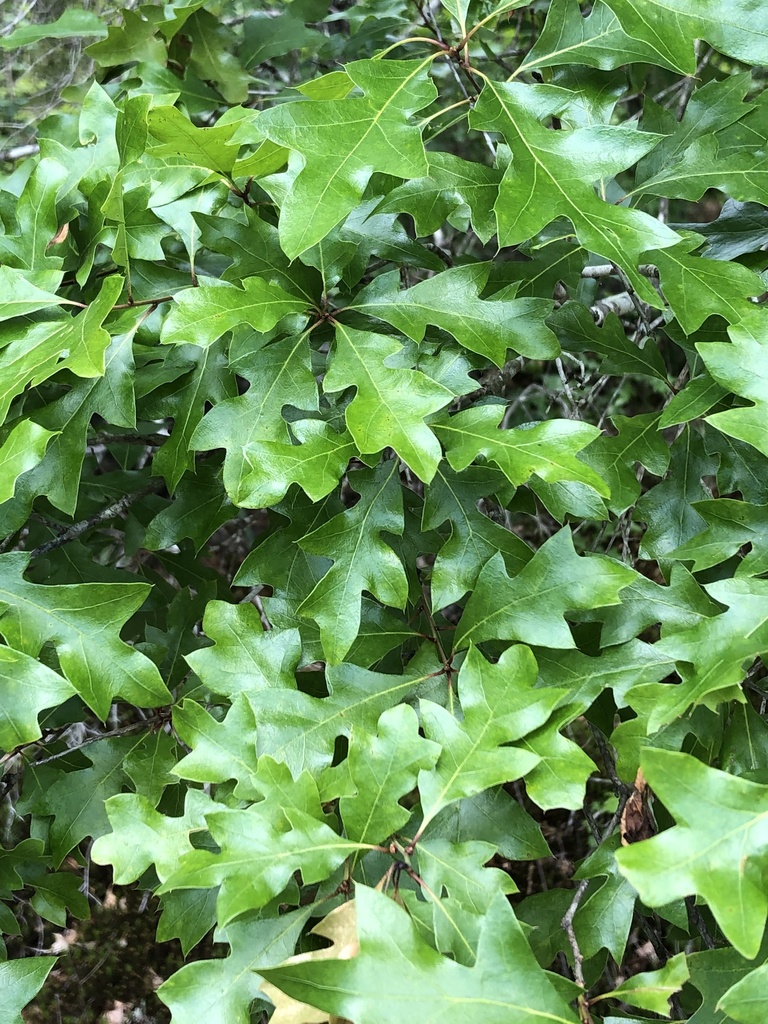
Georgia Oak
Quercus georgiana
Quercus georgiana, the Georgia oak or Stone Mountain oak, is a rare deciduous red oak, native to the southeastern United States.
From the article Quercus georgiana on Wikipedia (CC BY-SA), quoted section by section
Description
Quercus georgiana is a small tree, often shrubby in the wild, growing to 8–15 meters (26–49 feet) tall. It is classified in the red oak section Quercus sect. Lobatae.
Leaves. The shiny green leaves are 4–13 centimeters (1+1⁄2–5 inches) long and 2–9 cm (1–3+1⁄2 in) wide, with a 0.6–2.3 cm (1⁄4–1 in) petiole, and five irregular, pointed, bristle-tipped lobes; they are glabrous (hairless), except for small but conspicuous tufts of hairs in the vein axils on the underside. The leaves turn dark red to brown in the autumn, stay on the tree throughout the winter, and fall as the new leaves bud in the spring.
Flowering and fruiting. Like all oaks, flowering and leaf-out occur in late spring when all frost danger has passed. The flowers are monoecious catkins which, being self-incompatible, require the presence of another oak for pollination.
The acorns are round, 9–14 millimeters (3⁄8–1⁄2 inch) long, maturing about 18 months after pollination.
Twigs and buds. Twigs are deep red, 1–2 mm in diameter and glabrous. Terminal buds are red-brown, ovoid to subconic, 2.5–5 mm, and glabrous or with scales somewhat ciliate.
Range & habitat
The Georgia oak is native to the southeastern United States, mainly in northern Georgia, but with additional populations in Alabama, North Carolina, and South Carolina. It grows on dry granite and sandstone outcrops of slopes of hills at 50–500 m (160–1,640 ft) altitude. The tree was first discovered in 1849 at Stone Mountain, Georgia, where several stands of pure specimens grow along the popular walk-up trail at around 400 m (1,300 ft), near the large chestnut oak in the middle of the trail and before the rest pavilion halfway up the trail. Georgia oaks are also found at nearby monadnocks, including Panola Mountain and Arabia Mountain in Georgia.
Wikipedia: “Distribution and habitat”
At the table
It is occasionally cultivated as a specimen or garden tree in USDA plant hardiness zones 5–8. Besides landscape horticulture, the Georgia oak has no commercial uses.
Wikipedia: “Uses”
Where it lives
Recorded sightings
—
geo-referenced records in GBIF, from museums, herbaria and field observers.
Drag the globe to turn it. Dots are where records exist, not a range map; darker means more records.
In the stacks
Searching the stacks…
Every page naming Quercus georgiana in the Biodiversity Heritage Library →
This page is assembled live from iNaturalist, GBIF, Wikipedia, the Source Library and the Internet Archive. It is not yet part of the hand-edited codex. iNaturalist taxon 167648.