- Plants
- ›Vascular Plants
- ›flowering plants
- ›Dicots
- ›beeches, oaks, walnuts, and allies
- ›beech family
- ›Quercus
- ›Quercus
- ›Lobatae
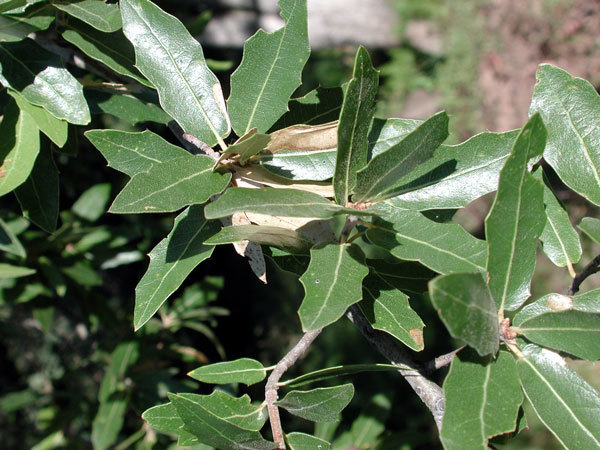
Emory oak
Quercus emoryi
Quercus emoryi, the Emory oak, is a species of oak common in Arizona (including inside Saguaro National Park), New Mexico and western Texas (including inside Big Bend National Park), United States, and northern Mexico (Sonora, Chihuahua, Coahuila (including Parque Nacional Maderas del Carmen), Durango, Nuevo León, and San Luis Potosí). It typically grows in dry hills at moderate altitudes.
From the article Quercus emoryi on Wikipedia (CC BY-SA), quoted section by section
Description
Quercus emoryi is a wintergreen tree in the red oak group, retaining its leaves throughout the winter until new leaves are produced in spring. It is a large shrub or small tree from 5–17 metres (16–56 feet) tall. The leaves are 3–6 centimetres (1–2+1⁄2 inches) long, simple or wavy-toothed, leathery, dark green above, paler below. The acorns are 1.5–2 cm (5⁄8–3⁄4 in) long, blackish-brown, and mature in 6–8 months from pollination; the kernel is sweet, and is an important food for people and for certain other mammals. The seeds of this tree are called chich'il in Ndee, wi-yo:thi or toa in O'odham, bellotas in Spanish, and acorns in English. The English and Latin botanical names for this tree come from the name of a United States Army surveyor, Lieutenant William Hemsley Emory, who surveyed the area that had become known as West-Texas in the 1840s.
What it does
The Emory acorn is sweet and is an important food for livestock, deer, squirrels, cliff chipmunks (Tamnias dorsalis), and birds such as quail and wild turkeys. Deer and livestock also browse the foliage.
Wikipedia: “Ecology”
At the table
Native American groups have eaten Emory acorns traditionally, ceremonially, and in contemporary cuisine. The acorns are most commonly ground into meal. Emory oak health and habitat have been challenged in 2020, including in Oak Flat, Arizona in the Tonto National Forest by the Resolution Copper mining company's large copper mine.
According to the United States Department of Agriculture:Emory oak acorns are a critically important resource for Western Apache Tribal Nation, both as a food source and due to its cultural and ceremonial uses. For decades, Apache elders watched in frustration as groves produced less acorn yield and declined in overall health. The ... Emory oak Collaborative Tribal Restoration Initiative is restor[ing] and protect[ing] Emory oak stands ... to ensure the long-term persistence of Emory oak. Habitat loss, fire suppression, livestock grazing, groundwater reductions, species competition and climate change have all impacted the Emory oak population. This program uses tribal traditional ecological knowledge to guide goals and activities.
Wikipedia: “Uses”
Where it lives
Recorded sightings
—
geo-referenced records in GBIF, from museums, herbaria and field observers.
Drag the globe to turn it. Dots are where records exist, not a range map; darker means more records.
In the stacks
Searching the stacks…
Every page naming Quercus emoryi in the Biodiversity Heritage Library →
This page is assembled live from iNaturalist, GBIF, Wikipedia, the Source Library and the Internet Archive. It is not yet part of the hand-edited codex. iNaturalist taxon 167646.