- Plants
- ›Vascular Plants
- ›flowering plants
- ›Dicots
- ›Heathers, Balsams, Primroses, and Allies
- ›heath family
- ›Wintergreens
- ›Pyrola
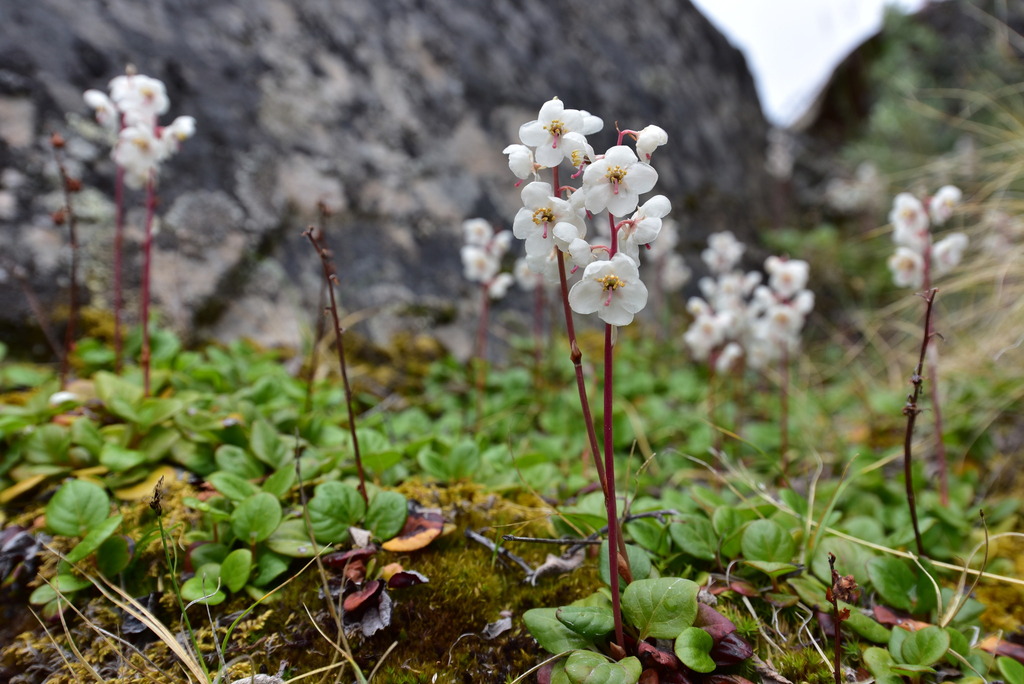
Arctic wintergreen
Pyrola grandiflora
Pyrola grandiflora (, commonly known as Arctic wintergreen or largeflowered wintergreen, is a hardy perennial evergreen subshrub in the family Ericaceae. It is widely distributed in the Northern Hemisphere from temperate to tundra-like climates.
From the article Pyrola grandiflora on Wikipedia (CC BY-SA), quoted section by section
Description
According to the United States Department of Agriculture (USDA), individuals of this species are considered to be a type of subshrub that grows under 0.5 meters never reaching one meter at maturity. The plant reaches heights of 3–25 cm with simple leaves that are basal and long-petioled.
Leaf morphology. The leaves can be described as having pinnate venation with obtuse or rounded leaf blade bases, rounded leaf apices, sub-entire blade margins, and glabrous surface. A leaf's abaxial surface is dull, pale and its adaxial surface is shiny, dark green with a leathery feeling upon touch. There is also sometimes white tissue that borders larger veins adaxially. The plant is evergreen and its leaves are persistent throughout all seasons unlike deciduous plants.
Stem, petioles, and roots. The stem known as a caudex grows in branches vertically at the ground level or underground. They are short and grow from a slender rhizome. There is a small transition zone between the roots and the basal leaves. It also is composed of a scape with one to two bracts. The petioles are 5–25 mm long, unwinged, flat, glabrous and are attached to the basal leaves or absent with bract leaves on the flowering stem. The root of the large-flowered wintergreen is a taproot.
Wikipedia: “Morphology”
Range & habitat
Pyrola grandiflora is found throughout the Northern Hemisphere and is circumpolar including places: Greenland, Canada, United States, Alaska, Yukon, Northwest Territories Islands, Continental Northwest Territories, Nunavut Islands, Continental Nunavut, Northern Quebec, Eurasia, and the Arctic.
Wikipedia: “Distribution”
What it does
According to the Köppen climate classification, Pyrola grandiflora grows in certain types of climates: hemiboreal, taiga, and tundra found in the North Hemisphere or circumpolar. This perennial subshrub is able to grow on numerous substrates (surface in which an organism grows) on alpine tundra, heathlands, coniferous forests, boreal forests (taiga), woodlands, slopes, ridges, dry meadows, stony places and imperfectly drained moist or dry areas. Additionally, on humus in shrubby tundra, it is able to grow along with Vaccinium uliginosum, Salix alaxensis, Betula glandulosa. Flowering season is often between April and June.
Wikipedia: “Habitat and ecology”
In medicine
Although other species of Pyrola such as Pyrola asarifolia have been considered to treat urinary diseases, mouth and throat inflammations, postpartum swelling, hemorrhoids, and insect bites, there have been no studies found that display that Pyrola grandiflora has medicinal properties as well.
== References ==
Wikipedia: “Medicinal use”
Where it lives
Recorded sightings
—
geo-referenced records in GBIF, from museums, herbaria and field observers.
Drag the globe to turn it. Dots are where records exist, not a range map; darker means more records.
In the stacks
Searching the stacks…
Every page naming Pyrola grandiflora in the Biodiversity Heritage Library →
This page is assembled live from iNaturalist, GBIF, Wikipedia, the Source Library and the Internet Archive. It is not yet part of the hand-edited codex. iNaturalist taxon 167622.