- Plants
- ›Vascular Plants
- ›flowering plants
- ›Dicots
- ›Heathers, Balsams, Primroses, and Allies
- ›primrose family
- ›primrose subfamily
- ›Primuleae
- ›Primula
- ›Aleuritia
- ›Aleuritia
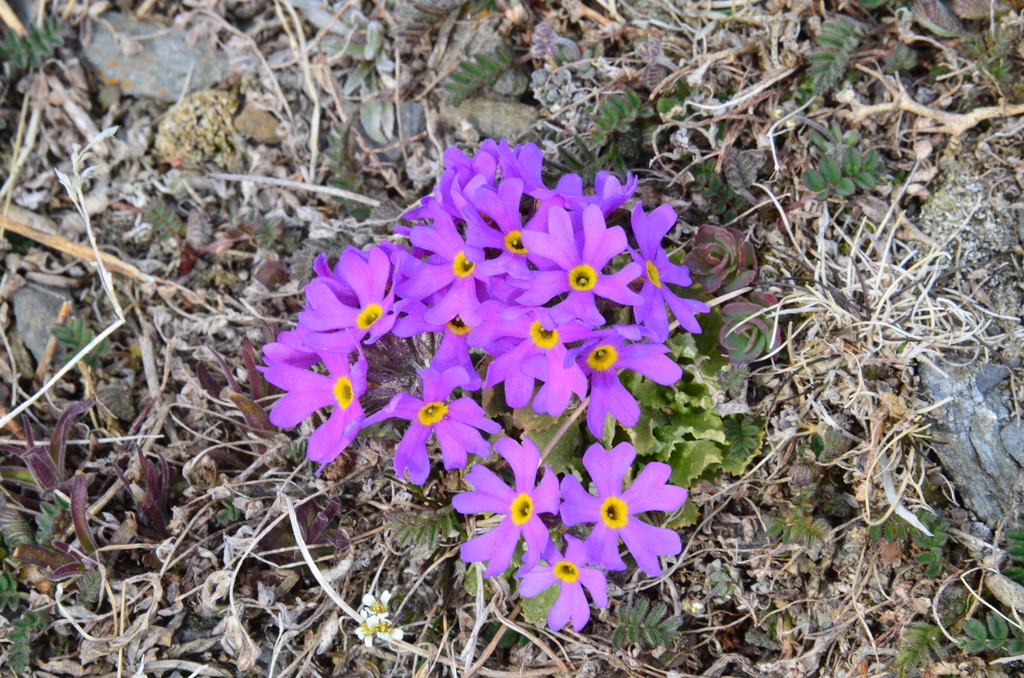
Slender Primrose
Primula borealis
Primula borealis, also known as the Northern primrose or slender primrose, is a species of flowering plant within the genus Primula and family Primulaceae. The species is a halophyte, inhabiting coastal saline habitats within subalpine and subarctic regions.
From the article Primula borealis on Wikipedia (CC BY-SA), quoted section by section
Description
Primula borealis is a small herbaceous perennial plant, typically measuring between 1 and 12 centimetres in height. It possesses thin and short rhizomes, that give rise to shoots. Due to the rhizomes P. borealis possesses a clumping growth habit. P. borealis possesses both diploid and polyploid individuals, with a chromosome count of 2n = 18 and 36.
Leaves. The leaves of Primula borealis are not aromatic and have indistinct petioles, which are narrowly winged. The leaf blade is variable in shape, ranging from spatulate to rhombic. It typically measures between 1 and 3.5 cm in length and 0.1 to 0.7 cm in width. The leaves are thin in texture and have smooth surfaces devoid of deep reticulate veins on the underside. The margins of the leaves are crenate to remotely denticulate, exhibiting small rounded or tooth-like projections. The apex of the leaves is either obtuse or acute, depending on the individual plant. Overall, the leaves of P. borealis contribute to the plant's attractive foliage.
Flowers. Inflorescences of Primula borealis typically have 1 to 10 flowers, rising from the central rosette of leaves. The flowers can range in colour from the common lavender to a less common rosy violet or white. The involucral bracts, which surround the flowers, are notable for their saccate or gibbous shape at the base. …
Range & habitat
Primula borealis is distributed within the Northern Hemisphere, occurring in specific regions of North America and Eastern Asia. In North America, P. borealis is found in the Northwest Territories and Yukon, both located in Canada. It is also known to occur in the state of Alaska in the United States. In eastern Asia, P. borealis is distributed across several areas. It is found in Beringia within the Kamchatka Peninsula located in the Far East of Russia. The species is also present in Khabarovsk, a region in the South-eastern Russia. Additionally, P. borealis can be found in Krasnoyarsk, a large territory in Siberia. P. borealis also extends its distribution to Magadan, a region in North-eastern Russia that experiences a subarctic climate. Primula borealis is a halophyte, which inhabits subalpine and subarctic biomes. It is known to grow in coastal saline habitat such as estuaries, sand dunes and salt marshes. These areas are characterized by high salt concentrations in the soil and water. The species may also be found growing on floodplain meadows or in proximity to freshwater hot springs, often growing in damp clay deposits. …
Wikipedia: “Distribution and habitat”
Where it lives
Recorded sightings
—
geo-referenced records in GBIF, from museums, herbaria and field observers.
Drag the globe to turn it. Dots are where records exist, not a range map; darker means more records.
In the stacks
Searching the stacks…
Every page naming Primula borealis in the Biodiversity Heritage Library →
This page is assembled live from iNaturalist, GBIF, Wikipedia, the Source Library and the Internet Archive. It is not yet part of the hand-edited codex. iNaturalist taxon 167418.