- Plants
- ›Vascular Plants
- ›flowering plants
- ›Dicots
- ›pinks, cactuses, and allies
- ›purslane family
- ›Portulaca
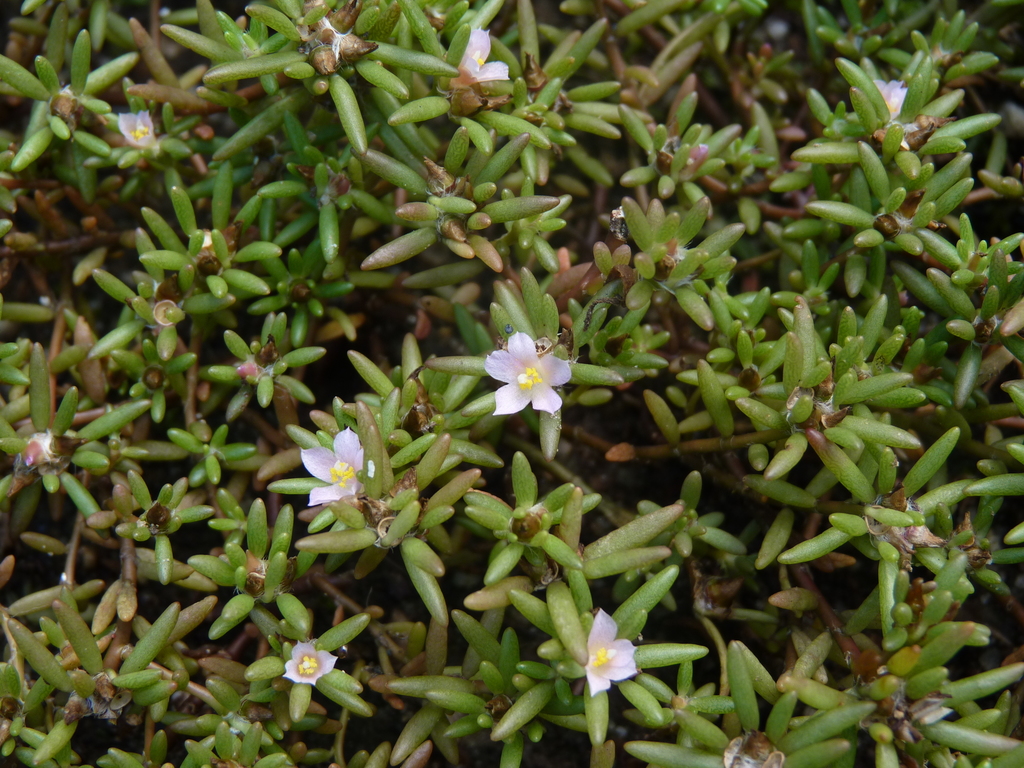
Small's Purslane
Portulaca smallii
Portulaca smallii, or Small's purslane, is an annual flowering plant found in the southeast of the United States. It belongs to the Portulacaceae family.
From the article Portulaca smallii on Wikipedia (CC BY-SA), quoted section by section
Description
Portulaca smallii flowers are cosexual and the plant is a dicot with 4-5 petals and 8-12 stamens per flower. The stigmas are four-lobed and the fruits are sub-globose capsules. The flowers range from white to medium pink, but color does not vary within a plant. The leaves demonstrate an alternating pattern. There are axillary trichomes by the leaves and flowers. The leaves are fleshy and elongate and the margins are entire. The plant is 2-15 cm tall, with the leaves being 4-15mm long, 0.5-3 mm wide, and linear-lanceolate in shape. The leaf apex is subobtuse to subacute in shape. Seeds are gray or black, and stellate-tuberculate in shape. They can be as large as .85mm.
Range & habitat
Portulaca smallii can be found in the southeastern piedmont, in Virginia, North Carolina, South Carolina, and Georgia, usually at an elevation of 200-300m. It grows in sandy soil on granite rocks, in the ecotone between dense vegetation and rock where the soil is shallow and few other plants can be found. It grows best when in full sun conditions. Erosion, high temperatures, droughts, and wind limit the ability for other plants to survive in these areas. This results in low competition for P. smallii. There is evidence of P. smallii thriving in disturbed environments. By Dundas Granite Flatrock, it was found growing not on the granite rock, but instead in an old logging bed, a grazed woodland, and a mowed golf green. However, it does not spread rapidly and does not have an adaptation for large scale seed dispersal.
Wikipedia: “Distribution and habitat”
What it does
Portulaca smallii has been observed experiencing predation from larval leaf beetles, red spider mites, and spring-tails. Hymenoptera species pollinate P. smallii. When grown with ryegrass, P. smallii experienced greater initial growth, but lesser total growth. These plants grew high with fewer branches and leaves than plants grown in the absence of ryegrass. The control P. smallii also ended up reaching a greater height than the plants grown with ryegrass.
Wikipedia: “Species interactions”
Where it lives
Recorded sightings
—
geo-referenced records in GBIF, from museums, herbaria and field observers.
Drag the globe to turn it. Dots are where records exist, not a range map; darker means more records.
In the stacks
Searching the stacks…
Every page naming Portulaca smallii in the Biodiversity Heritage Library →
This page is assembled live from iNaturalist, GBIF, Wikipedia, the Source Library and the Internet Archive. It is not yet part of the hand-edited codex. iNaturalist taxon 167314.