- Plants
- ›Vascular Plants
- ›flowering plants
- ›Dicots
- ›pinks, cactuses, and allies
- ›Pokeweed Family
- ›Phytolacca
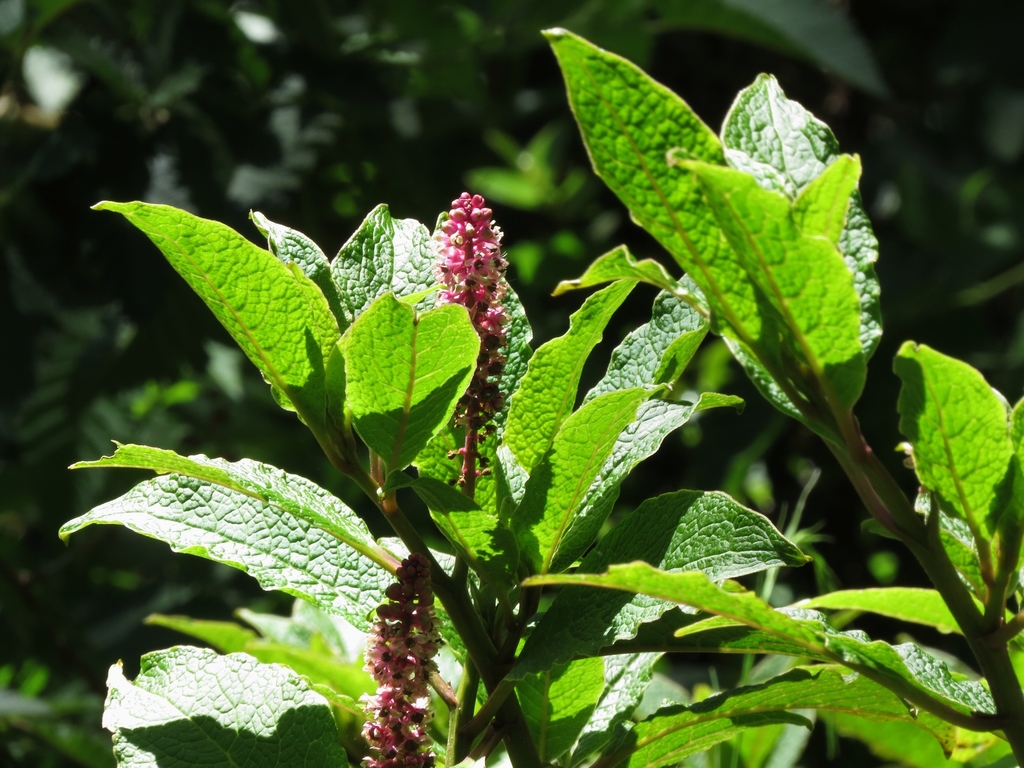
pōpolo kū mai
Phytolacca sandwicensis
Phytolacca sandwicensis, also known as Hawai'i pokeweed, is a member of the Phytolaccaceae family and is a flowering and fruit bearing species endemic to the Hawaiian Islands, where it is found on Kauaʻi, Oʻahu, Molokaʻi, Maui, and Hawaiʻi. Locally it is referred to as pōpolo kū mai and/or pōpolo. Pōpolo itself is a term for any Solanum species, which its berries resemble.
The genus Phytolacca has about 25 different species within it. They are commonly found in North America, South America, East Asia and New Zealand, with Phytolacca sandwicensis being the only species exclusively found in the Hawaiian Islands.
From the article Phytolacca sandwicensis on Wikipedia (CC BY-SA), quoted section by section
Description
Phytolacca sandwicensis is a non-woody plant which grows to a moderate height of over 3 feet tall and 10 feet across. The flowers which it produces range in color from dark pink, pink, to white typically. The flower is unique because it blooms on a spike of sorts known as inflorescence, which also bears the fruit of the plant. The fruit is typically dark purple in color. The pokeweed has green oval shaped leaves which can be either glabrous, meaning it has no fuzz or hairs, or they can be puberulent, meaning they have hair or fuzz.
Range & habitat
Phytolacca sandwicensis is a terrestrial species endemic to the Hawaiian Islands of the Pacific Ocean. It is a rather rare plant to find in the wild. Hawai'i pokeweed can be found in open areas or stream beds within wet or mesic forests. It is capable of withstanding various elevation extremes ranging from around 300 feet above sea level to 6500 feet above sea level. Phytolacca sandwicensis requires a wet environment to survive with a moderate amount of sunlight exposure. It is capable of living in open areas with lots of light exposure, but for landscaping purposes it has been found that a limited amount of sunlight produces a more desirable color and shape. Hawai'i pokeweed also prefers to reside in a cinder or organic soil which is well drained.
Wikipedia: “Habitat”
At the table
Traditionally the plant was used by the native islanders as a dye for tattooing. They found that crushing the berries created a desirable purple colored dye.
Wikipedia: “Traditional uses”
Where it lives
Recorded sightings
—
geo-referenced records in GBIF, from museums, herbaria and field observers.
Drag the globe to turn it. Dots are where records exist, not a range map; darker means more records.
In the stacks
Searching the stacks…
Every page naming Phytolacca sandwicensis in the Biodiversity Heritage Library →
This page is assembled live from iNaturalist, GBIF, Wikipedia, the Source Library and the Internet Archive. It is not yet part of the hand-edited codex. iNaturalist taxon 166863.