- Plants
- ›Vascular Plants
- ›flowering plants
- ›monocots
- ›grasses, sedges, cattails, and allies
- ›grasses
- ›Reeds, Giant Canes, and allies
- ›Molinieae
- ›Phragmites
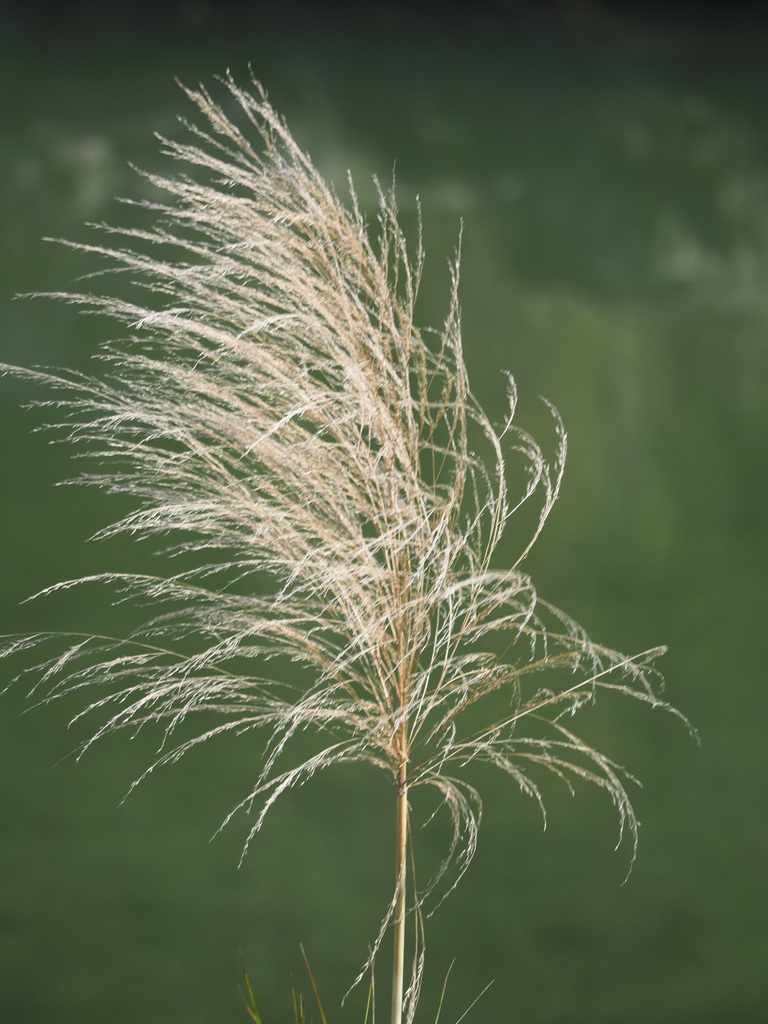
Tall Reed
Phragmites karka
Phragmites karka, the tall reed or common reed, is a species of flowering plant in the grass family. It is native to West Africa.
From the article Phragmites karka on Wikipedia (CC BY-SA), quoted section by section
Description
It is a herbaceous, perennial species with a rhizomatous geophyte (underground storage organ) and primarily grows in the tropical regions during the dry season. During the winter, it is deciduous. Plants can grow to 4–10 metres in height, with a diameter of 15-25mm.
The species is a fast-growing aquatic plant, often found in swamps, riverbanks and standing water, usually at elevations below 1,000 m.
Range & habitat
This species has a widespread distribution that includes West Africa, Southern Arabian Peninsula, Kenya, South Asia, Southeast Asia and the Pacific Islands. It is also present in New Zealand, where it is categorised as an invasive weed.
Wikipedia: “Distribution”
At the table
Locally, this species is utilised as a source of building and construction material, and as food. It is often planted near rivers to purify water, and as an anchor against soil erosion. The young shoots of this plant can be cooked and eaten, like bamboo or asparagus. The young leaves can also be used as fodder. The grass is also use for thatching and making screens, baskets, brooms, hats, mats, paper and reeds for musical instruments and fuel. In the Philippines, the panicles of this species are bunched-up in a fan-shape to create a broom, with the culms being tightly bound to a central bamboo piece.
Wikipedia: “Uses”
Where it lives
Recorded sightings
—
geo-referenced records in GBIF, from museums, herbaria and field observers.
Drag the globe to turn it. Dots are where records exist, not a range map; darker means more records.
In the old herbals & bestiaries

Commentaries on the Six Books of Pedanius Dioscorides on Medical Matter
Pietro Andrea Mattioli · 1565 · p.509

François Bouchard — Recueil de cent-trente-trois oiseaux des plus belles especes (1775)
François Bouchard · 1775 · p.169

François Bouchard — Recueil de cent-trente-trois oiseaux des plus belles especes (1775)
François Bouchard · 1775 · p.122
In the stacks
Searching the stacks…
Every page naming Phragmites karka in the Biodiversity Heritage Library →
This page is assembled live from iNaturalist, GBIF, Wikipedia, the Source Library and the Internet Archive. It is not yet part of the hand-edited codex. iNaturalist taxon 166742.