- Plants
- ›Vascular Plants
- ›flowering plants
- ›Dicots
- ›Mints, Plantains, Olives, and Allies
- ›Plantain Family
- ›Penstemon and allies
- ›Penstemon
- ›Penstemon
- ›Penstemon
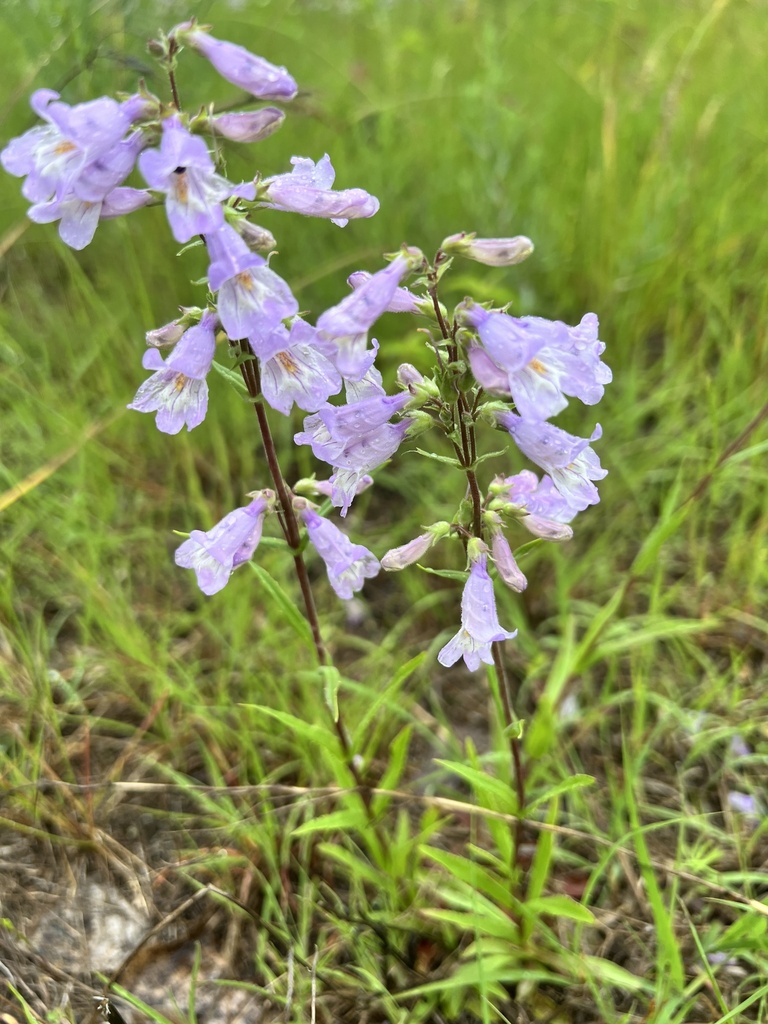
Lilac Penstemon
Penstemon gracilis
Penstemon gracilis, more commonly the slender penstemon or lilac penstemon, is flowering plant in the veronica family. It primarily grows in the northern Great Plains of the United States and southern Canada.
From the article Penstemon gracilis on Wikipedia (CC BY-SA), quoted section by section
Description
Slender penstemon is a perennial plant that generally is 20 to 50 centimeters (8 to 20 in) tall when fully grown, but occasionally can be just 15 cm (6 in). Each plant will usually have one to four stems, but on occasion can have as many as six. The stems may grow directly upward or outwards before bending to grow upwards. They are commonly reddish higher up and are glandular-pubescent, having hairs with glands that will exude plant chemicals, near the inflorescence, but have backwards facing hairs without glands towards the base. The stems grow from a short and slender caudex that is herbaceous rather than woody. The caudex tops a taproot. The leaves of slender penstemons are both cauline and basal, attached to the stems or directly to the base of the plant. They are never leathery and are usually hairless, but in some populations or individuals they can be sparsely or densely hairy. The leaves with puberulent, short, thin hairs, are most often found in the Driftless Area of Wisconsin or mixed with hairless plants in North Dakota. They have edges that are just short of being smooth to serrate, having asymmetrical teeth that point forward. The basal leaves and the lowest leaves on the stems are 2.5 to 7.5 centimeters long and just 4 to 15 millimeters wide. They can be ovate, oblanceolate, or lanceolate. The stems have four to seven pairs of leaves. …
Range & habitat
Slender penstemons are native to central and western Canada, the north-central United States, and the eastern edge of the Rocky Mountains to northern New Mexico. In Canada they reach the south-westernmost part of Ontario and extend westwards to Alberta and the northeast of British Columbia. In the United States isolated occurrences are recorded in Lake County, Indiana and Kane County, Illinois. However, according to the Flora of North America the Indiana population is a human introduction. The single report of the species in Michigan is in Dickinson County, in the Upper Peninsula. To the west it becomes more common, being reported in approximately the western half of Wisconsin, most of Minnesota, and both the Dakotas. It is only in northwest Iowa and is more common in the northern counties of Nebraska. Almost all the occurrences in Montana are in the east with the exception of Sanders County in the far west of the state. Most of the range is in the northeast of Wyoming and the occurrences in Colorado are at lower elevations in the eastern Rocky Mountains. It reaches its southern limits in northern New Mexico where it is found occasionally in the lower mountains in the North East. It can be found at elevations of 300 to 2,100 meters (980 to 6,890 ft). It is primary a species of the northern Great Plains and grows in tallgrass, mixed grass, and shortgrass prairies. …
Wikipedia: “Range and habitat”
What it does
In a study of changing bloom dates due to climate change lilac penstemon was one of just ten species out of more than 120 studied from northern Great Plains that maintained a consistent flowering date despite warmer temperatures. In fact it bloomed an average of two days earlier in 2007–2010 than its average in 1910–1961.
Conservation. Lilac penstemon was evaluated by the conservation organization NatureServe in 2016 and rated as secure at the global level (G5). It was similarly rated as apparently secure (S4) in New Mexico, Ontario, Saskatchewan, and Alberta. However it was found to be vulnerable (S3) in Wyoming, British Columbia, and Manitoba and critically imperiled (S1) in Iowa and Michigan. They have not rated the rest of the states and provinces in its range.
Wikipedia: “Ecology”
How it is grown
Within its native range it is grown as a xeriscape plant in gardens and is winter hardy in USDA Zones 3 to 6.
Wikipedia: “Cultivation”
Where it lives
Recorded sightings
—
geo-referenced records in GBIF, from museums, herbaria and field observers.
Drag the globe to turn it. Dots are where records exist, not a range map; darker means more records.
In the stacks
Searching the stacks…
Every page naming Penstemon gracilis in the Biodiversity Heritage Library →
This page is assembled live from iNaturalist, GBIF, Wikipedia, the Source Library and the Internet Archive. It is not yet part of the hand-edited codex. iNaturalist taxon 166372.