- Plants
- ›Vascular Plants
- ›flowering plants
- ›Dicots
- ›Mints, Plantains, Olives, and Allies
- ›broomrape family
- ›Pedicularideae
- ›Pedicularis
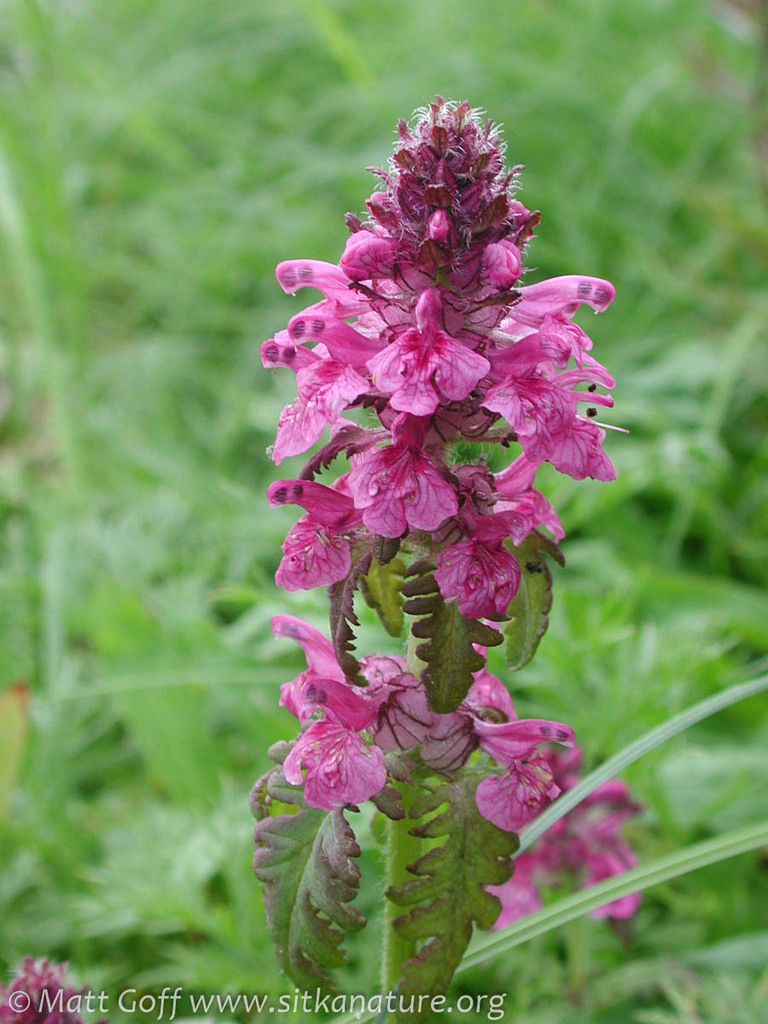
Whorled Lousewort
Pedicularis verticillata
Pedicularis verticillata, the whorled lousewort, is a species of flowering plant in the family Orobanchaceae which can be found in Alaska, North-Western Canada, and everywhere in China at the elevation of 2,100–4,400 metres (6,900–14,400 ft). Its native habitats include moist meadows and lakeshores.
From the article Pedicularis verticillata on Wikipedia (CC BY-SA), quoted section by section
Description
The plant is a perennial herb and is 15–35 centimetres (5.9–13.8 in) high. The stems are erect at the center and have hairs which come in four lines. It leaves carry 3 centimetres (1.2 in) long petioles which are white coloured while its leaf-blades are oblong, lanceolate and are 2.5–3 centimetres (0.98–1.18 in) by 1–1.2 centimetres (0.39–0.47 in) (sometimes they are as wide as 1.8 centimetres (0.71 in)). Both stem and basal leaves are of the same length while the species' calyx is red and is 6 millimetres (0.24 in) long and is ovoid. Raceme is inflorescent and dense, with white coloured flowers. It corolla is of purple colour and is 1.3 centimetres (0.51 in) with right tube being bent. The galea is falcate, 5 millimetres (0.20 in) long and rounded at the front. The plant' capsule is 1–1.5 centimetres (0.39–0.59 in) by 4–5 millimetres (0.16–0.20 in), and is both apiculate and lanceolate with the seeds being 1.8 millimetres (0.071 in) long.
Where it lives
Recorded sightings
—
geo-referenced records in GBIF, from museums, herbaria and field observers.
Drag the globe to turn it. Dots are where records exist, not a range map; darker means more records.
In the stacks
Searching the stacks…
Every page naming Pedicularis verticillata in the Biodiversity Heritage Library →
This page is assembled live from iNaturalist, GBIF, Wikipedia, the Source Library and the Internet Archive. It is not yet part of the hand-edited codex. iNaturalist taxon 166253.