- Plants
- ›Vascular Plants
- ›flowering plants
- ›Dicots
- ›pinks, cactuses, and allies
- ›cacti
- ›Opuntioideae
- ›Opuntieae
- ›Opuntia
- ›Armatae
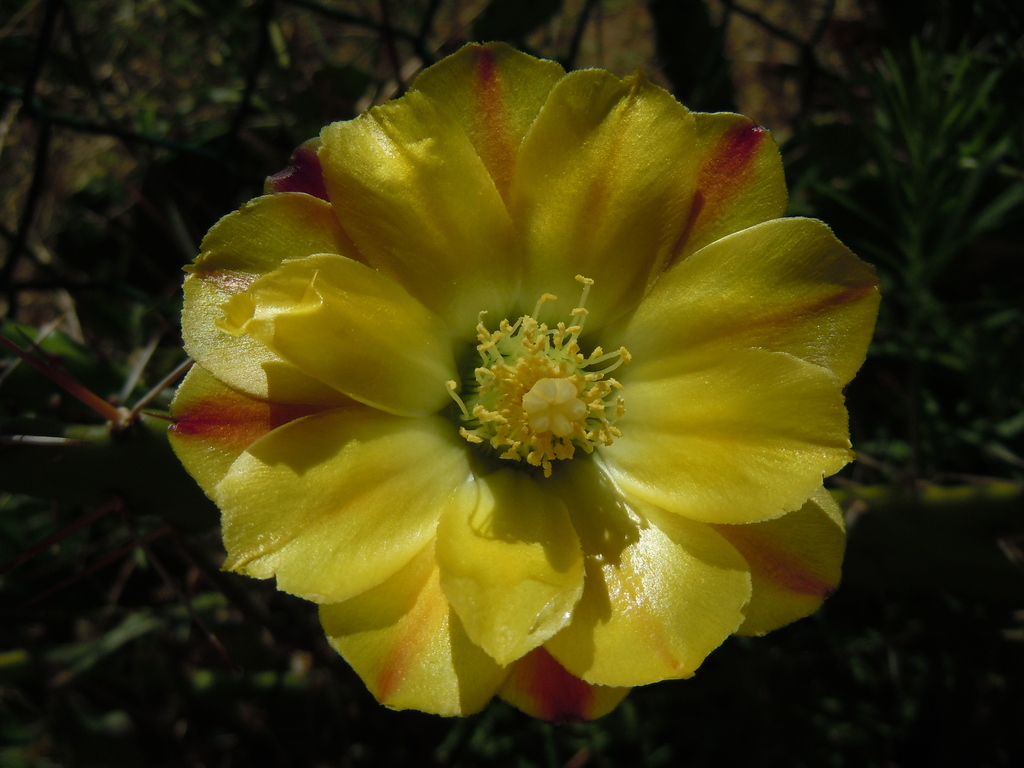
Drooping Prickly Pear
Opuntia monacantha
Opuntia monacantha, commonly known as drooping prickly pear, cochineal prickly pear, or Barbary fig, is a species of plant in the Cactaceae family. It is native to Argentina, Brazil, Paraguay, and Uruguay and is naturalised in Australia and South Africa. Its natural habitats are subtropical or tropical moist lowland forests and sandy shores.
From the article Opuntia monacantha on Wikipedia (CC BY-SA), quoted section by section
Description
Opuntia monacantha is a succulent, thorny shrub that grows almost tree-like with several branches and profusely expanded crown in branches that reaches a height of up to 5 meters. The oval to elongated shoots narrowed at the base are shiny green. They are quite thin and 4 to 10 inches long. The widely spaced areoles have brownish glochids. The straight spine (rarely 2 to 3 are present) is brown and between 3 and 4 centimeters long. The dark yellow flowers reach a diameter of up to 8 centimeters. The pear-shaped, red fruits are spineless and up to 7 centimeters long.
Range & habitat
It is native to Argentina, Brazil, Paraguay, and Uruguay and is naturalised in Australia and South Africa up to altitudes of 1000 meters. Its natural habitats are subtropical or tropical moist lowland forest and sandy shores.
Wikipedia: “Distribution”
Where it lives
Recorded sightings
—
geo-referenced records in GBIF, from museums, herbaria and field observers.
Drag the globe to turn it. Dots are where records exist, not a range map; darker means more records.
In the stacks
Searching the stacks…
Every page naming Opuntia monacantha in the Biodiversity Heritage Library →
This page is assembled live from iNaturalist, GBIF, Wikipedia, the Source Library and the Internet Archive. It is not yet part of the hand-edited codex. iNaturalist taxon 165894.