- Plants
- ›Vascular Plants
- ›flowering plants
- ›monocots
- ›grasses, sedges, cattails, and allies
- ›grasses
- ›Pooideae
- ›needlegrasses and allies
- ›Nassella
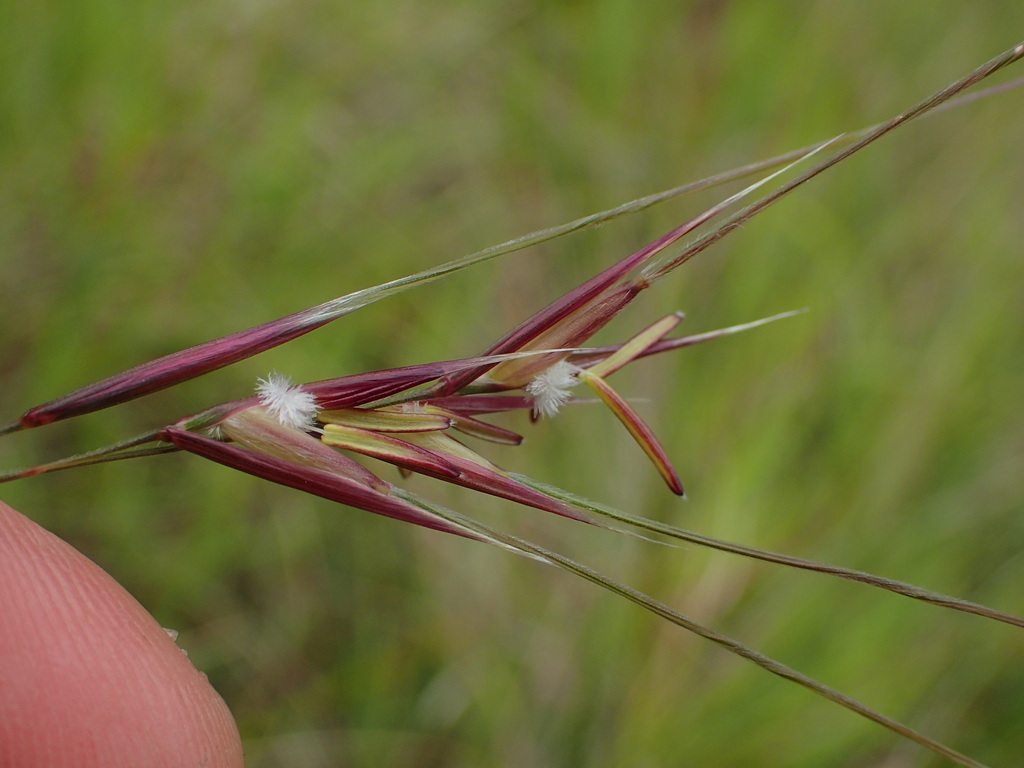
purple needlegrass
Nassella pulchra
Nassella pulchra, basionym Stipa pulchra, is a species of grass known by the common names purple needlegrass and purple tussockgrass. It is native to the U.S. state of California, where it occurs throughout the coastal hills, valleys, and mountain ranges, as well as the Sacramento Valley and parts of the Sierra Nevada foothills, and Baja California.
It grows in many types of local habitat, including grassland, chaparral, and oak woodland. It grows well on clay and serpentine soils.
From the article Nassella pulchra on Wikipedia (CC BY-SA), quoted section by section
Description
Nassella pulchra is a perennial bunch grass producing tufts of erect, unbranched stems up to 1 metre (3.3 ft) tall. The extensive root system can reach 20 feet (6.1 m) deep into the soil, making the grass more tolerant of drought. The open, nodding inflorescence is up to 60 centimeters long and has many branches bearing Spikelets. The plant produces copious seed, up to 227 pounds per acre in dense stands. The pointed fruit is purple-tinged when young and has an awn up to 10 centimeters long which is twisted and bent twice. The shape of the seed helps it self-bury.
What it does
In addition to supporting native oaks, it supports common branded skipper and Uncas skipper caterpillars.
Wikipedia: “Ecology”
At the table
This grass is the preferred material used by the California Indian basket weavers for teaching the art of basket weaving.
Wikipedia: “Uses”
Where it lives
Recorded sightings
—
geo-referenced records in GBIF, from museums, herbaria and field observers.
Drag the globe to turn it. Dots are where records exist, not a range map; darker means more records.
In the stacks
Searching the stacks…
Every page naming Nassella pulchra in the Biodiversity Heritage Library →
This page is assembled live from iNaturalist, GBIF, Wikipedia, the Source Library and the Internet Archive. It is not yet part of the hand-edited codex. iNaturalist taxon 165659.