- Plants
- ›Vascular Plants
- ›flowering plants
- ›Dicots
- ›borages
- ›borage family
- ›Cynoglossoideae
- ›Asperugeae
- ›Mertensia
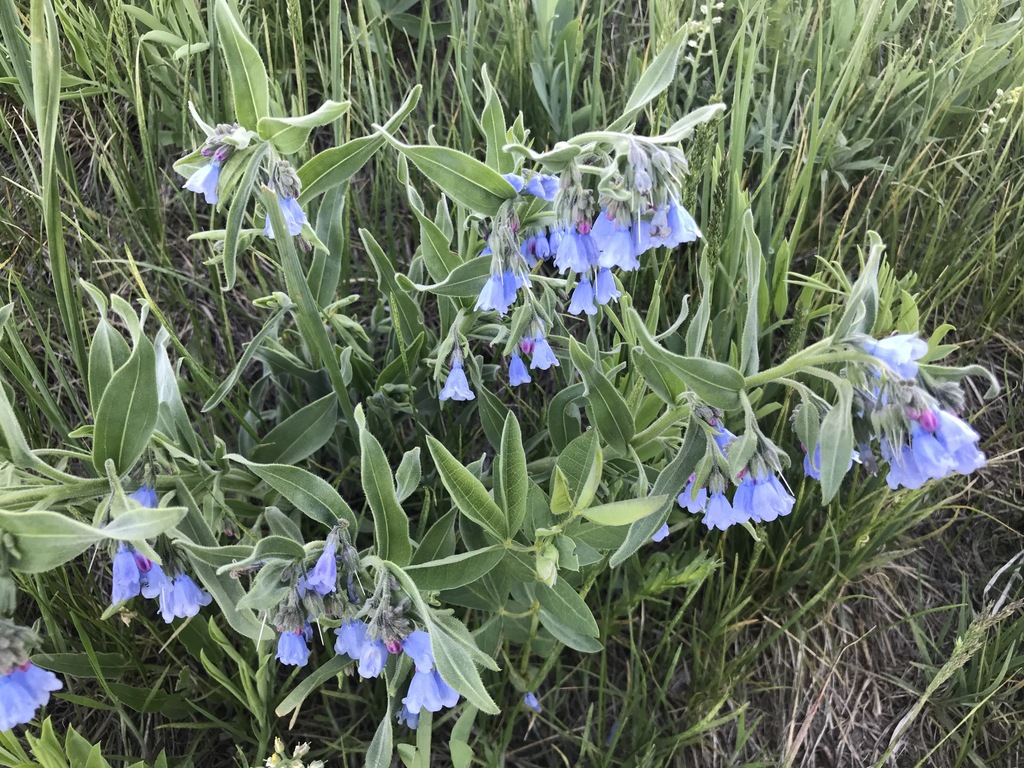
Prairie Bluebells
Mertensia lanceolata
Mertensia lanceolata, known as prairie bluebells, lance-leaved bluebells, lance-leaved lungwort, and narrow-leaved languid ladies is a species of flowering plant native to the Rocky Mountains and areas of the northern Great Plains in western North America. A herbaceous perennial it has blue-green leaves alternately arranged on its smooth flowering stalk. Its flower buds are pink-purple and become blue as they open.
From the article Mertensia lanceolata on Wikipedia (CC BY-SA), quoted section by section
Description
Mertensia lanceolata is a variable species with flowering individuals typically growing 10–45 cm in height. The species is found in Rocky Mountain habitats from the plains to alpine areas. The leaves are blue-green due to the waxy coating with a prominent center vein. Immature plants will have a few that spring directly from the ground (basal leaves) that are halfway between egg shaped and a lance head shaped (ovate-lanceolate). They may be on short stalks that are longer than the leaf or without any leaf stem (sessile). Older plants will have leaves that attach to the flower stalk alternately with a much narrower leaf, either lanceolate or somewhat more rectangular (oblong-lanceolate) and may or may not have basal leaves. The leaves or flower stalks arise from the large taproot. Flowering stalks lean outwards at an angle with multiple flowers hanging downwards from the top of the stalk. The flowers are five fused petals forming a short trumpet. The flower buds are pink in color, while the flowers are very often a pale sky-blue, but may also be nearly white or a deep blue color. The united tube of the flower is 3–7 millimeters in length. The inflorescence is dense with flowers, but is more widely spaced as it becomes older, paniculate in character. Flowering lasts for about a month, but may continue longer when conditions are favorable. …
Range & habitat
Mertensia lanceolata grows in the Rocky Mountains from northern New Mexico in the south to Alberta in Canada, including Colorado, Wyoming, Utah, and Montana. It also grows in some states and provinces to the east of the Rockies, Manitoba and Saskatchewan in Canada, and Nebraska, North Dakota, and South Dakota in the United States. They grow in a variety of habitats including in forests, the edges of woodlands, stream banks, prairies, rocky hillsides, and alpine tundra.
Conservation. NatureServe has evaluated the species as globally secure (G5), but its status has not been reviewed since 1988. At that time they found the species to be vulnerable (S3) in Saskatchewan and imperiled (S2) in Alberta, Manitoba, and Nebraska. They assessed it as apparently secure (S4) in Wyoming and did not evaluate it at the state level for the rest of its range.
Wikipedia: “Range and habitat”
What it does
In a study of the forest after the Hayman Fire in Colorado, similar numbers of Mertensia lanceolata plants were found before and after the fire. The species is associated with a history of low-intensity forest fires in ponderosa pine forests at sites along the Front Range in Colorado. Between 1981 and 1996 it expanded from being found in the lower mountain and upper montane forest life zones in Colorado, into the alpine tundra without colonizing the subalpine zone in between.
Wikipedia: “Ecology”
How it is grown
Narrow-leaved languid ladies are valued by wildflower gardeners for its dainty vibrant blue flower display and long season of blooming when moisture is good. They grow in either well draining or clay soils and is tolerant of limestone derived soils. Plants will live for many years when given space to grow its deep, branching taproot. It is also rated as with the lowest possible flammability for landscaping to create defensible space by Colorado State University Extension. A germination study of languid ladies found that the species exhibits very little need for cold stratification with 70% of seeds sprouting after four weeks at 21 °C (70 °F), though germination was accelerated by being held at 4.5 °C (40.1 °F) for three months before planting. After just two days the cold treated seeds had 30% germination rates. The species is winter hardy to USDA zone 4. Plants are rarely available from commercial growers and the seeds are somewhat rare even from wildflower seed exchanges.
== References ==
Wikipedia: “Cultivation”
Where it lives
Recorded sightings
—
geo-referenced records in GBIF, from museums, herbaria and field observers.
Drag the globe to turn it. Dots are where records exist, not a range map; darker means more records.
In the stacks
Searching the stacks…
Every page naming Mertensia lanceolata in the Biodiversity Heritage Library →
This page is assembled live from iNaturalist, GBIF, Wikipedia, the Source Library and the Internet Archive. It is not yet part of the hand-edited codex. iNaturalist taxon 165348.