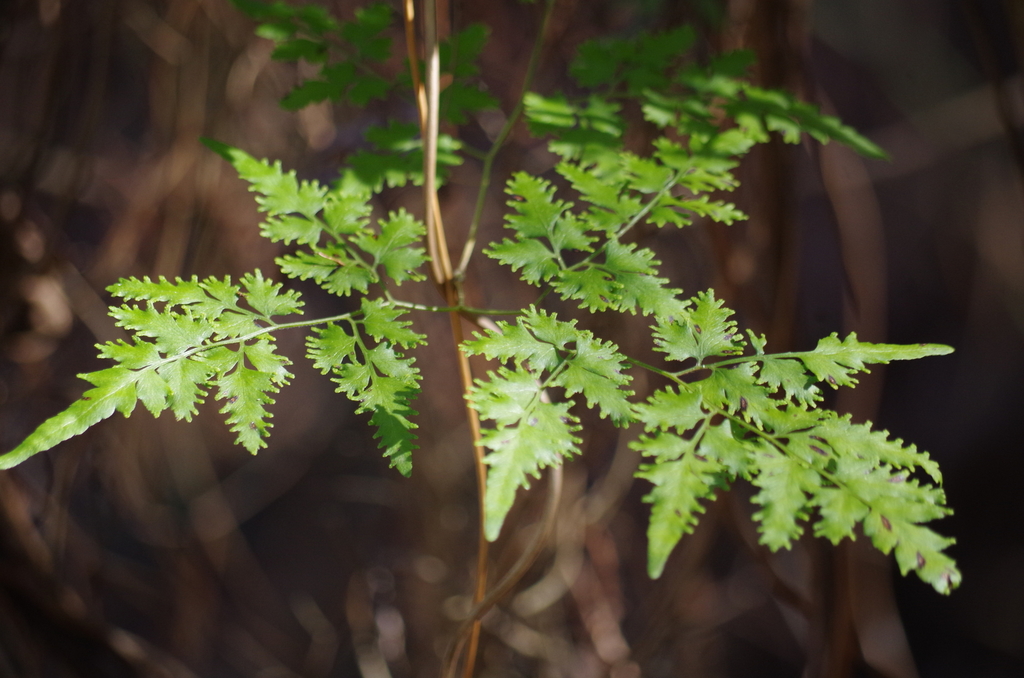
Japanese climbing fern
Lygodium japonicum
Lygodium japonicum is a species of fern that is known by the common names Japanese climbing fern and vine-like fern. It is native to eastern Asia, from Pakistan through India east to Taiwan, Japan, Korea, and south through southeastern Asia to New Guinea. The fern is present in the southeastern United States, Puerto Rico, South Africa, and Australia as an introduced species.
From the article Lygodium japonicum on Wikipedia (CC BY-SA), quoted section by section
Description
This fern produces a creeping stem from which grow very long leaves, the longest exceeding 30 metres (98 feet). The leaves have rachises, which are vine-like and may climb other vegetation. What appear to be individual leaves sprouting from the twining rachis are actually leaflets, which are smaller segments from the main leaf. There are two types of leaflets, sterile and fertile. The sterile frond has lance-shaped segments. The fertile frond has more intricately divided, fringed segments. It is lined with sporangia on the edges. The plant reproduces via spores and spreads vegetatively via underground rhizomes.
Where it lives
Recorded sightings
—
geo-referenced records in GBIF, from museums, herbaria and field observers.
Drag the globe to turn it. Dots are where records exist, not a range map; darker means more records.
In the old herbals & bestiaries


In the stacks
Searching the stacks…
Every page naming Lygodium japonicum in the Biodiversity Heritage Library →
This page is assembled live from iNaturalist, GBIF, Wikipedia, the Source Library and the Internet Archive. It is not yet part of the hand-edited codex. iNaturalist taxon 164985.