- Plants
- ›Vascular Plants
- ›flowering plants
- ›monocots
- ›grasses, sedges, cattails, and allies
- ›grasses
- ›Pooideae
- ›Poeae
- ›fescues and ryegrasses
- ›Lolium
- ›Schedonorus
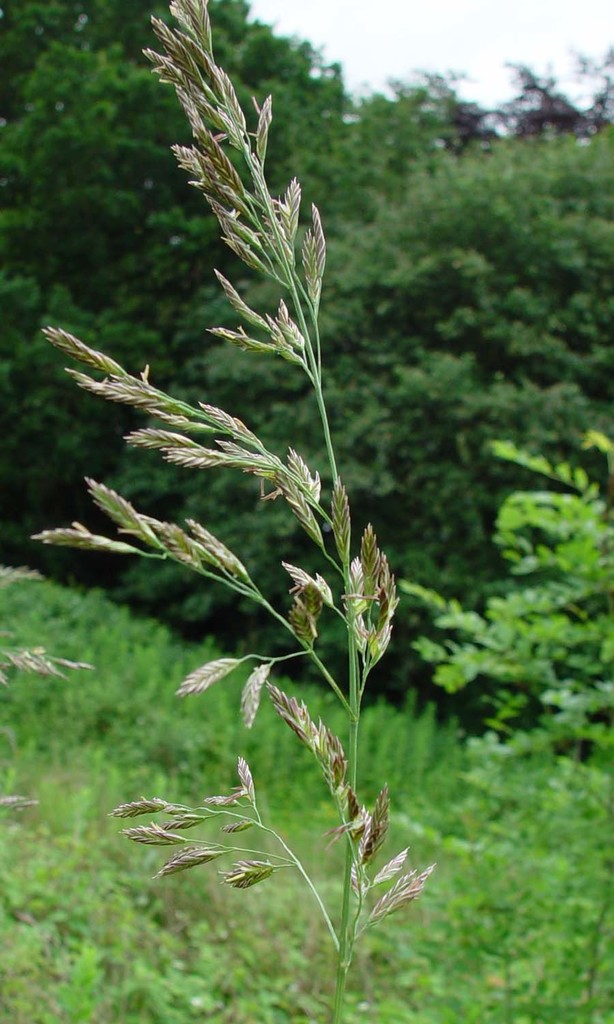
tall fescue
Lolium arundinaceum
Lolium arundinaceum, commonly known as tall fescue, is a cool-season, perennial C3 grass species native to Europe and introduced to North America and other parts of the world. It naturally occurs in grasslands and coastal marshes. Tall fescue is grown in a range of cultivars, widely used for livestock forage, in lawns and recreational areas as turf, and occasionally for managing soil erosion.
Most publications have used the names Festuca arundinacea or, more recently, Schedonorus arundinaceus for this species, but DNA studies appear to have settled a long debate that it should be included within the genus Lolium instead.
From the article Lolium arundinaceum on Wikipedia (CC BY-SA), quoted section by section
Description
Tall fescue is a long-lived tuft-forming perennial with erect to spreading hollow flowering stems up to about 165 cm (5 ft 5 in) tall (exceptionally up to 200 cm) which are hairless (glabrous), including the leaf sheaths, but with a short (1.5 mm) ligule and slightly hairy (ciliate) pointed auricles that can wrap slightly around the stem. The leaf blade is flat, up to about 10 mm wide, and also glabrous, but rough on both sides and the margins. The tillers (non-flowering stems) are typically shorter but otherwise similar to the culms. The leaves have prominent veins running parallel the entire length of the blade. Emerging leaves are rolled in the bud (convolute vernation). Note that most grasses are folded not rolled, which make this a key identification feature on tall fescue. Flowering typically occurs from early June until late August, with an erect to slightly nodding open panicle up to about 40 cm (1 ft 4 in) long. The branches are normally in pairs, each of which has 3-18 spikelets, which are 9–15 mm long and comprise 4-8 bisexual florets and two short, unequal glumes. The lower glume has only 1 nerve whereas the upper one has 3. The lemmas typically have a short (3 mm) awn arising just below the tip. Each floret has 3 stamens with anthers about 3–4 mm long. The fruit is a nut or caryopsis with the seed tightly enclosed by the hardened lemma and palea.
Range & habitat
Tall fescue is native to Europe, West Asia and North Africa. It was introduced to North and South America, Australia and Southeast Asia. It is widespread in the United States. Occurs in fields, meadows, waste areas and pastures. The cultivated species has become a common sight in California grasslands and habitats, such as the California coastal prairie plant community, since its introduction this species has been a topic of debate.
Wikipedia: “Distribution and status”
What it does
In its native European environment, tall fescue is found in damp grasslands, river banks, and coastal areas. The British National Vegetation Classification lists it as a minor component in a range of grassland types, but it is particularly characteristic of its own MG12 Festuca arundinacea community, which is a tussocky type of pasture that occurs in brackish grazing marshes around the south and west coasts. This vegetation type is also home to some uncommon plants such as parsley water-dropwort and slender spike-rush. Tall fescue is also found in a number of salt marsh and maritime cliff communities. In New Zealand, where it is introduced, the species is particularly prolific in salt marshes, where it is often dominant. Native to Europe, tall fescue has established itself in introduced regions like North America, where it thrives in habitats such as grasslands, wetlands, riparian corridors, and marshy landscapes. Its Ellenberg values in Britain are L = 8, F = 6, R = 7, N = 6, and S = 1, which show that it favours damp, brightly sunny places with neutral soils and moderate fertility, and that it can occur in slightly brackish situations.
Endophyte association. Tall fescue can be found growing in most soils of the southeast including marginal, acidic, and poorly drained soils and in areas of low fertility, and where stresses occur due to drought and overgrazing. …
Wikipedia: “Habitat and ecology”
At the table
Tall fescue was introduced into the United States in the late 19th century, but it did not establish itself as a widely used perennial forage until the 1940s. As in Europe, tall fescue has become an important, well-adapted cool season forage grass for agriculture in the US with many cultivars. In addition to forage, it has become an important grass for turf and soil conservation. Tall fescue is the most heat tolerant of the major cool season grasses. Tall fescue has a deep root system compared to other cool season grasses. This non-native grass is well adapted to the "transition zone" Mid-Atlantic and Southeastern United States and now occupies over 35,000,000 acres (140,000 km2). In addition to serving as forage and turf grass, tall fescue is sometimes planted to stabilize soil, benefiting from its robust root network and adaptability to different environments. The dominant cultivar grown in the United States is Kentucky 31. In 1931 E. N. Fergus, a professor of agronomy at the University of Kentucky, collected seed from a population on a hillside in Menifee County, Kentucky although formal cultivar release did not happen until 1943. Fergus heard about this "wonder grass" while judging a sorghum syrup competition in a nearby town. He wanted to see this grass because it was green, lush, and growing well on a sloped hillside during a drought. …
Wikipedia: “Uses”
Where it lives
Recorded sightings
—
geo-referenced records in GBIF, from museums, herbaria and field observers.
Drag the globe to turn it. Dots are where records exist, not a range map; darker means more records.
In the stacks
Searching the stacks…
Every page naming Lolium arundinaceum in the Biodiversity Heritage Library →
This page is assembled live from iNaturalist, GBIF, Wikipedia, the Source Library and the Internet Archive. It is not yet part of the hand-edited codex. iNaturalist taxon 164708.