- Plants
- ›Vascular Plants
- ›flowering plants
- ›Dicots
- ›nightshades, bindweeds, gooseweeds, and allies
- ›bindweed family
- ›Bindweeds, Morning-glories and Allies
- ›Ipomoeeae
- ›Ipomoea
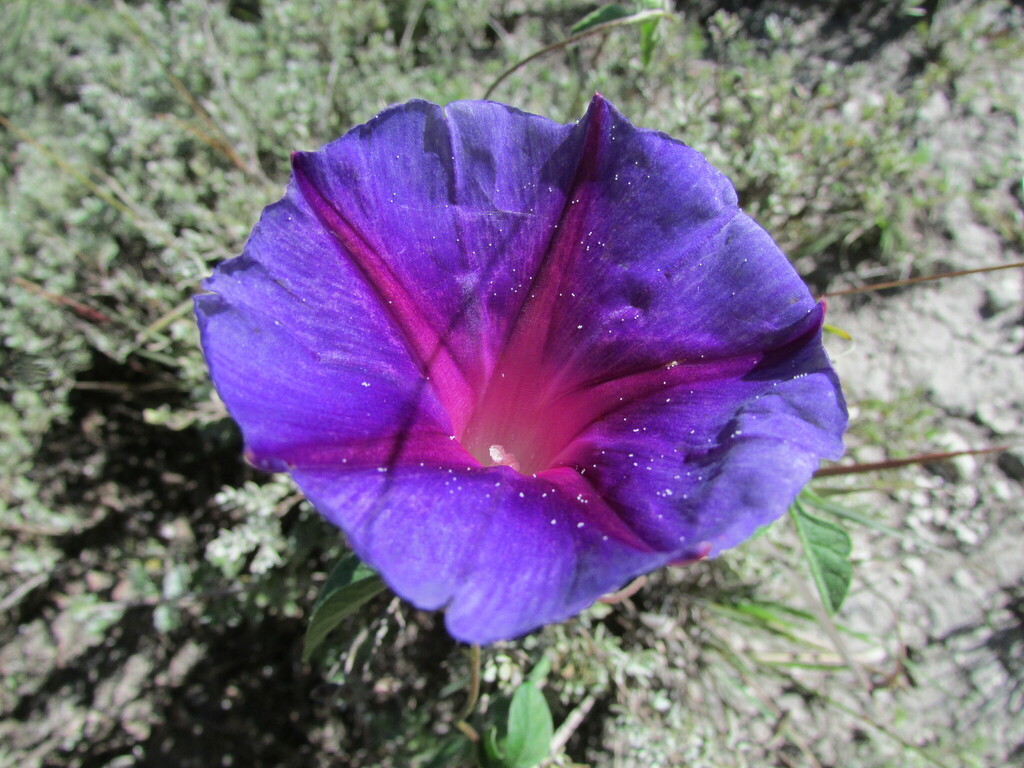
Silky Morning Glory
Ipomoea pubescens
Ipomoea pubescens, the silky morning glory, is a species of flowering plant belonging to the family Convolvulaceae.
From the article Ipomoea pubescens on Wikipedia (CC BY-SA), quoted section by section
Description
Ipomoea pubescens is a herbaceous, perennial, twining vine with a relatively large root. The egg-shaped leaves are 3-5-lobed, with cordate bases, and up to 8 cm long (~3 inches) and 9 cm wide (3½ inches). Leaves are covered with relatively long hairs, which sometimes have a silky feeling. Flowers have blue to violet, funnel-shaped corollas up to 8 cm long (~3 inches) and 7 cm wide (2¾ inches)
Range & habitat
The map on the iNaturalist information page for Ipomoea pubescens shows the locations of research-grade observations of the species in two disjunct regions. In the north it occurs from mountainous southwestern USA (Arizona, New Mexico & Texas) south through the Mexican higlands into Oaxaca state. Apparently the species is absent from Central America, but reappears in mountainous western South America from Colombia south to northern Argentina.
Wikipedia: “Distribution”
In medicine
In Mexico, in the historical classic Historia de las Plantas de la Nueva España, written by Francisco Hernández de Toledo after his first exploration of Mexico from 1571 to 1576, it's written that the root, which has warm properties and a pleasant taste, when crushed and taken in doses of one ounce with water, purges all humors through the lower duct, without harm or discomfort.
Wikipedia: “As medicine”
In human culture
The genus name Ipomoea is derived from the Greek ips meaning "worm," and homoios for "resembling" -- "resembling a worm." Probably this refers to the sprawling underground roots often produced by species of this genus, though it could be describing the viney species' worm-like twining habit. The species name pubescens comes from the Latin word pubens meaning "with downy hair."
Wikipedia: “Etymology”
Where it lives
Recorded sightings
—
geo-referenced records in GBIF, from museums, herbaria and field observers.
Drag the globe to turn it. Dots are where records exist, not a range map; darker means more records.
In the stacks
Searching the stacks…
Every page naming Ipomoea pubescens in the Biodiversity Heritage Library →
This page is assembled live from iNaturalist, GBIF, Wikipedia, the Source Library and the Internet Archive. It is not yet part of the hand-edited codex. iNaturalist taxon 164095.