- Plants
- ›Vascular Plants
- ›flowering plants
- ›Dicots
- ›begonias, gourds, and allies
- ›gourd family
- ›Coniandreae
- ›Ibervillea
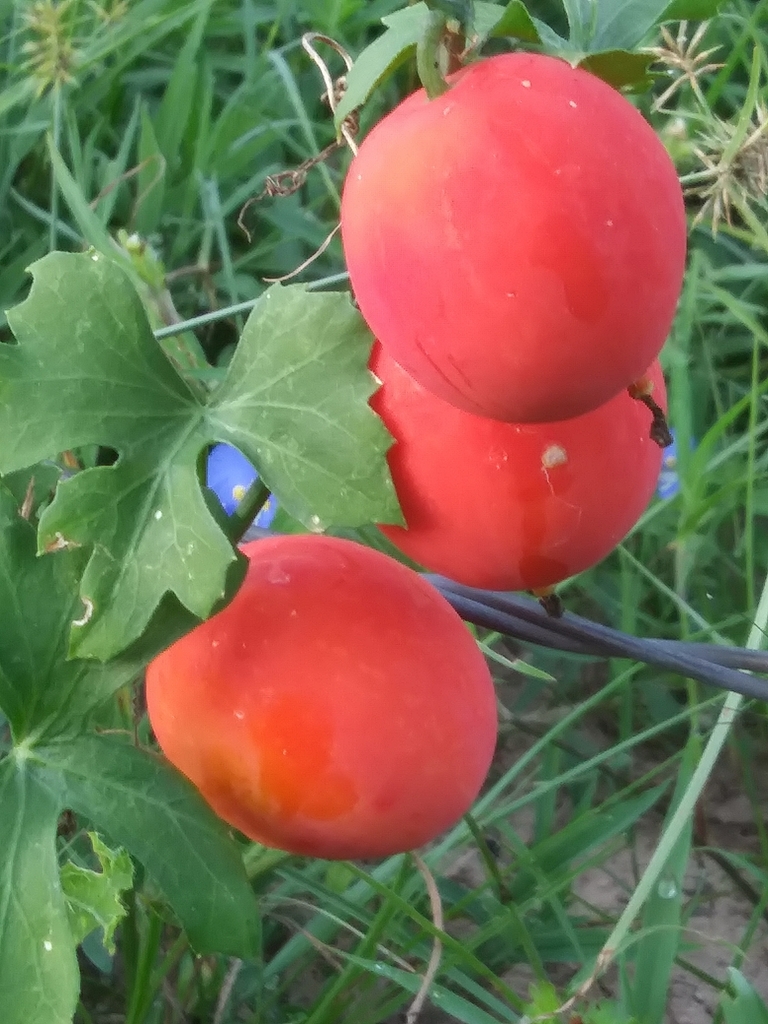
snake apple
Ibervillea lindheimeri
Ibervillea lindheimeri, commonly called snake apple, balsam gourd, Rio Grande globeberry, or Lindheimer's globeberry is a species of flowering plant in the gourd family Cucurbitaceae.
From the article Ibervillea lindheimeri on Wikipedia (CC BY-SA), quoted section by section
Description
Ibervillea lindheimeri is a perennial, deciduous vining plant with alternate leaves that grows up to 10 feet. The leaves have 3 to 5 lobes which are deeply cut and finely toothed and are 1.5 to 3.5 inches in diameter. The yellow flowers typically bloom between April-September and have 5 deeply-cut and fine-toothed lobes. Flowers are about 0.5in across. It produces 20-30mm berry-like, orange-red fruits which contain densely hairy seeds
Range & habitat
Ibervillea lindheimeri is native to Texas, Oklahoma and New Mexico in the United States as well as Northern Mexico. It grows best in sunnier environments and will produce greater quantity of fruits, but is able to grow well in partial shade. It is a climbing plant typically requiring something to climb with tendrils.
Wikipedia: “Distribution and habitat”
At the table
Ibervillea lindheimeri has been cultivated for its attractive leaves and red fruits as both an indoor plant and for gardens. The flowers attract a variety of pollinating insects and birds feed on the fruits. The fruits are not known to be poisonous, and as such are not referenced in any toxic plant databases however, they are also not edible by humans and likewise not listed in any edible plant databases.
== References ==
Wikipedia: “Uses”
Where it lives
Recorded sightings
—
geo-referenced records in GBIF, from museums, herbaria and field observers.
Drag the globe to turn it. Dots are where records exist, not a range map; darker means more records.
In the stacks
Searching the stacks…
Every page naming Ibervillea lindheimeri in the Biodiversity Heritage Library →
This page is assembled live from iNaturalist, GBIF, Wikipedia, the Source Library and the Internet Archive. It is not yet part of the hand-edited codex. iNaturalist taxon 164029.