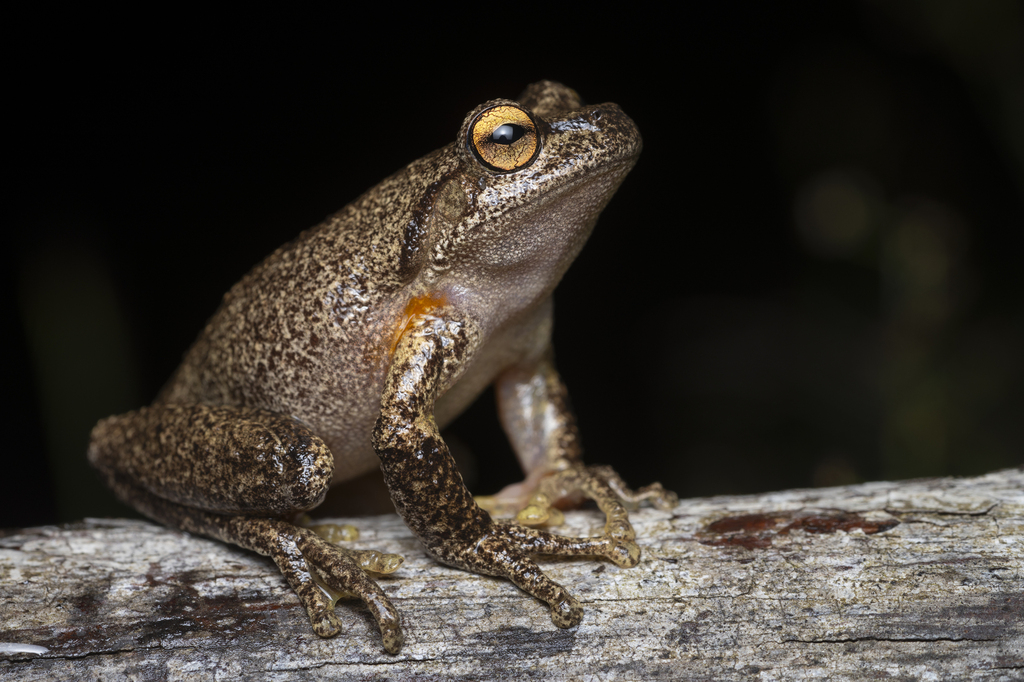
Southern Heath Frog
Rawlinsonia watsoni
Watson's tree frog (Rawlinsonia watsoni), also known as the large brown tree frog or southern heath frog, is a species of tree frog endemic to south-eastern Australia.
From the article Watson's tree frog on Wikipedia (CC BY-SA), quoted section by section
Description
The species is a medium-sized frog. With a snout-vent length (SVL) of up to 64 mm, the females are larger than the males (SVL = 59 mm). The back and outer surfaces of the limbs are light brown, flecked and mottled with darker brown and yellow. The underparts are white. There are distinctive red-orange makings on the backs of the legs, the feet, sides and groin. The head has a rounded snout with yellow eyes, distinct circular tympanums and black stripes extending from the snout through the eyes to the sides of the body. The legs are long and the feet largely unwebbed, with terminal discs on the fingers and toes. The species is very similar to Littlejohn's tree frog; the main distinguishing characteristic is the breeding call of the males, with Watson's tree frog uttering fewer pulses in each note (with a mean of 22.8 per second as compared to 27.8) for a call length of 3–12 seconds. The call has been described as "wriiik wriiik wriik wriik".
Range & habitat
The ranges of the two split species appear to be separated at the southern border of the Sydney Basin bioregion. The known range of L. watsoni extends from the Budderoo National Park and Barren Grounds Nature Reserve in the Shoalhaven River catchment of south-eastern New South Wales southwards to the eastern side of the Snowy River National Park in East Gippsland, Victoria, with an altitudinal range from near sea-level to 1,100 m. Distribution is very patchy, with few records from the southern part of the range. The topography of the northern end of the distribution range is characterised by steep cliffs and valleys, forming a biogeographic barrier which marks the geographic separation between Littlejohn's and Watson's tree frogs. The species occurs in a variety of forest types, as well as woodland, bushland and heathland. It prefers moister sites, especially in or near tall moist forest. The most important habitat factor is the presence of pools that contain water long enough for tadpoles to complete metamorphosis. It has not been recorded from previously wooded land cleared for farming or plantation forestry.
Wikipedia: “Distribution and habitat”
Listen
Looking for field recordings…
Where it lives
Recorded sightings
—
geo-referenced records in GBIF, from museums, herbaria and field observers.
Drag the globe to turn it. Dots are where records exist, not a range map; darker means more records.
In the stacks
Searching the stacks…
Every page naming Rawlinsonia watsoni in the Biodiversity Heritage Library →
This page is assembled live from iNaturalist, GBIF, Wikipedia, the Source Library and the Internet Archive. It is not yet part of the hand-edited codex. iNaturalist taxon 1633170.