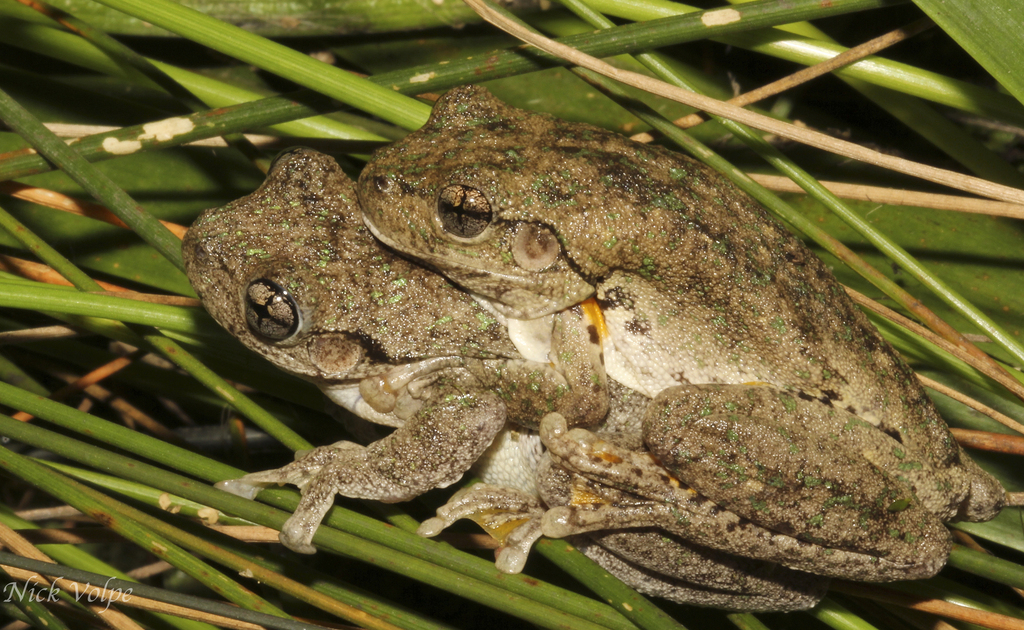
Peron's Tree Frog
Pengilleyia peronii
Peron's tree frog (Pengilleyia peronii), also known as the emerald-spotted tree frog, emerald-speckled tree frog, laughing tree frog, and maniacal cackle frog, is a species of tree frog in the family Pelodryadidae. The species is endemic to Australia, where it is common.
From the article Peron's tree frog on Wikipedia (CC BY-SA), quoted section by section
Description
Peron's tree frog is one of the most variably coloured frogs in Australia, with the ability to change colour in less than one hour. Itvaries in shades of grey and brown, with the lightest being almost white. It has mottled yellow and black thighs, armpits, and groin. Occasionally, emerald spots are found on the back, which increase in number with age. A characteristic uncommon in the family Pelodryadidae is pupils which appear cross-shaped. Within the genus Pengilleyia, this characteristic is only shared with Tyler's tree frog (Pengilleyia tyleri). The male Peron's tree frog has a head + body length of about 44–53 mm (1.7–2.1 in), while females are 46–65 mm (1.8–2.6 in).
What it does
The call of Peron's tree frog is a high-pitched cackle, giving it the common names: the "laughing tree frog" and the "maniacal cackle frog". It is found in forests, woodlands, shrublands, and open areas, often far from a water source. It inhabits a variety of niches, predominantly arboreal, such as tree hollows, cracks, and beneath flaking bark. It is commonly found near civilisation (such as suburban Sydney), using ponds as its breeding-water source. It can often be seen on windows or near lights at night, hunting the insects attracted to these light sources. I can often be found at dusk on houseboat windows and beneath street lamps along the Murray River in South Australia.
Wikipedia: “Ecology and behaviour”
In human culture
The specific name, peronii, is in honour of François Péron, a French naturalist and explorer.
Wikipedia: “Etymology”
Listen
Looking for field recordings…
Where it lives
Recorded sightings
—
geo-referenced records in GBIF, from museums, herbaria and field observers.
Drag the globe to turn it. Dots are where records exist, not a range map; darker means more records.
In the stacks
Searching the stacks…
Every page naming Pengilleyia peronii in the Biodiversity Heritage Library →
This page is assembled live from iNaturalist, GBIF, Wikipedia, the Source Library and the Internet Archive. It is not yet part of the hand-edited codex. iNaturalist taxon 1633155.