- Plants
- ›Vascular Plants
- ›flowering plants
- ›Dicots
- ›pinks, cactuses, and allies
- ›cacti
- ›globular cacti, moonlight cacti, torch cacti, and allies
- ›Globular Cactuses
- ›Escobaria
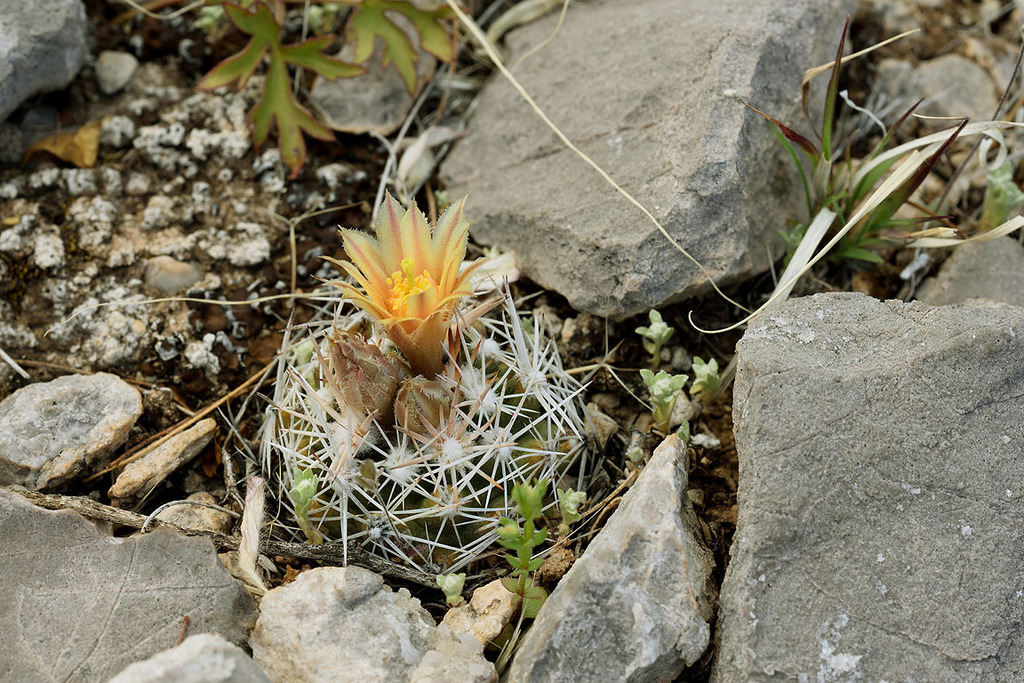
Cochise Foxtail Cactus
Escobaria robbinsiorum
Escobaria robbinsorum (syn. Coryphantha robbinsorum) is a rare species of cactus known by the common names Cochise pincushion cactus and Cochise foxtail cactus. It is native to southern Arizona in the United States, where it is known only from Cochise County, and northern Sonora in Mexico. There are scattered small occurrences on the north side of the border, and one known population to the south. Because of its rarity and a number of threats to remaining...
From the article Pelecyphora robbinsiorum on Wikipedia (CC BY-SA), quoted section by section
Description
This cactus lives mostly buried in the ground with only its top few centimeters exposed, reach heights of 2–6 centimeters and the same diameter. . There is a cluster of spines on each areole, surrounded by a tuft of white woolly hairs and tightly packed warts are 5–8 millimeters long. The spines are straight and white, often with dark tips, and measure 1–2 centimeters long. Central spines are usually not present. The 11–17 white marginal spines have a darker tip and are occasionally twisted, 0.3–1.8 centimeters long. The flower is 1–3 centimeters long and has greenish yellow tepals. The flowers are 1.8–2.0 centimeters long and reach a diameter of 1.2–1.5 centimeters. The orange-red, short cylindrical fruits are 6–8.5 millimeters long. The fruit is bright red to orange, succulent, and under a centimeter in length. The plant grows in nearly solid bedrock with little soil or sand, in full sunlight. It can be found in dense colonies of up to 1000 individuals.
Range & habitat
It is native to southern Arizona in the United States, where it is known only from Cochise County, and northern Sonora in Mexico. There are scattered small occurrences on the north side of the border, and one known population to the south. Because of its rarity and a number of threats to remaining plants, the species was federally listed with a threatened status in 1986. Threats to this plant include a prolonged drought in the region which is thought to have caused mortality. Drought conditions can also make the living cacti harder to find because they shrink and retract into the ground. Illegal activity at the Mexico – United States border is thought to impact the plant. Drug smuggling and illegal immigration activity damage the habitat in the area by increasing trampling, vehicle damage, and possibly incidence of fire. Trampling may also occur when well-meaning volunteers and researchers comb the area for specimens. The plant is probably a target for harvesting by cactus enthusiasts and dealers, but the populations in Arizona are relatively well-protected from this activity. Oil exploration and grazing affect the area. Invasive plant species, especially buffelgrass (Pennisetum ciliare), are becoming more abundant in this desert region and compete with native flora. Insects apparently damage the cacti, but to what extent is not known. …
Wikipedia: “Distribution”
Where it lives
Recorded sightings
—
geo-referenced records in GBIF, from museums, herbaria and field observers.
Drag the globe to turn it. Dots are where records exist, not a range map; darker means more records.
In the stacks
Searching the stacks…
Every page naming Escobaria robbinsiorum in the Biodiversity Heritage Library →
This page is assembled live from iNaturalist, GBIF, Wikipedia, the Source Library and the Internet Archive. It is not yet part of the hand-edited codex. iNaturalist taxon 162736.