- Plants
- ›Vascular Plants
- ›flowering plants
- ›Dicots
- ›pinks, cactuses, and allies
- ›cacti
- ›globular cacti, moonlight cacti, torch cacti, and allies
- ›Pachycereae
- ›Echinocereus
- ›Triglochidiatus
- ›Triglochidiati
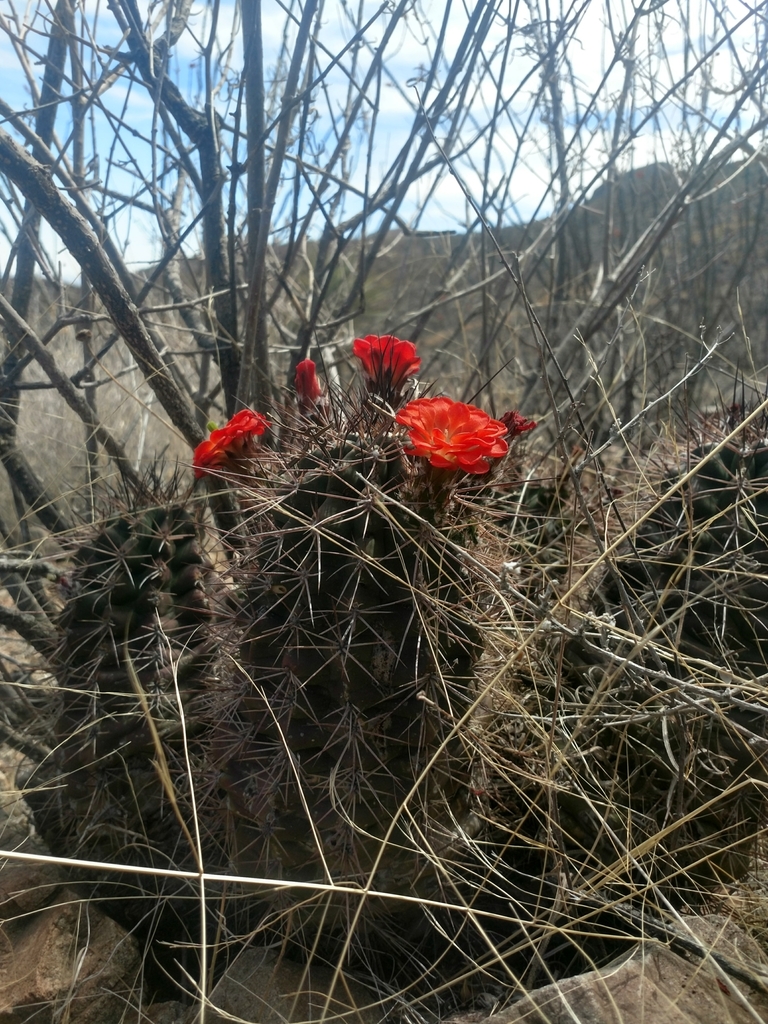
Echinocereus polyacanthus
Echinocereus polyacanthus is a species of cactus native to Mexico.
From the article Echinocereus polyacanthus on Wikipedia (CC BY-SA), quoted section by section
Description
Echinocereus polyacanthus grows solitary or in clusters, often forming groups or cushions with up to 400 shoots. The bright to dark green cylindrical shoots taper at both the base and tip, measuring 10 to 30 centimeters in length and 2 to 7.5 cm (0.79 to 2.95 in) in diameter. They feature nine to 13 smooth or tuberous ribs. Each plant has one to seven brown or yellow-brown central spines, thickened at the base, and up to 5 cm (2.0 in) long, though their length varies. Additionally, there are six to 14 overlapping, dirty white radial spines, each up to 2 cm (0.79 in) long. The flowers are tubular to funnel-shaped, ranging from bright pinkish-orange to deep red, with a yellowish or whitish throat. They appear near the shoot tips, measuring 3 to 14 cm (1.2 to 5.5 in) in length and 2 to 8 cm (0.79 to 3.15 in) in diameter. The green, egg-shaped fruits contain white flesh and do not tear.
Range & habitat
Echinocereus polyacanthus is found in Arizona and New Mexico in the United States, extending Chihuaua, Durango, Cosihuiriachi, Sierra Madre Occidental in eastern Sonora Mexico, and Baja California peninsula in Mexico growing on rocky outcrops between 1,300 and 2,000 m (4,300 and 6,600 ft).
Wikipedia: “Distribution”
Where it lives
Recorded sightings
—
geo-referenced records in GBIF, from museums, herbaria and field observers.
Drag the globe to turn it. Dots are where records exist, not a range map; darker means more records.
In the stacks
Searching the stacks…
Every page naming Echinocereus polyacanthus in the Biodiversity Heritage Library →
This page is assembled live from iNaturalist, GBIF, Wikipedia, the Source Library and the Internet Archive. It is not yet part of the hand-edited codex. iNaturalist taxon 162184.