- Plants
- ›Vascular Plants
- ›flowering plants
- ›Dicots
- ›nightshades, bindweeds, gooseweeds, and allies
- ›nightshade family
- ›nightshades and allies
- ›devil's and angel's trumpets
- ›Datura
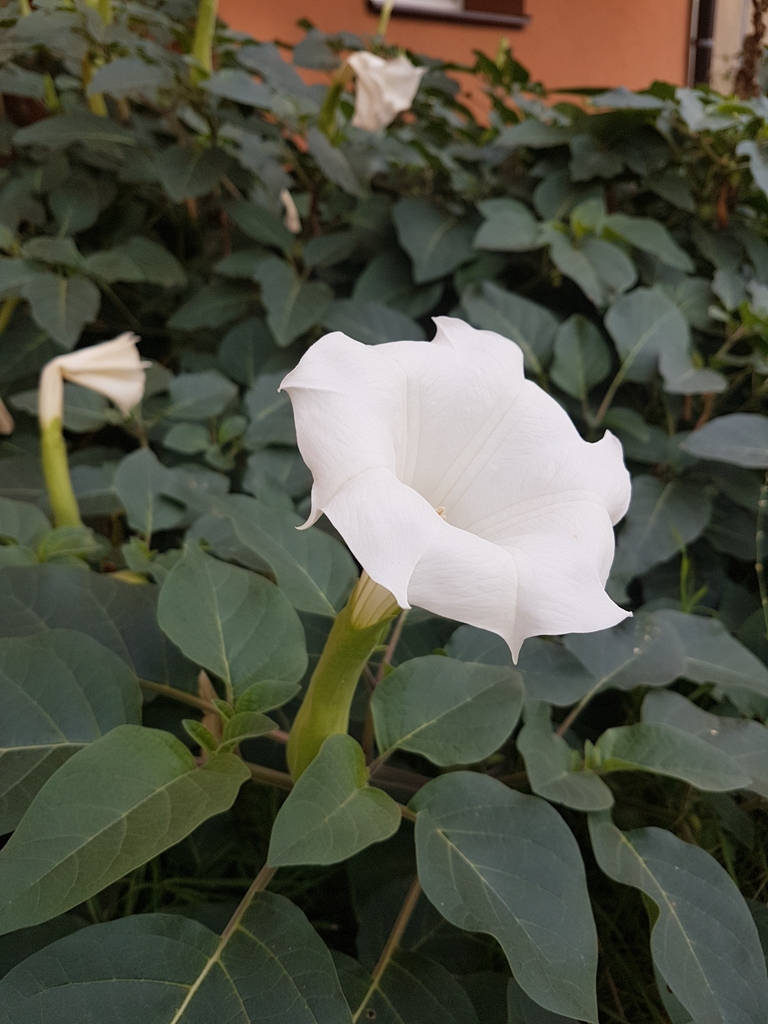
downy thorn-apple
Datura innoxia
Datura innoxia (often spelled inoxia), known as pricklyburr, recurved thorn-apple, downy thorn-apple, Indian-apple, lovache, moonflower, nacazcul, toloatzin, toloaxihuitl, tolguache or toloache, is a species of flowering plant in the family Solanaceae. It is more rarely called sacred datura, a common name which is applied more often to the closely related Datura wrightii. It is native to the Southwestern United States, Central and South America, and introduced in Africa, Asia, Australia and Europe. The scientific name is often cited as D. innoxia. When English botanist Philip Miller first described the species in 1768, he misspelled the Latin word innoxia (inoffensive) when naming it D. inoxia. The name Datura meteloides was for some time erroneously applied to some members of the species, but that name has now been abandoned.
From the article Datura innoxia on Wikipedia (CC BY-SA), quoted section by section
Description
Datura innoxia is a tuberous-rooted subshrub that typically reaches a height of 0.6 to 1.5 metres. Its stems and leaves are covered with short and soft grayish hairs, giving the whole plant a grayish appearance. It has elliptic smooth-edged leaves with pinnate venation. All parts of the plant emit a foul odor similar to rancid peanut butter when crushed or bruised, although most people find the fragrance of the flowers to be quite pleasant when they bloom at night. The flowers are white, trumpet-shaped, 12–19 cm (4.5–7.5 in) long. They first grow upright, and later incline downward. It flowers from early summer until late fall. The fruit is an egg-shaped spiny capsule, about 5 cm in diameter. Like those of other species belonging to section Dutra of the genus Datura, it splits open irregularly when ripe to disperse its seeds. Another means of dispersal may also occur, in which the spiny fruit becomes entangled in the fur of animals, who then carry the fruit far from the mother plant. The seeds are long-lived, having the ability to lie dormant in the soil for many years. …
At the table
When cultivated, the plant is usually treated as an annual to be grown from seed, but its tuberous roots (somewhat reminiscent of those of the cultivated Dahlia) can be kept from freezing and planted in the spring of the following year. Datura innoxia, like other Datura species, contains the highly toxic alkaloids atropine, hyoscine (scopolamine), and hyoscyamine. The Aztecs called the plant by the Nahuatl names toloatzin and toloaxihuitl (trans. "the plant with the nodding head", in reference to the nodding seed capsules) and used it long before the Spanish conquest of Mexico for many therapeutic purposes, such as poultices for wounds where it acts as an anodyne. Although the Aztecs warned against madness and "various and vain imaginings", many Native Americans have used the plant as an entheogen for hallucinations and rites of passage. The alkaloids of these plants are very similar to those of mandrake, deadly nightshade, and henbane, which are also highly poisonous plants used cautiously for effective pain relief in antiquity. Datura intoxication typically produces a complete inability to differentiate reality from fantasy (delirium, as contrasted to hallucination); hyperthermia; tachycardia; bizarre, and possibly violent behavior; and severe mydriasis with resultant painful photophobia that can last several days. Pronounced amnesia is another commonly reported effect. …
Wikipedia: “Uses”
Toxicity
All parts of Datura plants are toxic, containing dangerous levels of tropane alkaloids (hyoscyamine, hyoscine) and may be fatal if ingested by humans and other animals, including livestock and pets. The main observed effects of ingestion are enlarged pupils, dry mouth, trouble breathing, blurred vision, hallucinations, panic, death. In some places, it is prohibited to buy, sell or cultivate Datura plants.
Where it lives
Recorded sightings
—
geo-referenced records in GBIF, from museums, herbaria and field observers.
Drag the globe to turn it. Dots are where records exist, not a range map; darker means more records.
In the stacks
Searching the stacks…
Every page naming Datura innoxia in the Biodiversity Heritage Library →
This page is assembled live from iNaturalist, GBIF, Wikipedia, the Source Library and the Internet Archive. It is not yet part of the hand-edited codex. iNaturalist taxon 161639.