- Plants
- ›Vascular Plants
- ›flowering plants
- ›Dicots
- ›Mustards, Capers, and Allies
- ›Spider Flower Family
- ›Cleome
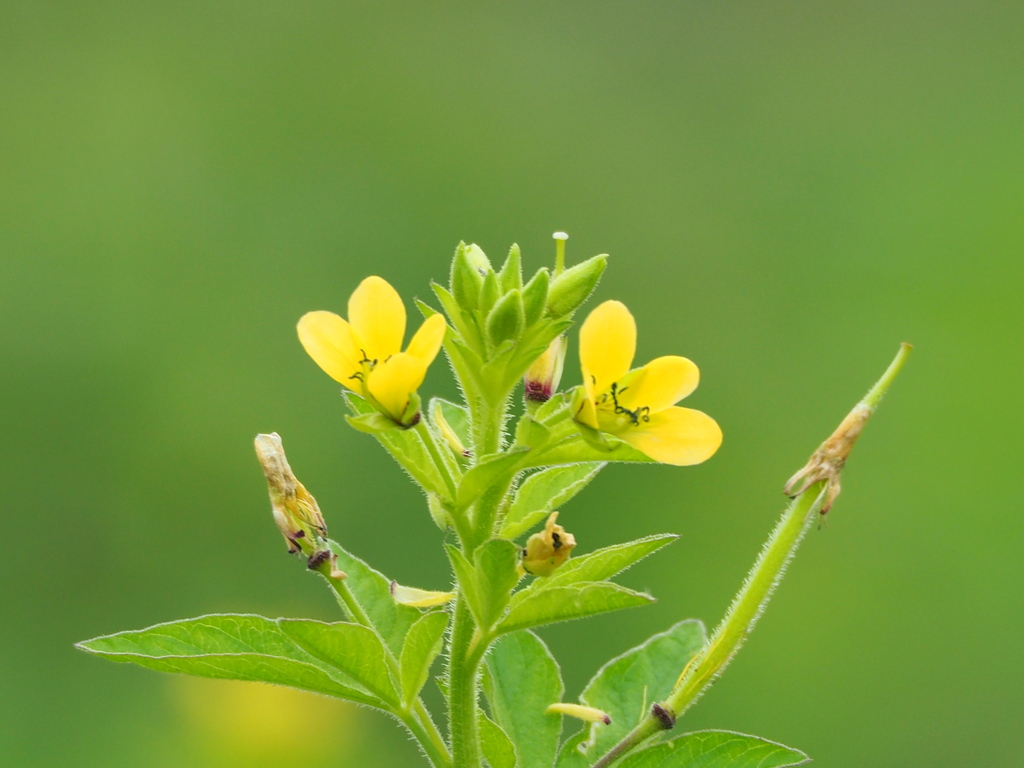
Asian Spiderflower
Cleome viscosa
Cleome viscosa, the Asian spiderflower or tick weed is an annual herb that grows up to a meter high. It belongs to the family Cleomaceae. It is considered an invasive species and is widely distributed in warm and humid habitats across the Americas, Africa and Asia, and in Australia (where it is considered a native). It is commonly found during the rainy season.
The crushed leaves have been investigated as a treatment for stored seeds of cowpea, to prevent weevil infestation.
From the article Cleome viscosa on Wikipedia (CC BY-SA), quoted section by section
Description
Plants (10–)30–100(–160) cm. Stems viscid. Leaves: petiole 1.5–4.5(–8) cm, glandular-hirsute; leaflet blade ovate to oblanceolate-elliptic, (0.6–)2–6 × 0.5–3.5 cm, margins entire and glandular-ciliate, apex acute to obtuse, surfaces glandular-hirsute. Racemes 5–10 cm (10–15 cm in fruit); bracts (often deciduous), trifoliate, 10–25 mm, glandular-hirsute. Pedicels 6–30 mm, glandular-hirsute. Flowers: sepals green, lanceolate, 5–10 × 0.8–1.2 mm, glandular-hirsute; petals arranged in adaxial semicircle before anthesis, radially arranged at anthesis, bright yellow, sometimes purple basally, oblong to ovate, 7–14 × 3–4 mm; stamens dimorphic, 4–10 adaxial ones much shorter with swelling proximal to anthers, green, 5–9 mm; anthers 1.4–3 mm; ovary 6–10 mm, densely glandular; style 1–1.2 mm. Capsules dehiscing only partway from apex to base, 30–100 × 2–4 mm, glandular-hirsute. Seeds light brown, 1.2–1.8 × 1–1.2 mm, finely ridged transversely. 2n = 20.
Where it lives
Recorded sightings
—
geo-referenced records in GBIF, from museums, herbaria and field observers.
Drag the globe to turn it. Dots are where records exist, not a range map; darker means more records.
In the stacks
Searching the stacks…
Every page naming Cleome viscosa in the Biodiversity Heritage Library →
This page is assembled live from iNaturalist, GBIF, Wikipedia, the Source Library and the Internet Archive. It is not yet part of the hand-edited codex. iNaturalist taxon 160710.