- Plants
- ›Vascular Plants
- ›flowering plants
- ›Dicots
- ›Nances, Willows, and Allies
- ›Coco Plum Family
- ›Chrysobalanus
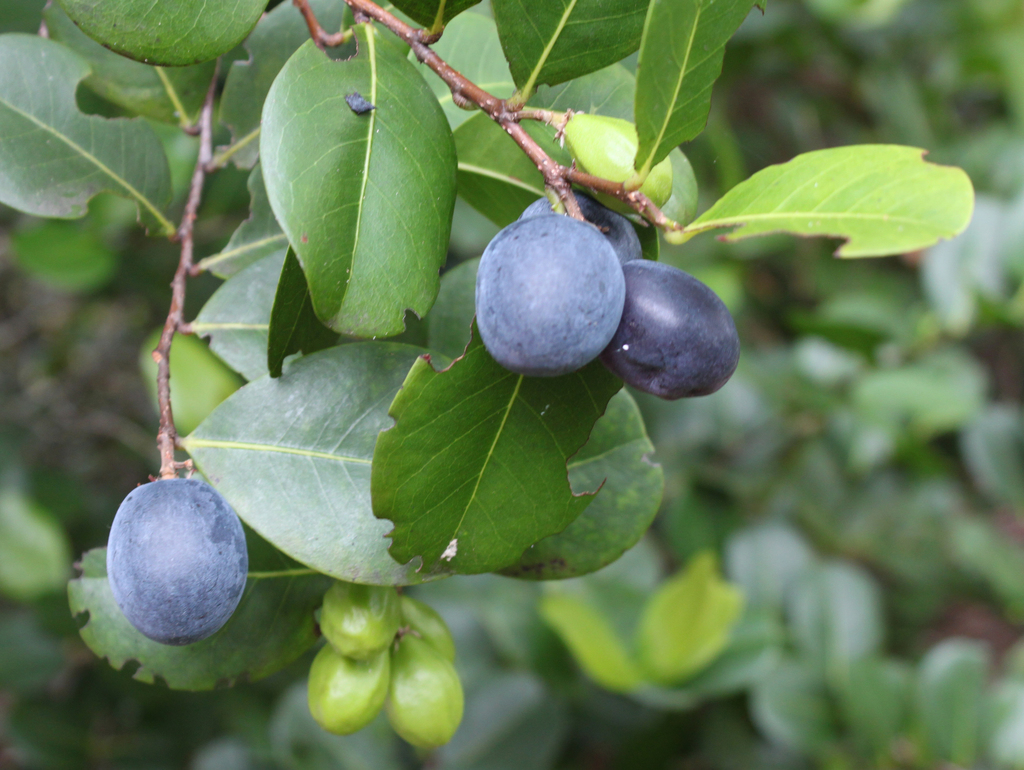
Cocoplum
Chrysobalanus icaco
Chrysobalanus icaco, the cocoplum, paradise plum, abajeru or icaco is a low shrub or bushy tree found near sea beaches and inland throughout tropical Africa, tropical Americas and the Caribbean, and in southern Florida and the Bahamas. An evergreen, it is also found as an exotic species on other tropical islands, where it has become a problematic invasive. Although taxonomists disagree on whether Chrysobalanus icaco has multiple subspecies or varieties, it is recognized as having two ecotypes, described as an inland, much less salt-tolerant, and more upright C. icaco var. pellocarpus and a coastal C. icaco var. icaco. Both the ripe fruit of C. icaco, and the seed inside the ridged shell it contains, are considered edible.
From the article Chrysobalanus icaco on Wikipedia (CC BY-SA), quoted section by section
Description
Chrysobalanus icaco is a shrub 1–3 metres (3.3–9.8 ft), or bushy tree 2–6 metres (6.6–19.7 ft), rarely to 10 metres (33 ft). It has evergreen broad-oval to nearly round somewhat leathery leaves (3 to 10 cm long and 2.5 to 7 cm wide). Leaf colors range from green to light red. The bark is greyish or reddish brown, with white specks. The clustered flowers are small, greenish-white, and appear intermittently throughout the year but more abundantly in late spring. The fruit that follows (a drupe) is variable, with that of the coastal form being round, up to 5 cm in diameter, white, pale-yellow with a rose blush or dark-purple in color, while that of the inland form is oval, up to 2.5 cm long, and dark-purple. The fruit is edible, with an almost tasteless to mildly sweet flavor, and is sometimes used for jam. It contains a five- or six-ridged brown stone with an edible white seed. The common name for this fruit in Dominica, Barbados, Trinidad and Tobago, Guyana, and other Caribbean islands is "fat pork". …
Where it lives
Recorded sightings
—
geo-referenced records in GBIF, from museums, herbaria and field observers.
Drag the globe to turn it. Dots are where records exist, not a range map; darker means more records.
In the stacks
Searching the stacks…
Every page naming Chrysobalanus icaco in the Biodiversity Heritage Library →
This page is assembled live from iNaturalist, GBIF, Wikipedia, the Source Library and the Internet Archive. It is not yet part of the hand-edited codex. iNaturalist taxon 160544.