- Plants
- ›Vascular Plants
- ›flowering plants
- ›Dicots
- ›beeches, oaks, walnuts, and allies
- ›walnut family
- ›Carya
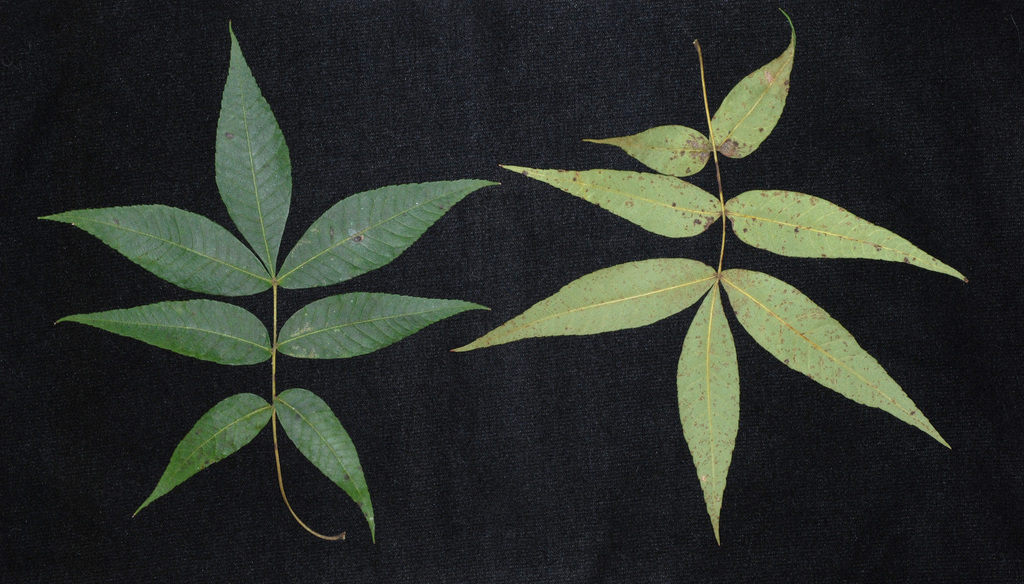
sand hickory
Carya pallida
Carya pallida, sand hickory, or pale hickory is a species of hickory native to the southeastern United States. It is a perennial, dicotyledonous plant which prefers rocky or sandy habitats. The sand hickory can reach heights of up to 30m, but its typical height is between 9-24m. In an open area, Carya crowns are usually towering and slim. The sand hickory nut is edible and consumed by various organisms.
From the article Carya pallida on Wikipedia (CC BY-SA), quoted section by section
Description
Sand hickory bark changes appearance at maturity. Young tree bark is even and a light-gray or brown colour. Deep squamous ridges and dark-gray colours are present on the bark of older specimens. Male catkins and female flowers grow on each plant making it monoecious. Carya pallida leaves are compound and alternate. Leaflets are commonly ovate, and are in groups of 5 to 9, but 7 is most typical. Its rachis and midrib are hirsute with tattered, soft hairs. The abaxial side is covered in scales ranging from silvery-blue to silvery-yellow. Characteristic of hickory, C. pallida wood is thick, durable, and shock absorbent. Compared to other hickories, their twigs are slimmer. Emerging buds are protected by mahogany bud scales. Carya spp., the "true hickories", form extensive taproots which can make transplanting trees difficult or impossible. Loss of new trees is common, so extra care must be taken. Carya pallida has the potential to be a fitting shade or specimen tree. Male catkins are 7 to 10 cm (3–4 in) long while female flowers are of similar size. Pollination occurs by wind dispersal. Blooming occurs during the spring season from March to May. Flowers range from yellow to green to brown. The nut of C. pallida is oval, dark-brown, and protected by a thin shell. The kernel has been described as sweet tasting. Kernels are consumed by rodents, squirrels, and large birds.
Range & habitat
The sand hickory has been recorded in most southeastern states. Its range extends from Delaware and to the west of Missouri. Carya pallida has not been recorded in Pennsylvania, West Virginia, or Ohio. Rarely, it can be found in southwestern Indiana, and it is uncommon in Maryland. Population decline has been reported in Arkansas, Illinois, Indiana, Louisiana, and Missouri. Sand hickory is also prominent in dry oak-hickory forests. Specifically, it can be often found alongside longleaf pine (Pinus palustris) and scrub oak (Quercus marilandica). Hybridization with pignut hickory (Carya glabra) has been reported.
Wikipedia: “Distribution and habitat”
How it is grown
Carya spp. are more likely to contain rare earth elements (REE) or metallomes in their cells than other genera. They have been found to contain Scandium, Lanthanum, Gadolinium, and other minerals. Currently, the role of the REE is unknown. Horticulturists speculate that they could aid in disease resistance, enzyme activities, ion transportation or other chemical functions. Carya pallida is a tetraploid species along with C. floridana, C. glabra, C. texana, and C. tomentosa. Carya spp. may be divided into three groups: 16, 24, and 32-chromosomal counts.
Wikipedia: “Horticulture science”
Where it lives
Recorded sightings
—
geo-referenced records in GBIF, from museums, herbaria and field observers.
Drag the globe to turn it. Dots are where records exist, not a range map; darker means more records.
In the stacks
Searching the stacks…
Every page naming Carya pallida in the Biodiversity Heritage Library →
This page is assembled live from iNaturalist, GBIF, Wikipedia, the Source Library and the Internet Archive. It is not yet part of the hand-edited codex. iNaturalist taxon 160168.