- Plants
- ›Vascular Plants
- ›flowering plants
- ›Dicots
- ›beeches, oaks, walnuts, and allies
- ›walnut family
- ›Carya
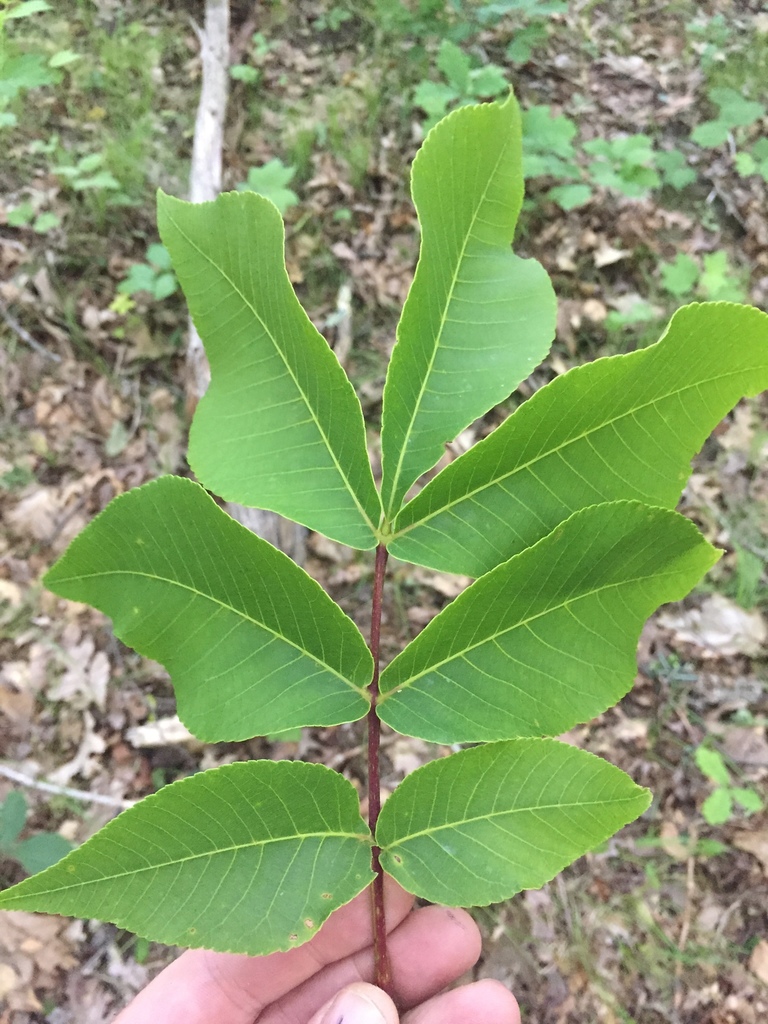
red hickory
Carya ovalis
Carya ovalis, the red hickory or sweet pignut hickory, is a fairly uncommon but widespread hickory native to eastern North America. It is typically found growing in dry, well drained sandy upland ridges and sloped woodlands from southern Ontario, Canada, and in the United States east to New Hampshire, south to northern Florida west to eastern Texas and north-west to Nebraska. This species was formerly treated as a variety or northern ecotype of the pignut hickory C. glabra, described as Carya glabra var. odorata. This discrepancy has not yet been completely resolved, and some sources and authors still consider red hickory as a variety or synonym of pignut hickory. However both trees are quite morphologically distinct.
From the article Carya ovalis on Wikipedia (CC BY-SA), quoted section by section
Description
The red hickory is generally encountered as a medium-sized tree, capable of growing to 30 m (100 ft) in height. The single trunk is straight and often continues for the entire height of the tree, although sometimes splits into several large limbs once the canopy has been breached. The branches are strong, stout and long, ascending in the upper crown and drooping in the lower crown; the branches around mid-height are more or less horizontal. This creates a broad, thick, column-shaped form that casts dense shade. Individuals have been known to live from 100–250 years of age. The largest known red hickory, located in Clay County, Kentucky, is 175 feet tall and 56 inches in diameter at breast height.
The leaves are pinnately compound, typically producing five to nine leaflets (seven being the most common). The terminal leaflet is often the largest, with the auxiliary leaflets decreasing in size from the tip to the base of the rachis. Leaflets are broadest above or at their median length, with finely serrated margins. They are dark green and smooth or glaucous above and paler and finely pubescent underneath. …
Where it lives
Recorded sightings
—
geo-referenced records in GBIF, from museums, herbaria and field observers.
Drag the globe to turn it. Dots are where records exist, not a range map; darker means more records.
In the stacks
Searching the stacks…
Every page naming Carya ovalis in the Biodiversity Heritage Library →
This page is assembled live from iNaturalist, GBIF, Wikipedia, the Source Library and the Internet Archive. It is not yet part of the hand-edited codex. iNaturalist taxon 160167.