- Plants
- ›Vascular Plants
- ›flowering plants
- ›Dicots
- ›pinks, cactuses, and allies
- ›cacti
- ›globular cacti, moonlight cacti, torch cacti, and allies
- ›Rhipsalideae
- ›Schlumbergera
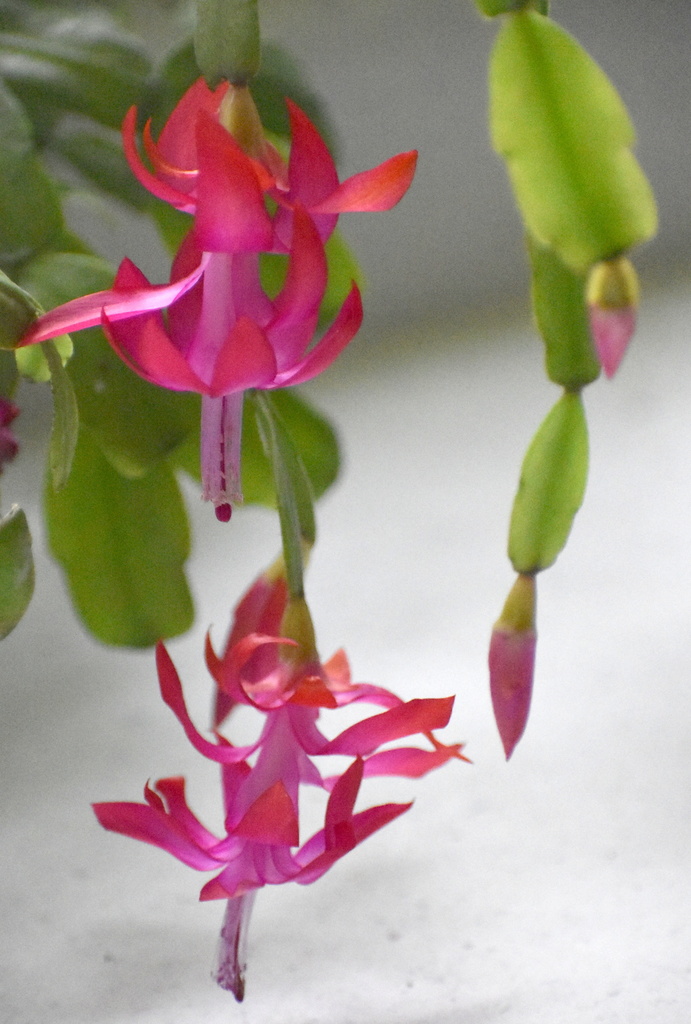
Christmas Cactus
Schlumbergera × buckleyi
Schlumbergera is a small genus of cacti with six to nine species native to the coastal mountains of southeastern Brazil. These plants grow on trees or rocks in habitats that are generally shady with high humidity, and can be quite different in appearance from their desert-dwelling cousins. Most species of Schlumbergera have stems which resemble leaf-like pads joined one to the other and flowers which appear from areoles at the joints and tips of the stems. Two species have cylindrical stems more similar to other cacti.
Common names for these cacti generally refer to their flowering season. In the Northern Hemisphere, they are called Christmas cactus, Thanksgiving cactus, crab cactus and holiday cactus. In Brazil, the genus is referred to as Flor de Maio ("May flower"), reflecting the period in which they flower in the Southern Hemisphere. Most of the popular houseplants are cultivars of Schlumbergera, rather than species, with flowers in white, pink, yellow, orange, red or purple. The Easter cactus or Whitsun cactus, placed in the genus Rhipsalidopsis, is also called a holiday cactus and has flowers in red, orange, pink and white.
From the article Schlumbergera on Wikipedia (CC BY-SA), quoted section by section
Description
In the wild, Schlumbergera species grow either on trees (epiphytic) or on rocks (epilithic) and can form sizeable shrubs with woody bases; a height of up to 1.2 m (4 ft) has been reported for one species (S. opuntioides). They are leafless, the green stems acting as photosynthetic organs. The stems are composed of segments, which take one of two forms. In most species the segments are strongly flattened (cladodes), being made up of a central core with two (or more rarely three) "wings". Special structures characteristic of cacti, called "areoles", then occur at the ends of the segments of the stem. In two species the stems are less flattened, more cylinder-shaped, and the areoles are arranged in a more or less spiral pattern all over the segments. In both cases, the areoles, which may have wool and bristles, are where the flower buds appear. The flowers either hang downwards and are almost regular (radially symmetrical or actinomorphic) or, as in most species, are held more or less horizontally with the higher side of the flower different from the lower side (radially asymmetrical or zygomorphic). In those species whose flowers are held up, their angle with the horizontal is relatively constant and is characteristic of the species. Each flower has 20–30 tepals. The outer tepals (those closer to the base of the flower) are short and unconnected, and spread out or curve backwards. …
Range & habitat
Schlumbergera occurs only in the coastal mountains of south-east Brazil, in the states of São Paulo, Rio de Janeiro, Minas Gerais, and Espírito Santo. Its observed range extends from close to the Tropic of Capricorn northwards to 20°S. I.e. in the southernmost part of the tropics. Plants grow at altitudes from 700 metres (2,300 ft) in the case of S. truncata to 2,780 metres (9,120 ft) in the case of S. microsphaerica, either in the coastal moist forests or in rocky areas. The natural distribution of Schlumbergera species has become confused because European cultivars were deliberately introduced into some areas, including the Serra dos Órgãos National Park, by the Brazilian Agricultural Department, to compensate for over-collecting of wild plants. Because of their height and proximity to the Atlantic Ocean, the coastal mountains produce high-altitude moist forests – warm moist air is forced upwards into higher, colder locations where it condenses. Schlumbergera species grow in habitats which are generally relatively cool, shaded and of high humidity. David Hunt describes collecting specimens in conditions of cloud, drizzle and overnight temperatures down to −4 °C (25 °F). Plants are epiphytic or lithophytic, growing on moss-covered tree branches or in rock crevices, often in small pockets of substrate formed from decayed leaves and other vegetation. S. …
Wikipedia: “Distribution, habitat and ecology”
In human culture
Schlumbergera truncata was in cultivation in Europe by 1818, and S. russelliana was introduced in 1839. The two species were deliberately crossed in England by W. Buckley, resulting in the hybrid now called S. × buckleyi, first recorded in 1852. By the 1860s, a substantial number of cultivars (cultivated varieties) were available in a range of colours and habits, and were used as ornamental plants in "stoves" (heated greenhouses) and in homes, where they were popular for their autumn and winter flowering. Many cultivars were selected seedlings of S. truncata, but at least three S. × buckleyi hybrids were available, of which one, now called S. 'Buckleyi', is thought to be the original Christmas cactus. By the early part of the 20th century, the genus had become less popular, and many of the early cultivars were lost. From around the 1950s onwards, breeding resumed in Europe, North America, Australia and New Zealand. New plants were produced by crossing among the species and existing cultivars of S. truncata, S. russelliana and the hybrid S. × buckleyi. Treatments which induced mutations were also used. The result was a wide range of flower colours which had not been available before, including the first true yellow to be sold commercially, S. 'Gold Charm' (which was a sterile triploid). …
Wikipedia: “History”
Where it lives
Recorded sightings
—
geo-referenced records in GBIF, from museums, herbaria and field observers.
Drag the globe to turn it. Dots are where records exist, not a range map; darker means more records.
In the stacks
Searching the stacks…
Every page naming Schlumbergera × buckleyi in the Biodiversity Heritage Library →
This page is assembled live from iNaturalist, GBIF, Wikipedia, the Source Library and the Internet Archive. It is not yet part of the hand-edited codex. iNaturalist taxon 1596733.