- Plants
- ›Vascular Plants
- ›flowering plants
- ›monocots
- ›grasses, sedges, cattails, and allies
- ›grasses
- ›Pooideae
- ›Bromeae
- ›Bromus
- ›Bromopsis
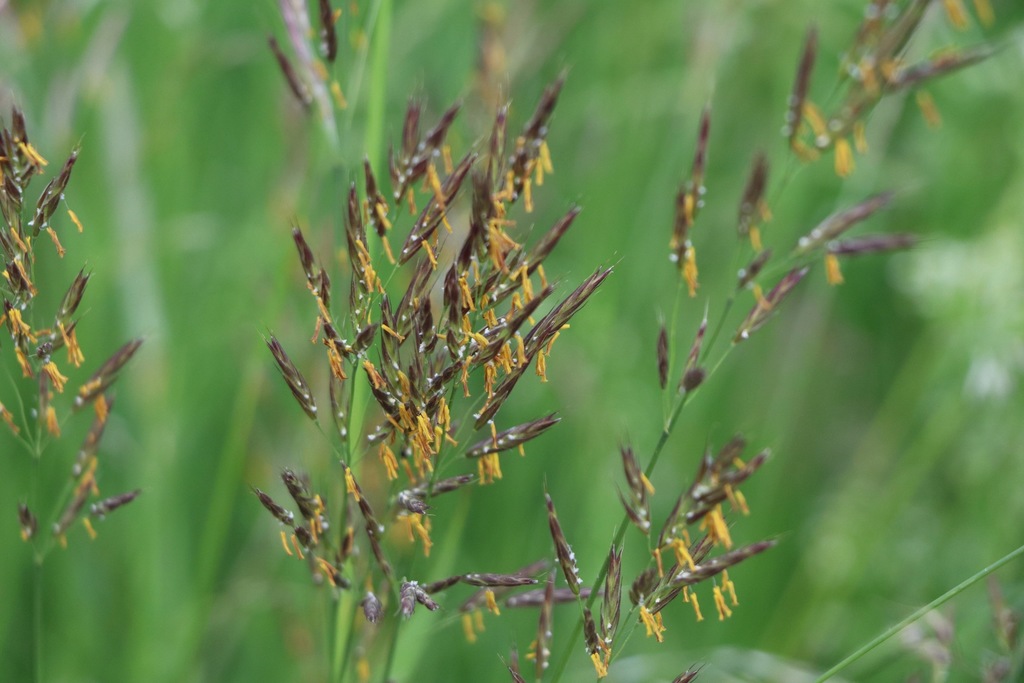
Upright Brome
Bromus erectus
Bromus erectus, commonly known as erect brome, upright brome or meadow brome, is a dense, course, tufted perennial grass. It can grow to 120 centimetres (47 in). Like many brome grasses the plant is hairy. The specific epithet erectus is Latin, meaning "erect". The diploid number of the grass is 56.
From the article Bromus erectus on Wikipedia (CC BY-SA), quoted section by section
Description
Bromus erectus is a perennial, tufted grass with basal tufts of cespitose leaves that is nonrhizomatous. The culms grow between 0.6–1.2 m (2 ft 0 in – 3 ft 11 in) in height. The internodes are typically glabrous. The flattened cauline leaves have pubescent or glabrous sheaths. The leaf blades are 10–20 cm (3.9–7.9 in) long and 2–6 mm (0.079–0.236 in) wide. The grass lacks auricles and the ligule is blunt but finely serrated, sometimes with hairy edges. The contracted and ellipsoid panicle is usually upright, rather than nodding, measuring 7–15 cm (2.8–5.9 in) long. The lanceolate spikelets are 1.5–3 cm (0.59–1.18 in) long and have five to twelve flowers. The glumes are acute, with the lower glumes one-nerved and 7–9 mm (0.28–0.35 in) long, and the upper glumes three-nerved and 9–11 mm (0.35–0.43 in) long. The glabrous or slightly scabrous lemmas are prominently nerved and 10–15 mm (0.39–0.59 in) long, with awns 5–6 mm (0.20–0.24 in) long. The anthers are 4–6 mm (0.16–0.24 in) long. B. erectus flowers in June and July.
Range & habitat
Found on well-drained calcerous soils in disturbed areas, fields, and roadsides, B. erectus is widespread in Europe, South West Asia, North West Africa, and has been introduced into North America.
Wikipedia: “Range”
Where it lives
Recorded sightings
—
geo-referenced records in GBIF, from museums, herbaria and field observers.
Drag the globe to turn it. Dots are where records exist, not a range map; darker means more records.
In the stacks
Searching the stacks…
Every page naming Bromus erectus in the Biodiversity Heritage Library →
This page is assembled live from iNaturalist, GBIF, Wikipedia, the Source Library and the Internet Archive. It is not yet part of the hand-edited codex. iNaturalist taxon 159458.