- Plants
- ›Vascular Plants
- ›flowering plants
- ›Dicots
- ›beeches, oaks, walnuts, and allies
- ›birch family
- ›Betula
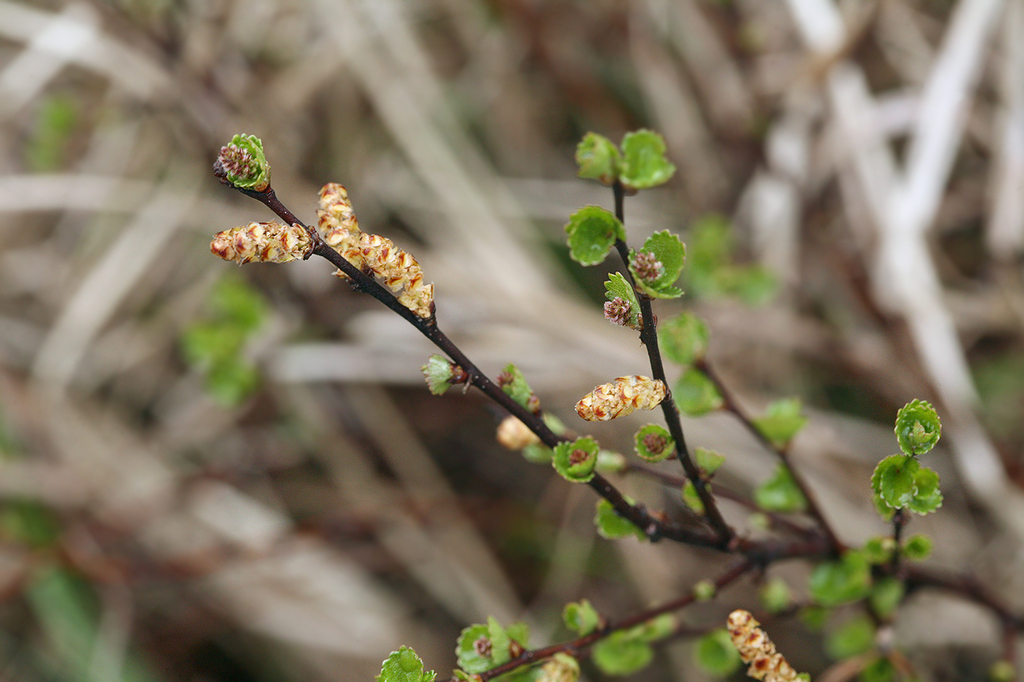
Dwarf Birch
Betula nana
Betula nana, the dwarf birch, is a species of birch in the flowering plant family Betulaceae, found mainly in the tundra of the Arctic region.
From the article Betula nana on Wikipedia (CC BY-SA), quoted section by section
Description
It is a monoecious, deciduous shrub growing up to 1–1.2 metres (3 ft 3 in – 3 ft 11 in) high. The bark is non-peeling and shiny red-copper colored. The leaves are rounded, 6–20 millimetres (0.24–0.79 in) diameter, with a bluntly toothed margin. The leaves are a darker green on their upper surface. Leaf growth occurs after snow melt and become red in autumn. The wind-pollinated fruiting catkins are erect, 5–15 millimetres (0.20–0.59 in) long and 4–10 millimetres (0.16–0.39 in) broad.
Range & habitat
Betula nana is native to arctic and cool temperate regions of Greenland, Iceland, northern Europe, northern Asia and northern North America and it will grow in a variety of conditions. Outside of far northern areas, it is usually found growing only in mountains above 300 metres (980 ft), up to 835 metres (2,740 ft) in Great Britain and 2,200 metres (7,200 ft) in the Alps and Carpathians. Its northern range limit is on Svalbard, where it is confined to favourable sites. In the UK Betula nana is at its southern range limit, with many populations having declined significantly in recent decades. In southern Sweden the occurrence of Betula nana in Sund, Ydre is deemed a glacial relict. It generally favours wet, but well-drained sites, with a nutrient-poor, acidic soil that can be xeric and rocky. B. nana has a low tolerance for shade. In the Arctic it grows in alpine tundra, rocky barrens, and moorlands. In the Alps and Carpathians it grows in alpine tundra, subalpine damp moorlands, raised bogs with the moss Sphagnum magellanicum, and subalpine pine moors.
Wikipedia: “Distribution”
Where it lives
Recorded sightings
—
geo-referenced records in GBIF, from museums, herbaria and field observers.
Drag the globe to turn it. Dots are where records exist, not a range map; darker means more records.
In the stacks
Searching the stacks…
Every page naming Betula nana in the Biodiversity Heritage Library →
This page is assembled live from iNaturalist, GBIF, Wikipedia, the Source Library and the Internet Archive. It is not yet part of the hand-edited codex. iNaturalist taxon 159228.