- Plants
- ›Vascular Plants
- ›flowering plants
- ›Dicots
- ›Heathers, Balsams, Primroses, and Allies
- ›primrose family
- ›Cape Myrtle subfamily
- ›Ardisia
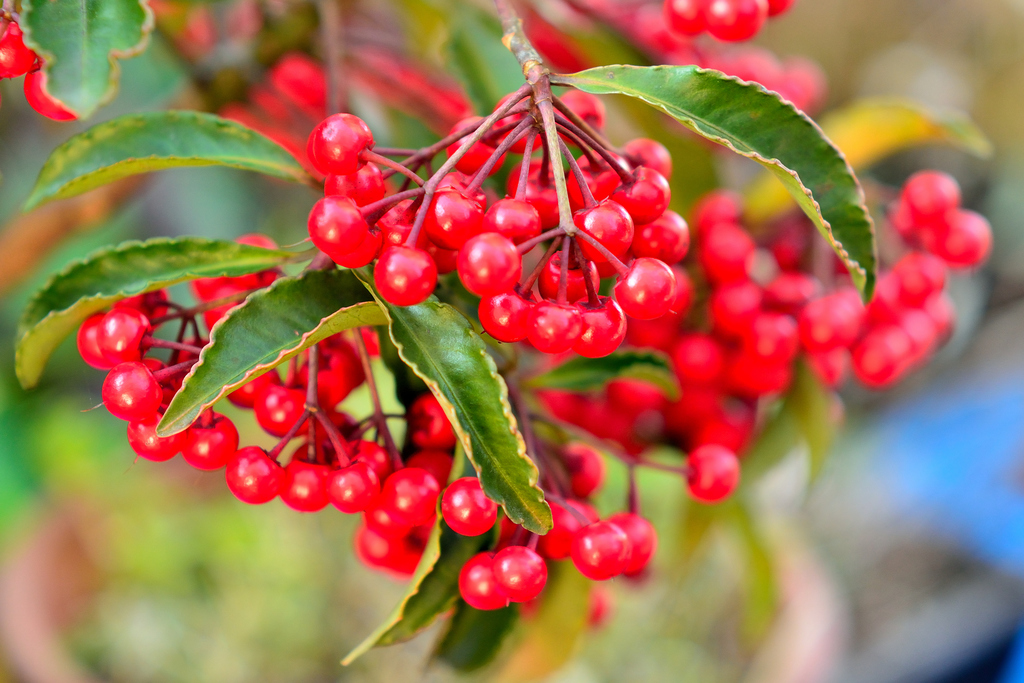
Coralberry
Ardisia crenata
Ardisia crenata is a species of flowering plant in the primrose family, Primulaceae, that is native to East Asia. It is known by a variety of names such as Christmas berry, coral ardisia, coral bush, coralberry, coralberry tree, hen's-eyes, and spiceberry. A. crenata is a compact shrub that reaches 1 metre (3.3 ft), often with a single stem. Leaves are dark green, thick, glossy, and have tightly waved edges. The flowers are small, white or reddish, fragrant, and form clusters. The fruit is a glossy, bright red drupe. The seeds are able to germinate under a dense canopy and are dispersed by birds and humans.
A. crenata was introduced to the United States in the early twentieth century as an ornamental species. It was observed to have escaped cultivation in 1982 and is now considered an invasive species.
From the article Ardisia crenata on Wikipedia (CC BY-SA), quoted section by section
Description
Christmas berry is an upright perennial shrub that grows 1.5–6 feet (0.46–1.83 m) tall. It maintains a densely tufted growth pattern and is often multi-trunked. Christmas berry prefers moist soil and germination can occur from pH 4 to pH 10. It does well in temperatures of 25 °C and above. Germination rates are as high as 97.79% after 40 days. Its leaves are simple, alternate and measure up to 8 inches long. They are waxy and dark green with a crenate margin containing small calluses within the ridges. The leaf tips are acuminate and their petioles are 3–10 mm long. They have a central vein with up to 18 pairs of side veins. Flowers are white or pink with yellow anthers and grow in axillary clusters and are very often covered in multiple black spots. Plants begin to bear fruit two years after sprouting. Christmas berry has an abundance of spherical, one-seeded red berries of about 0.25 inches in diameter that remain on the plant throughout the year. The berry clusters often droop below the glossy foliage. Berries are consumed by birds and, when present, raccoons, and subsequently excreted; seeds can also be distributed by flowing water. While there are indications the plant may be poisonous to livestock, pets and humans, due to cattle deaths in Florida, there is no scientific confirmation of this.
At the table
The leaves of Ardisia crenata are being investigated as a remedy to stop asthmatic contractions and spasms. The plant contains a medicinal substance known as FR900359 that could treat several diseases, including asthma, hypertension, and uveal melanoma.
Wikipedia: “Medical uses”
In human culture
Thriving ground cover prior to invasion will help slow down seedling colonization.
Wikipedia: “Cultural”
Where it lives
Recorded sightings
—
geo-referenced records in GBIF, from museums, herbaria and field observers.
Drag the globe to turn it. Dots are where records exist, not a range map; darker means more records.
In the stacks
Searching the stacks…
Every page naming Ardisia crenata in the Biodiversity Heritage Library →
This page is assembled live from iNaturalist, GBIF, Wikipedia, the Source Library and the Internet Archive. It is not yet part of the hand-edited codex. iNaturalist taxon 158586.