- Plants
- ›Vascular Plants
- ›flowering plants
- ›Dicots
- ›pinks, cactuses, and allies
- ›Amaranth family
- ›Gomphrenoideae
- ›Alternanthera
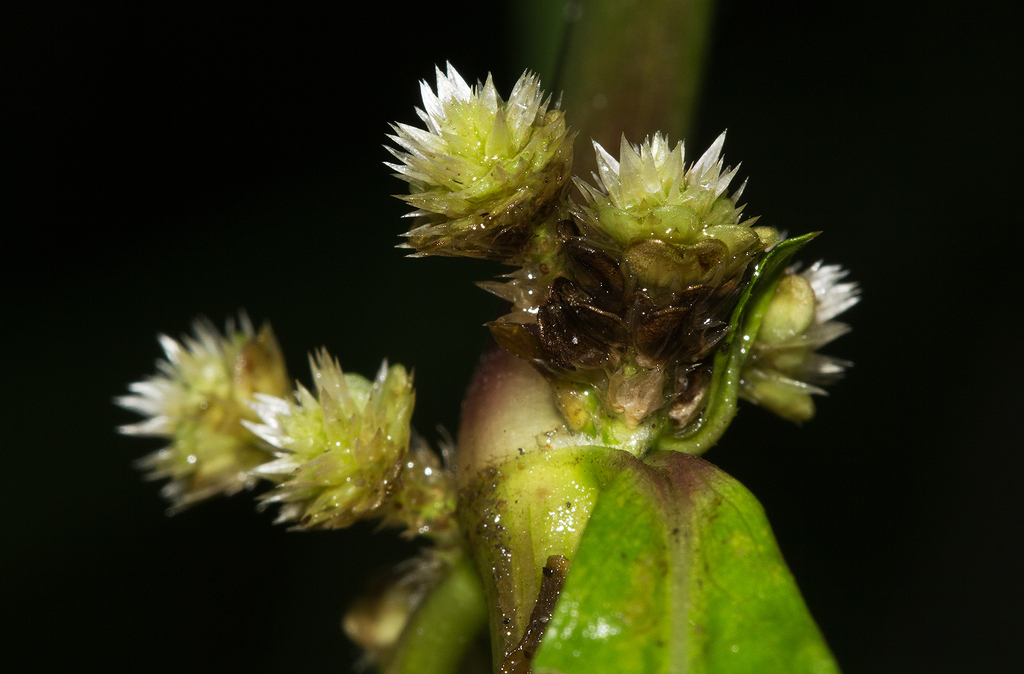
Sessile Joyweed
Alternanthera sessilis
Alternanthera sessilis is an aquatic plant known by several common names, including ponnanganni (in Tamil), ponnaganti aaku (in Telugu), Mukunuwenna(in Sinhalese), sessile joyweed and dwarf copperleaf. It is used as a vegetable specially in Sri Lanka and some Asian countries.
From the article Alternanthera sessilis on Wikipedia (CC BY-SA), quoted section by section
Description
This is a perennial herb with prostrate stems, rarely ascending, often rooting at the nodes. Leaves obovate to broadly elliptic, occasionally linear-lanceolate, 1–15 cm long, 0.3–3 cm wide, glabrous to sparsely villous, petioles 1–5 mm long. Flowers in sessile spikes, bract and bracteoles shiny white, 0.7–1.5 mm long, glabrous; sepals equal, 2.5–3 mm long, outer ones 1-nerved or indistinctly 3-nerved toward base; stamens 5, 2 sterile. In the wild it flowers from December until March.
Range & habitat
The plant occurs throughout the tropical and subtropical regions of the Old World. It has been introduced to the southern United States, and its origins in Central and South America are uncertain. This species is classified as a weed in parts of the southern states of the US. It is usually (but not always especially in areas of high humidity where it can even be a garden weed) found in wet or damp spots.
Wikipedia: “Distribution”
At the table
The plant grows wild, but is also cultivated for food, herbal medicines, and as an ornamental plant. The aquarium plant Alternanthera reineckii is sometimes misidentified as A. sessilis. In certain regions of South East Asia, the leaves and young shoots are consumed as vegetables. In South Asia the leaves, flowers and tender stems are consumed as vegetables. The plants are shredded finely and stir fried with grated coconut and spices to make a salad-like dish that is most commonly eaten as a rice accompaniment. The leaves are crunchy, slightly more so than the temperate climate spinach, and not slimy. Some cultivars are slightly bitter. They require steaming or boiling when eaten in large quantities because of the presence of oxalates. It is eaten alone as a green or added to other dishes as a spinach substitute. Reportedly, Brazilians usually eat it raw in salads with oil and or vinegar, tomato, and onion, although the literature recommends cooking it. The vegetable can be added to quiches, pies, curries, dals, pasta sauces, lasagna or added to dishes and stir-fries late in the cooking process as a spinach substitute and to add a nutty flavour. As a herbal medicine, the plant has diuretic, cooling, tonic and laxative properties. It has been used for the treatment of dysuria and haemorrhoids. …
Wikipedia: “Uses”
Where it lives
Recorded sightings
—
geo-referenced records in GBIF, from museums, herbaria and field observers.
Drag the globe to turn it. Dots are where records exist, not a range map; darker means more records.
In the stacks
Searching the stacks…
Every page naming Alternanthera sessilis in the Biodiversity Heritage Library →
This page is assembled live from iNaturalist, GBIF, Wikipedia, the Source Library and the Internet Archive. It is not yet part of the hand-edited codex. iNaturalist taxon 158232.