- Plants
- ›Vascular Plants
- ›flowering plants
- ›Dicots
- ›Roses, Elms, Figs, and Allies
- ›rose family
- ›brambles, roses, strawberries, and allies
- ›agrimonies and burnets
- ›agrimony subtribe
- ›Agrimonia
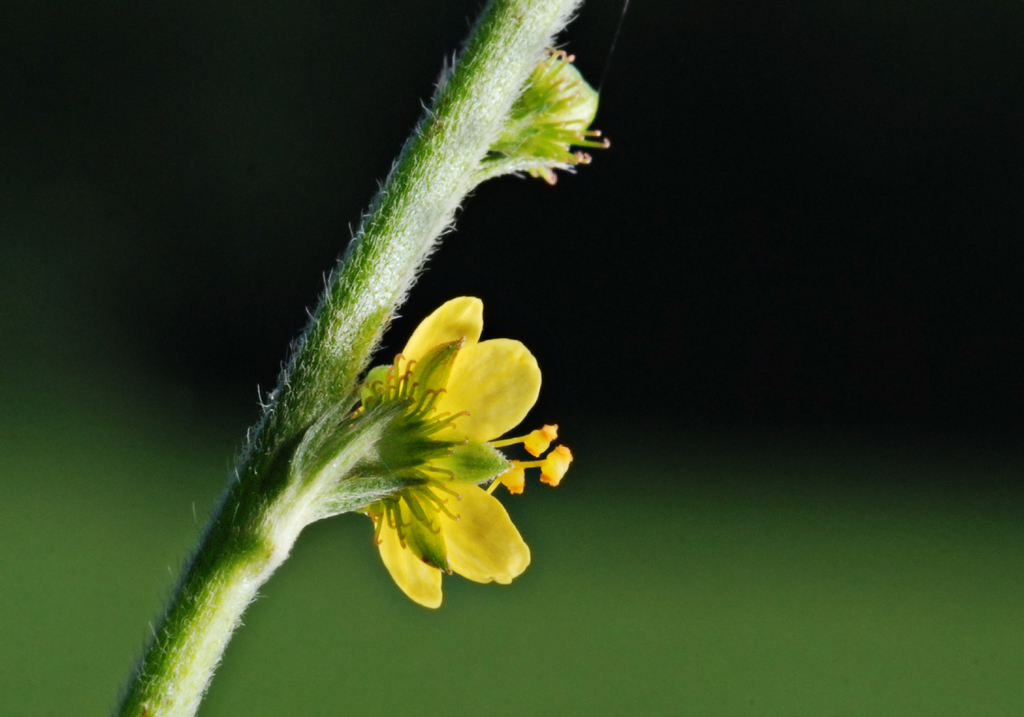
downy agrimony
Agrimonia pubescens
Agrimonia pubescens, the soft agrimony or downy agrimony, is a flowering plant in the genus Agrimonia, a member of the rose family. It grows in dry areas and woodlands.
From the article Agrimonia pubescens on Wikipedia (CC BY-SA), quoted section by section
Description
Agrimonia pubescens is an erect perennial, growing upwards of 40 in (1,000 mm) tall. It has erect and canescent or pubescent stems. The five to thirteen leaflets are oblong and dentate, and pinnately divided once. The leaves are lanceolate, with the terminal leaflet being the largest, measuring 1.25–4 in (32–102 mm) long and 0.5–2 in (13–51 mm) wide. The leaflets increase in size as they approach the top of the compound leaf. At the base of each petiole is oval-shaped stipule with a serrated margin, measuring approximately 0.75 in (19 mm) long and 0.38 in (9.7 mm) wide. The yellow flowers are borne on spike-like racemes. Each flower is 0.25–0.33 in (6.4–8.4 mm) wide with five yellow petals and five to ten stamens. The five sparsely pubescent sepals alternate with the petals. The small flowers and conical fruit have short pedicels. The seeds have hook-like projections and are clustered in a bell-like shape. The glabrous calyx measures 0.08 in (2.0 mm) while fruiting. The plant flowers from July through September.
Range & habitat
Agrimonia pubescens is found predominantly found in the United States, east of the Mississippi River.
== References ==
Wikipedia: “Range”
Where it lives
Recorded sightings
—
geo-referenced records in GBIF, from museums, herbaria and field observers.
Drag the globe to turn it. Dots are where records exist, not a range map; darker means more records.
In the stacks
Searching the stacks…
Every page naming Agrimonia pubescens in the Biodiversity Heritage Library →
This page is assembled live from iNaturalist, GBIF, Wikipedia, the Source Library and the Internet Archive. It is not yet part of the hand-edited codex. iNaturalist taxon 158125.