- Plants
- ›Vascular Plants
- ›flowering plants
- ›monocots
- ›grasses, sedges, cattails, and allies
- ›grasses
- ›Pooideae
- ›needlegrasses and allies
- ›Hesperostipa
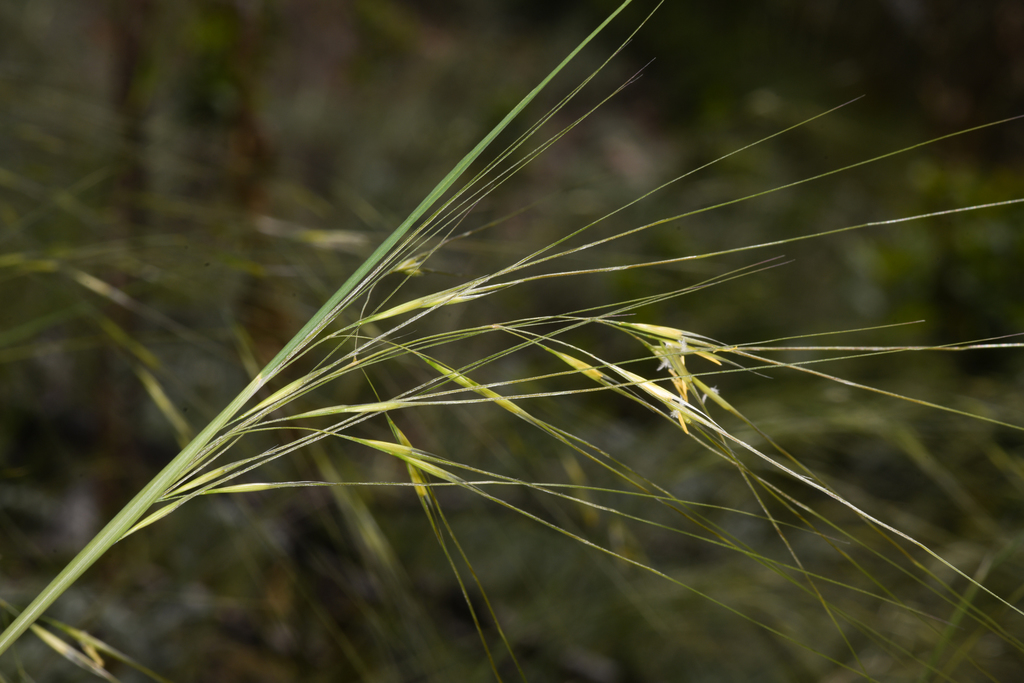
Needle-and-thread Grass
Hesperostipa comata
Hesperostipa comata, commonly known as needle-and-thread grass, is a species of grass native to North America, especially the western third. It has a wide distribution spanning from northern Canada to Mexico.
From the article Hesperostipa comata on Wikipedia (CC BY-SA), quoted section by section
Description
Hesperostipa comata is a perennial bunchgrass producing erect, unbranched stems to about 1 m (3 ft 3 in) in maximum height. The narrow inflorescence is up to 28 cm (11 in) long in taller plants, with the mature spikelet bearing a spiraling, hairy, spear-shaped awn up to 19 cm (7+1⁄2 in) in length. The seeds of this grass have hygroscopic extensions that bend with changes in humidity, enabling them to disperse over the ground. Each seed has an awn that twists several turns when the seed is released. Increased moisture causes it to untwist, and, upon drying, to twist again, thus the seed is drilled into the ground.
Range & habitat
This is a grass of many habitat types, from grassland to pine forest. Young shoots provide a favored food source for black-tailed prairie dogs and black-tailed jackrabbits, and the grass is a good early spring graze for livestock before it develops its long, sharp awn.
Wikipedia: “Habitat”
In human culture
This species was described by the explorers during the Lewis and Clark Expedition.
Needle and thread grass is the provincial grass of the prairie province of Saskatchewan. This species is popular among children because of the seed's ability to be thrown and stick to clothing.
Wikipedia: “Cultural”
Where it lives
Recorded sightings
—
geo-referenced records in GBIF, from museums, herbaria and field observers.
Drag the globe to turn it. Dots are where records exist, not a range map; darker means more records.
In the stacks
Searching the stacks…
Every page naming Hesperostipa comata in the Biodiversity Heritage Library →
This page is assembled live from iNaturalist, GBIF, Wikipedia, the Source Library and the Internet Archive. It is not yet part of the hand-edited codex. iNaturalist taxon 157659.