- Plants
- ›Vascular Plants
- ›flowering plants
- ›Dicots
- ›pepper plants, birthworts, and allies
- ›lizard's tail family
- ›Houttuynia
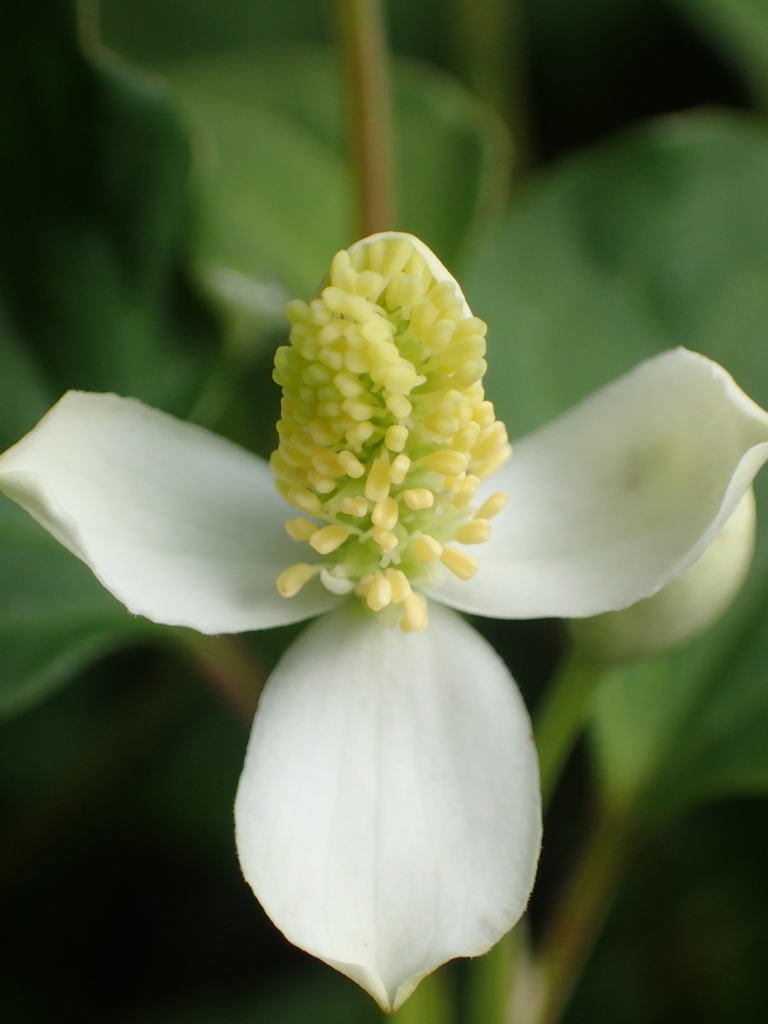
Chameleon Plant
Houttuynia cordata
Houttuynia cordata (simplified Chinese: 鱼腥草; traditional Chinese: 魚腥草; pinyin: yúxīng cǎo; literally: "fishy-smell herb"; Japanese: dokudami 蕺草, literally "poison blocking plant"; Vietnamese: giấp cá; Lao: pak kao tong ຜັກຄາວທອງ; Thai: phakkaawtong ผักคาวตอง, ผักคาวทอง, พลูคาว; Korean: 약모밀, 어성초). In Manipur, it is known as toningkok, in Tangkhul as Ngayungna in Hmar as Aithang, in Meghalaya it is known as Jamyrdoh, in Chakma as Mosondori, in Mizo as Uithinthang, and in thadou as "Aithanglou", Hrama in Poula. In...
From the article Houttuynia cordata on Wikipedia (CC BY-SA), quoted section by section
Range & habitat
It is native to Nepal, Taiwan, Myanmar, Bhutan, India, Indonesia, Japan, China, Thailand, Vietnam and Korea. In South Korea, it is found in Gyeongsangbuk-do, Ulleungdo, and the Southern region.
Wikipedia: “Distribution”
At the table
It is commonly grown as a leaf vegetable, and is used as a fresh herbal garnish. The leaf has an unusual taste from its volatile oil decanoyl acetaldehyde (3-oxododecanal), a taste that is often described as "fishy", earning it the nickname "fish mint". In northeastern India, the leaves are commonly used in salads, salsas, or cooked with other vegetables, and as a garnish over side dishes. The tender roots can also be ground into chutneys along with dry meat or fish, chilies, and tamarind. It is used raw as a salad and cooked along with fish as fish curry. In Japan and Korea, the dried leaves may be used as an herbal tea. It is called dokudami-cha (どくだみ茶) in Japan and eoseongcho cha (어성초차) in Korea. In Vietnamese cuisine, the plant is called diếp cá and is used with grilled meat and noodle salad dishes. Fish mint may be used as a garnish with several Vietnamese dishes, such as gỏi cuốn, stir-fried beef with fish mint salad, and bánh xèo.
Zhé'ěrgēn (Chinese: 折耳根, "broken ear-root") is the edible rhizome of Houttuynia cordata (yúxīngcǎo; 魚腥草; "fish-smelling grass") with a fresh, spicy, peppery flavour that is used in southwestern Chinese cuisine, i.e. that of Guizhou, Sichuan, Yunnan and western Guangxi. Typically the leaves are eaten in Sichuan and the root in Guizhou. …
Wikipedia: “Culinary use”
In medicine
Houttuynia cordata was used in traditional Chinese medicine, including by Chinese scientists in an attempt to treat SARS and various other disorders, although there is no high-quality clinical research to confirm such uses are safe or effective, as of 2018. When administered via injection, H. cordata can cause severe allergic reactions.
Wikipedia: “Traditional medicine”
How it is grown
Houttuynia cordata grows in moist to wet soil or slightly submerged in water, as long as it is exposed partially or fully to the sun. It can become invasive in gardens and difficult to eradicate as its roots run deep and actively spread. It can be propagated by division. It is usually found in one of its cultivated forms in temperate gardens. The 'Chameleon' variety (synonymous with H.cordata 'Court Jester', 'Tricolour', and 'Variegata') is slightly less vigorous than the parent species, with stubbier leaves mottled in both yellow and red. Another common variety, 'Flore Pleno', has masses of white bracts and retains the vigor of the parent species. Houttuynia cordata has been naturalized in North America.
Wikipedia: “Cultivation”
Where it lives
Recorded sightings
—
geo-referenced records in GBIF, from museums, herbaria and field observers.
Drag the globe to turn it. Dots are where records exist, not a range map; darker means more records.
In the old herbals & bestiaries

Commentaries on the Six Books of Dioscorides on Medical Matter
Pietro Andrea Mattioli · 1563 · p.457

Commentaries on the Six Books of Dioscorides on Medical Matter
Pietro Andrea Mattioli · 1563 · p.457

Illustrated Investigation of the Names and Realities of Plants, Volume 4
吳其濬 · 1848 · p.19

Compendium of Materia Medica: Illustrated Volume Middle of Middle
李時珍 · 1596 · p.93

Collected Illustrations of the Three Realms (Volume 104)
王圻, 王思義 · 1609 · p.44
In the stacks
Searching the stacks…
Every page naming Houttuynia cordata in the Biodiversity Heritage Library →
This page is assembled live from iNaturalist, GBIF, Wikipedia, the Source Library and the Internet Archive. It is not yet part of the hand-edited codex. iNaturalist taxon 157642.