- Plants
- ›Vascular Plants
- ›flowering plants
- ›Dicots
- ›Nances, Willows, and Allies
- ›willow family
- ›Salix
- ›Vetrix
- ›Hastatae
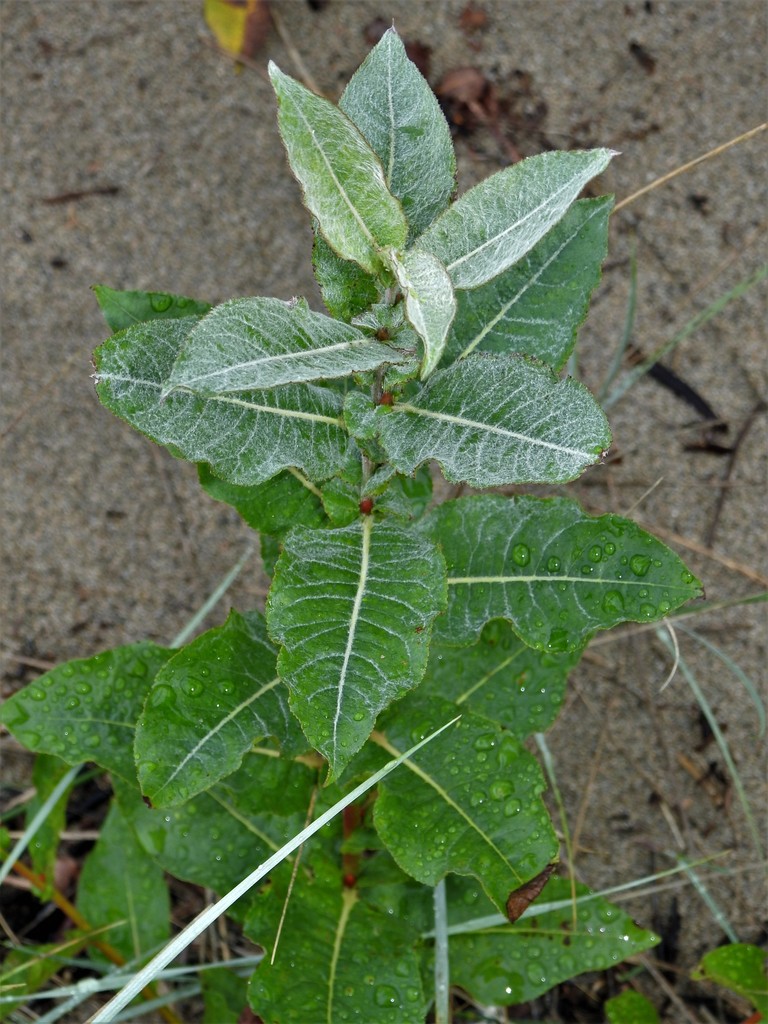
sand dune willow
Salix cordata
Salix cordata, the sand dune willow, furry willow, or heartleaf willow, is a perennial shrub that grows 3 to 12 feet (0.91 to 3.66 m) tall; plants taller than 6 feet (1.8 m) are rare. The plant is native to the northeast regions of the North American continent; it is found on sand dunes, river banks, and lake shores in sandy, silty or gravelly soils.
From the article Salix cordata on Wikipedia (CC BY-SA), quoted section by section
Range & habitat
In Canada the range of Salix cordata extends from Ontario to Newfoundland and Labrador, descending south into the American states of Illinois and Pennsylvania. Because it is a freshwater species, it is not native to Canadian Atlantic provinces, such as Nova Scotia.
Conservation efforts. Although not listed on the federal Endangered Species Act of 1973, Salix cordata is endangered in Wisconsin.
Wikipedia: “Distribution”
What it does
Salix cordata is the host species of the specialist herbivore beetle Altica subplicata. It is found in the sand dunes of lakes, such as Lake Michigan. Salix cordata readily hybridizes with Salix eriocephala.
Wikipedia: “Ecology”
At the table
Salix cordata has been used in revegetation efforts around former coal mines in New Brunswick, Canada. It is one of the fastest growing and most easily propagated of eight different Salix species being tested for biomass production.
== References ==
Wikipedia: “Uses”
Where it lives
Recorded sightings
—
geo-referenced records in GBIF, from museums, herbaria and field observers.
Drag the globe to turn it. Dots are where records exist, not a range map; darker means more records.
In the stacks
Searching the stacks…
Every page naming Salix cordata in the Biodiversity Heritage Library →
This page is assembled live from iNaturalist, GBIF, Wikipedia, the Source Library and the Internet Archive. It is not yet part of the hand-edited codex. iNaturalist taxon 155000.