- Plants
- ›Vascular Plants
- ›flowering plants
- ›Dicots
- ›Woodsorrels, Quandongs, and Allies
- ›Albany pitcher plant family
- ›Cephalotus
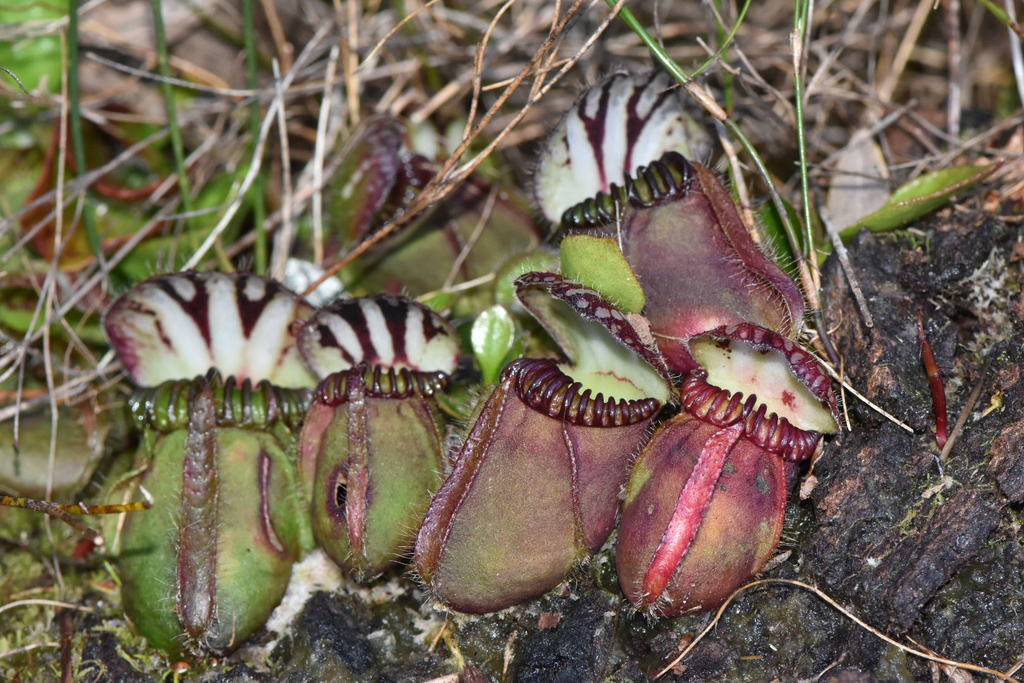
Albany pitcher plant
Cephalotus follicularis
Cephalotus (; from Greek: κεφαλή 'head' and οὔς/ὠτός 'ear', to describe the head of the anthers) is a genus which contains one species, Cephalotus follicularis the Albany pitcher plant, a small carnivorous pitcher plant. The pit-fall traps of the modified leaves have inspired the common names for this plant, which also include Western Australian pitcher plant, Australian pitcher plant, or fly-catcher plant. It is an evergreen herb that is endemic to peaty swamps in the southwestern corner of Western Australia. As with the unrelated Nepenthes, it catches its victims with pitfall traps.
From the article Cephalotus on Wikipedia (CC BY-SA), quoted section by section
Description
Cephalotus follicularis is a small, low growing, herbaceous species. Evergreen leaves appear from underground rhizomes, are simple with an entire leaf blade, and lie close to the ground. The insectivorous leaves are small and have the appearance of booties or moccasins, forming the 'pitcher' of the common name. The pitchers develop a dark red colour in high light levels but stay green in shadier conditions. The foliage is a basal arrangement that is closely arranged with outward facing adapted leaf blades. These leaves give the main form of the species a height around 20 cm. The 'pitcher' trap of the species is similar to other pitcher plants. The peristome at the entrance of the trap has a spiked arrangement that allows the prey to enter, but hinders its escape. The lid over the entrance, the operculum, prevents rainwater entering the pitcher and thus diluting the digestive enzymes inside. Insects trapped in this digestive fluid are consumed by the plant. The operculum has translucent cells which confuse its insect prey as they appear to be patches of sky. The inflorescence consists of groupings of small, hermaphroditic, six-parted, regular flowers, which are creamy, or whitish. In the cooler months of winter (down to about 5 degrees Celsius), they have a natural dormancy period of about 3–4 months, triggered by the temperature drop and reduced light levels.
Habit. …
Range & habitat
The plant is endemic to the southwest of Australia, in the coastal area northeast of Albany in a zone of around 400 kilometres (250 mi) between Augusta and Cape Riche. It is mainly found in cushions of sphagnum on consistently moist but well-drained, acidic peat soils over granite, in seeping areas, along riverbanks or under so-called tussocks, grasses that grow in clumps (z. B. from Restionaceae). The Australian pitcher plant is categorised as Vulnerable by the IUCN due to its restricted distribution. However, there is no acute threat. Because parts of its distribution area are protected and the plants are common within this, they have been removed from CITES-Appendix II.
Wikipedia: “Distribution and Endangerment”
What it does
The plant occurs in southern coastal districts of the Southwest botanical province in Australia; it has been recorded in the Warren, southern Jarrah Forest, and Esperance Plains regions. Its habitat is on moist peaty sands found in swamps or along creeks and streams, but it is tolerant of less damp situations. Its population in the wild has been reduced by habitat destruction and overcollecting; it is therefore classified as vulnerable species (VU A2ac; C2a(i)) by the IUCN. However, this classification is not in unison with Australia's national EPBC Act List of Threatened Species or Western Australia's Wildlife Conservation Act 1950, which both list the species as Not Threatened. The larvae of Badisis ambulans, an ant-like wingless micropezid fly, develop inside the pitchers. They have never been found anywhere else. The plants survive occasional bush fires in the undergrowth by sprouting again from the rhizome. However, the seeds are not pyrophytes.
Carnivore. After the pitcher is formed, the lid lifts from the peristome and the pitcher is ready to catch. Digestive fluid is already in the pitcher. The prey is attracted by nectar secretions on the bottom of the pitcher lid and between the grooves of the pitcher rim. This causes the prey to fall in and drown. The liquid contains enzymes that break down the nutrients, including esterases, phosphatases and proteases. …
Wikipedia: “Ecology”
At the table
The Australian pitcher plant is popular with enthusiasts of carnivorous plants and cultivated worldwide – however, its cultivation is considered challenging.
Cultivation. Cephalotus are cultivated worldwide. In the wild, they prefer warm day-time temperatures of up to 25 degrees Celsius during the growing season, coupled with cool night-time temperatures. It is commonly grown in a mixture of sphagnum peat moss, perlite, and sand, a reasonable humidity (60–80%) is also preferred. It is successfully propagated from root and leaf cuttings, usually non-carnivorous leaves although pitchers can also be used. A dormancy period is probably crucial to long-term health of the plant. The plants become colourful and grow vigorously when kept in direct sunlight, while plants cultivated in bright shade remain green. Living plants were delivered to Kew Gardens by Phillip Parker King in 1823. A specimen flowered in 1827 and provided one source for an illustration in Curtis's Botanical Magazine. This plant is a recipient of the Royal Horticultural Society's Award of Garden Merit.
There are several dozen Cephalotus clones that exist in cultivation; nine have been officially registered as cultivars. One of the most well-known is 'Eden Black', a cultivar with unusually dark-coloured pitchers.
Wikipedia: “Uses”
In human culture
Botanical specimens were first collected during the visit of HMS Investigator to King George Sound in December 1801 and January 1802. On 2 January 1802 the expedition's botanist, Robert Brown, wrote in his diary:
"Remaind on board. Described a few plants. Mr Good went in search of the pitcher plant wch Messrs Bauer & Westall had found yesterday in flower. He returned with it in the evening." This represents the earliest documentary reference to this species; and although not entirely unambiguous as to the first collection, it is usually taken as evidence that the plant was discovered by Ferdinand Bauer and William Westall on 1 January 1802. Whether or not there was an earlier collection is largely immaterial, however, as all collections were incorporated into Brown's collection without attribution, so Brown is treated as the collector in botanical contexts. Brown initially gave this species the manuscript name "'Cantharifera paludosa' KG III Sound", but this name was not published, and it would not be Brown who published the first description. The following year, further specimens were collected by Jean Baptiste Leschenault de la Tour, botanist to Nicolas Baudin's expedition. In 1806, Jacques Labillardière used these specimens as the basis of his publication of the species in Novae Hollandiae plantarum specimen. …
Wikipedia: “Taxonomic history”
Where it lives
Recorded sightings
—
geo-referenced records in GBIF, from museums, herbaria and field observers.
Drag the globe to turn it. Dots are where records exist, not a range map; darker means more records.
In the stacks
Searching the stacks…
Every page naming Cephalotus follicularis in the Biodiversity Heritage Library →
This page is assembled live from iNaturalist, GBIF, Wikipedia, the Source Library and the Internet Archive. It is not yet part of the hand-edited codex. iNaturalist taxon 148273.