- Animals
- ›Chordates
- ›Vertebrates
- ›Mammals
- ›Therians
- ›Placental Mammals
- ›Ungulates, Carnivorans, and Allies
- ›Odd-toed Ungulates
- ›Equines
- ›Equus
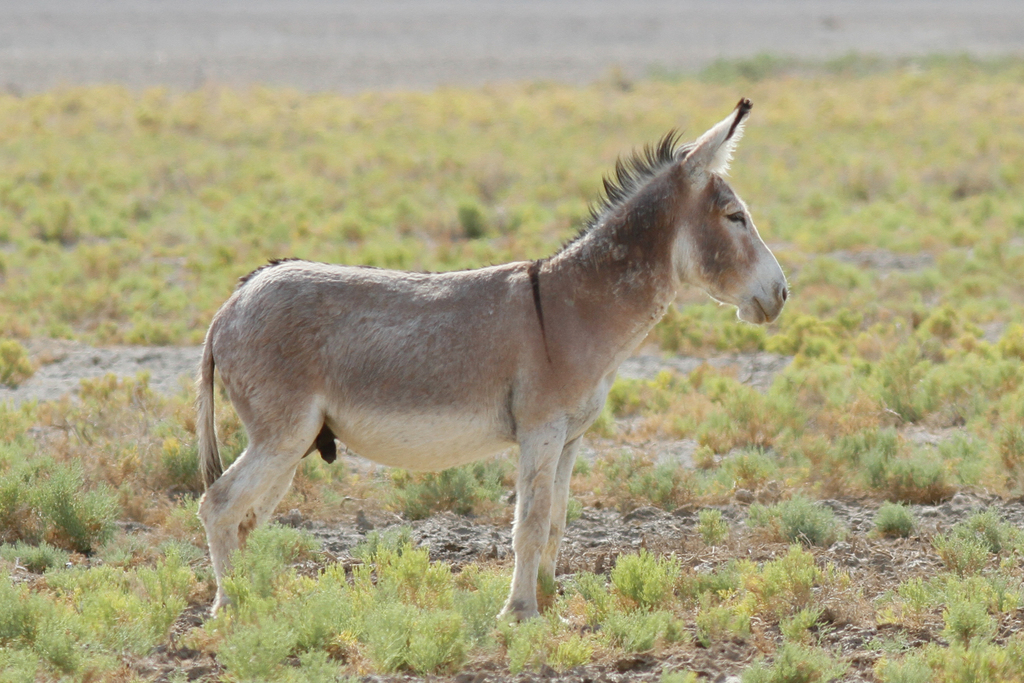
Donkey
Equus asinus
The donkey, ass, or burro is a domesticated equine. It derives from the African wild ass, Equus africanus, and may be classified either as a subspecies thereof, Equus africanus asinus, or as a separate species, Equus asinus. It was domesticated in Africa some 5000–7000 years ago, and has been used mainly as a working animal since that time.
There are more than 40 million donkeys in the world, mostly in underdeveloped countries, where they are used principally as draught or pack animals. While working donkeys are often associated with those living at or below subsistence, small numbers of donkeys or asses are kept for breeding, as pets, and for livestock protection in developed countries.
From the article Donkey on Wikipedia (CC BY-SA), quoted section by section
Description
Donkeys vary considerably in size, depending on both breed and environmental conditions, and heights at the withers range from less than 90 centimetres (35 in) to approximately 150 cm (59 in). Working donkeys in the poorest countries have a life expectancy of 12 to 15 years; in more prosperous countries, they may have a lifespan of 30 to 50 years. Donkeys are adapted to marginal desert lands. Unlike wild and feral horses, wild donkeys in dry areas are solitary and do not form harems. Each adult donkey establishes a home range; breeding over a large area may be dominated by one jack. The loud call or bray of the donkey, which typically lasts for twenty seconds and can be heard for over three kilometres, may help keep in contact with other donkeys over the wide spaces of the desert. Donkeys have large ears, which may pick up more distant sounds, and may help cool the donkey's blood. Donkeys can defend themselves by biting, striking with the front hooves or kicking with the hind legs. Their vocalization, called a bray, is often represented in English as "hee haw".
Cross on back. Most donkeys have dorsal and shoulder stripes, primitive markings which form a distinctive cross pattern on their backs.
Breeding. A jenny is normally pregnant for about 12 months, though the gestation period varies from 11 to 14 months, and usually gives birth to a single foal. …
Wikipedia: “Characteristics”
At the table
The donkey has been used as a working animal for at least 5000 years. Of the more than 40 million donkeys in the world, about 96% are in underdeveloped countries, where they are used principally as pack animals or for draught work in transport or agriculture. After human labour, the donkey is the cheapest form of agricultural power. They may also be ridden, or used for threshing, raising water, milling and other work. Some cultures that prohibit women from working with oxen in agriculture do not extend this taboo to donkeys. In developed countries where their use as beasts of burden has disappeared, donkeys are used to sire mules, to guard sheep, for donkey rides for children or tourists, and as pets. Donkeys may be pastured or stabled with horses and ponies, and are thought to have a calming effect on nervous horses. If a donkey is introduced to a mare and foal, the foal may turn to the donkey for support after it has been weaned from its mother. In the United States, Canada, and Australia, donkeys are used as livestock guard animals for smaller livestock such as sheep. When working as livestock guard animals, also called predator control animals or mobile flock protectors, donkeys will bray loudly and attack potential predators by kicking out with their front hooves. …
Wikipedia: “Uses”
In human culture
The genus Equus, which includes all extant equines, is believed to have evolved from Dinohippus, via the intermediate form Plesippus. One of the oldest species is Equus simplicidens, described as zebra-like with a donkey-shaped head. The oldest fossil to date is approximately 3.5 million years old, and was located in the US state of Idaho. The genus appears to have spread quickly into the Old World, with the similarly aged Equus livenzovensis documented from western Europe and Russia. Molecular phylogenies indicate the most recent common ancestor of all modern equids (members of the genus Equus) lived ~5.6 (3.9–7.8) mya. Direct paleogenomic sequencing of a 700,000-year-old middle Pleistocene horse metapodial bone from Canada implies a more recent 4.07 Myr before present date for the most recent common ancestor (MRCA) within the range of 4.0 to 4.5 Myr BP. The oldest divergencies are the Asian hemiones (subgenus E. (Asinus), including the kulan, onager, and kiang), followed by the African zebras (subgenera E. (Dolichohippus), and E. (Hippotigris)). All other modern forms including the domesticated horse (and many fossil Pliocene and Pleistocene forms) belong to the subgenus E. (Equus) which diverged ~4.8 (3.2–6.5) million years ago. The ancestors of the modern donkey are the Nubian and Somalian subspecies of African wild ass. …
Wikipedia: “History”
Listen
Looking for field recordings…
Where it lives
Recorded sightings
—
geo-referenced records in GBIF, from museums, herbaria and field observers.
Drag the globe to turn it. Dots are where records exist, not a range map; darker means more records.
In the old herbals & bestiaries

Margarita philosophica
Reisch, Gregorius · 1504 · p.465

Vorpforte der Schul-Unterweisung
Comenius, Jan Amos · 1678 · p.46

The Visible World
Jan Amos Comenius · 1658 · p.88

pad gling gur drag chos sde yongs rdzogs
Drametse Monastery Collection · 1700 · p.94

General History of the Waldensians
Léger, Jean · 1750 · p.103

Worksop Bestiary
Anonymous · 1185 · p.48

History of Monsters
Ulisse Aldrovandi · 1642 · p.382

Ortus sanitatis
1491 · p.643

Garden of Health
Jacob Meydenbach · 1491 · p.555

Garden of Health
Jacob Meydenbach · 1491 · p.571

Garden of Health
Jacob Meydenbach · 1491 · p.571

Garden of Health (Hortus Sanitatis)
Jacob Meydenbach · 1491 · p.690
In the stacks
Searching the stacks…
Every page naming Equus asinus in the Biodiversity Heritage Library →
This page is assembled live from iNaturalist, GBIF, Wikipedia, the Source Library and the Internet Archive. It is not yet part of the hand-edited codex. iNaturalist taxon 148030.