- Plants
- ›Vascular Plants
- ›flowering plants
- ›Dicots
- ›Mallows, Rock Roses, and Allies
- ›Mallow and Hibiscus Family
- ›Byttnerioideae
- ›Thomasia
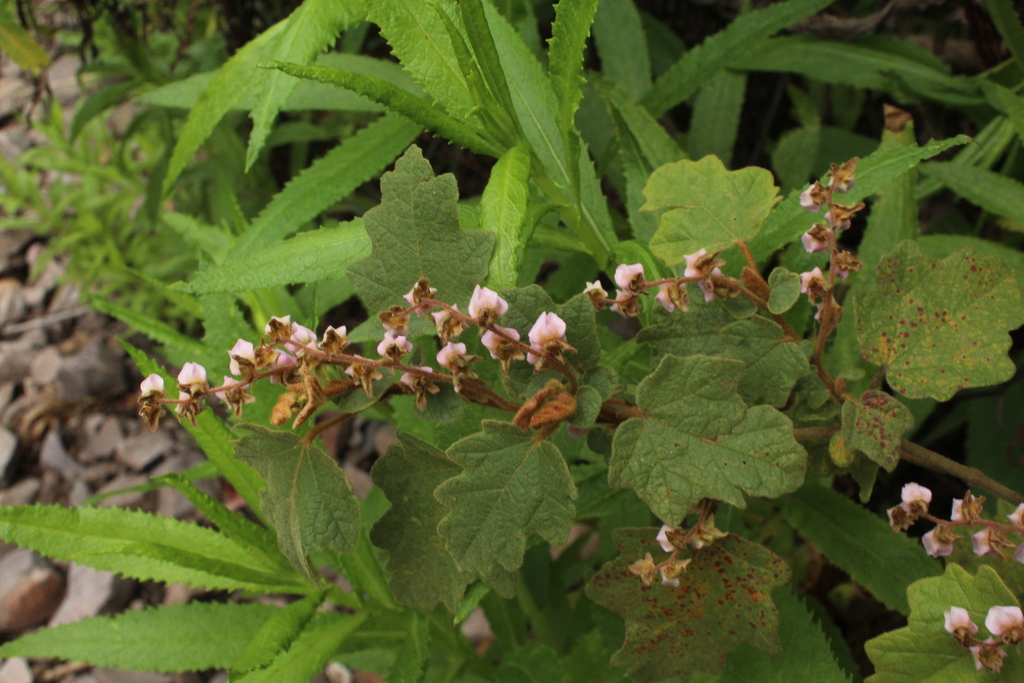
Thomasia brachystachys
Thomasia brachystachys is a species of flowering plant in the family Malvaceae and is endemic to the Southwest Australia south-west of Western Australia. It is an open, erect shrub with egg-shaped to heart-shaped leaves and pink to mauve flowers.
From the article Thomasia brachystachys on Wikipedia (CC BY-SA), quoted section by section
Description
Thomasia brachystachys is an open, erect shrub that typically grows to a height of up to 1.5 m (4 ft 11 in) and has a single stem at ground level, its stems densely covered with star-shaped hairs. The leaves are arranged alternately, egg-shaped to heart-shaped, 35–80 mm (1.4–3.1 in) long and 25–65 mm (0.98–2.56 in) wide on a petiole 12–20 mm (0.47–0.79 in) long. The edges of the leaves are lobed, the lower surface covered with star-shaped hairs and the upper surface becoming glabrous with age. There are oval, stem-clasping, densely hairy stipules up to 7 mm (0.28 in) long at the base of the petioles. The flowers are arranged in racemes of 5 to 8, about the same length as the leaves, each flower on a short pedicel, and about 10 mm (0.39 in) in diameter. The sepals are pink to mauve, joined for about half their length and there are bracts and broadly elliptic bracteoles at the base. The petals are small and scale-like, the five stamens free from each other, and the style no longer than the petals. The fruit is a dehiscent capsule.
Range & habitat
This thomasia grows in woodland and forest at higher altitudes in the Stirling Range National Park and near Gnowangerup.
Wikipedia: “Distribution and habitat”
How it is grown
This thomasia is described as an attractive species that has proved reliable in a range of conditions when grown in well-drained, humus-rich soil. It can be propagated from both seed and cuttings and is moderately drought and frost hardy.
== References ==
Wikipedia: “Use in horticulture”
Where it lives
Recorded sightings
—
geo-referenced records in GBIF, from museums, herbaria and field observers.
Drag the globe to turn it. Dots are where records exist, not a range map; darker means more records.
In the stacks
Searching the stacks…
Every page naming Thomasia brachystachys in the Biodiversity Heritage Library →
This page is assembled live from iNaturalist, GBIF, Wikipedia, the Source Library and the Internet Archive. It is not yet part of the hand-edited codex. iNaturalist taxon 1479927.