- Animals
- ›Chordates
- ›Vertebrates
- ›Mammals
- ›Therians
- ›Marsupials
- ›Kangaroos, Possums, Wombats, and Allies
- ›Macropods
- ›Kangaroos, Wallabies and Allies
- ›Kangaroos, Wallabies, Pademelons, and Dorcopsises
- ›Kangaroos and Wallabies
- ›Onychogalea
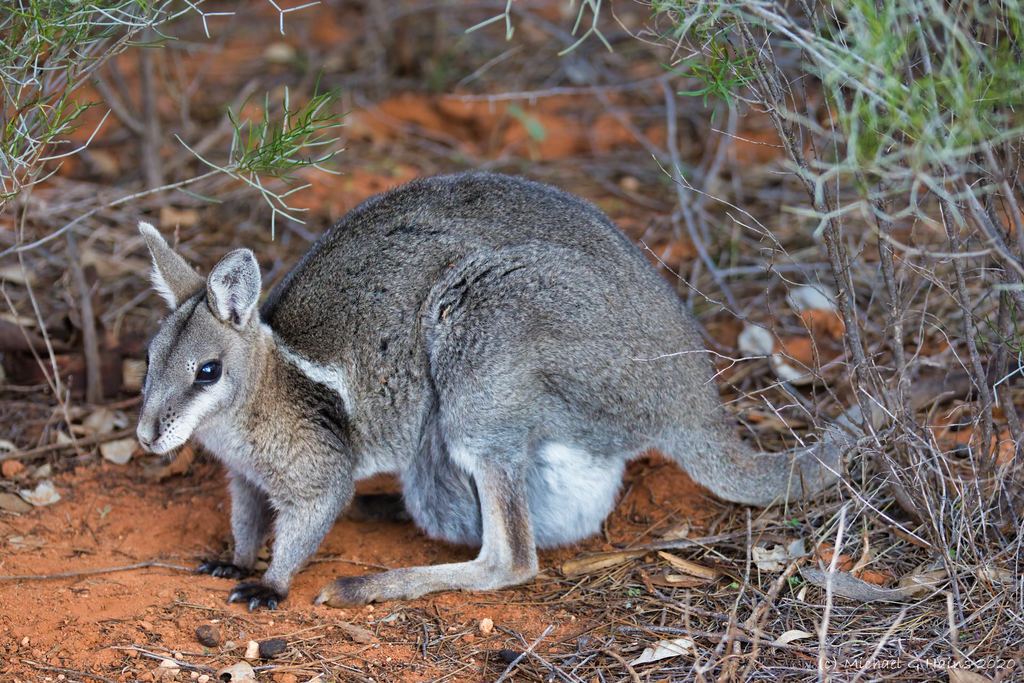
Bridled Nail-tail Wallaby
Onychogalea fraenata
The bridled nail-tail wallaby (Onychogalea fraenata), also known as the bridled nail-tailed wallaby, bridled nailtail wallaby, bridled wallaby, merrin, and flashjack, is a vulnerable species of macropod. It is a small wallaby found in three isolated areas in Queensland, Australia, and whose population is declining. In early 2019 the total population of the species was estimated to be fewer than 500 mature individuals in the wild and 2285 in captivity.
From the article Bridled nail-tail wallaby on Wikipedia (CC BY-SA), quoted section by section
Description
These small wallabies are named for two distinguishing characteristics: a white "bridle" line that runs down from the back of the neck around the shoulders, and a horny spur on the end of the tail. Other key physical features include a black stripe running down the dorsum of the neck between the scapulae, large eyes, and white stripes on the cheeks, which are often seen in other species of wallabies as well. The bridled nail-tail wallaby can grow to one metre in length, half of which is tail, and weighs 4–8 kg. Females are somewhat smaller than the males. The tail spur can be 3–6 mm long and partly covered in hair. Its purpose is unclear. The "nail-tail" is a feature common to two other species of wallabies: the northern nail-tail wallaby and the crescent nail-tail wallaby (which was declared to be extinct in 1956). The taste of the meat of this species was described by Gould as excellent.
Range & habitat
At the time of European settlement of Australia, bridled nail-tail wallabies were common all along the East Australian coastline region to the west of the Great Dividing Range. Naturalists in the 19th century reported that the species ranged from the Murray River region of Victoria through central New South Wales to Charters Towers in Queensland. The species declined in the late 19th and early 20th centuries with no confirmed sightings between 1937 and 1973, by which time it was believed to be extinct. After reading an article in a magazine about Australia's extinct species, a fencing contractor reported that there was an extant population on a property near Dingo, Queensland. This sighting was subsequently confirmed by researchers from the Queensland Parks and Wildlife Service, and the property became Taunton National Park in 1973, a scientific nature reserve for the purpose of ensuring the ongoing survival and protection of this endangered species. As of 2001, the range of this wallaby was estimated at less than 5% of its original range. The extant population was estimated to be fewer than 500 mature individuals in the wild in 2019.
Wikipedia: “Distribution and habitat”
What it does
The species are most active during the night-time and dusk periods. Day is usually spent sleeping in hollows near bushes or trees. In modern habitats, nail-tails keep close to the edges of pasture grasses. These wallabies have a reputation as shy and solitary animals. They may occasionally form small groups of up to four to feed together when grazing is in short supply. Gould was able to view the animal in its native habitat and recorded observations of its behaviour at the area around Brezi and then to observe their capture by the indigenous people at "Gundermein" on around the lower Namoi River. His notes the rapid movement of a live animal when pursued, outpacing the dogs accompanying his party, which ascended up a hollow tree and leapt from the top to enter a hollow log. At a second site Gould witnessed the capture of the species with nets by the local people, fulfilling his request for a series of specimens. The bridled nail-tail wallaby has a polygynous mating system. After a gestation period of about 23 days, the single joey undergoes further development in the mother's pouch for around four more months. The bridled nail-tail wallaby's defence behaviour when threatened by native predators is usually to lie flat on the ground and find some cover. …
Wikipedia: “Ecology and behaviour”
Listen
Looking for field recordings…
Where it lives
Recorded sightings
—
geo-referenced records in GBIF, from museums, herbaria and field observers.
Drag the globe to turn it. Dots are where records exist, not a range map; darker means more records.
In the stacks
Searching the stacks…
Every page naming Onychogalea fraenata in the Biodiversity Heritage Library →
This page is assembled live from iNaturalist, GBIF, Wikipedia, the Source Library and the Internet Archive. It is not yet part of the hand-edited codex. iNaturalist taxon 1473775.