- Plants
- ›Vascular Plants
- ›flowering plants
- ›Dicots
- ›borages
- ›borage family
- ›Boraginoideae
- ›Lithospermeae
- ›Echium
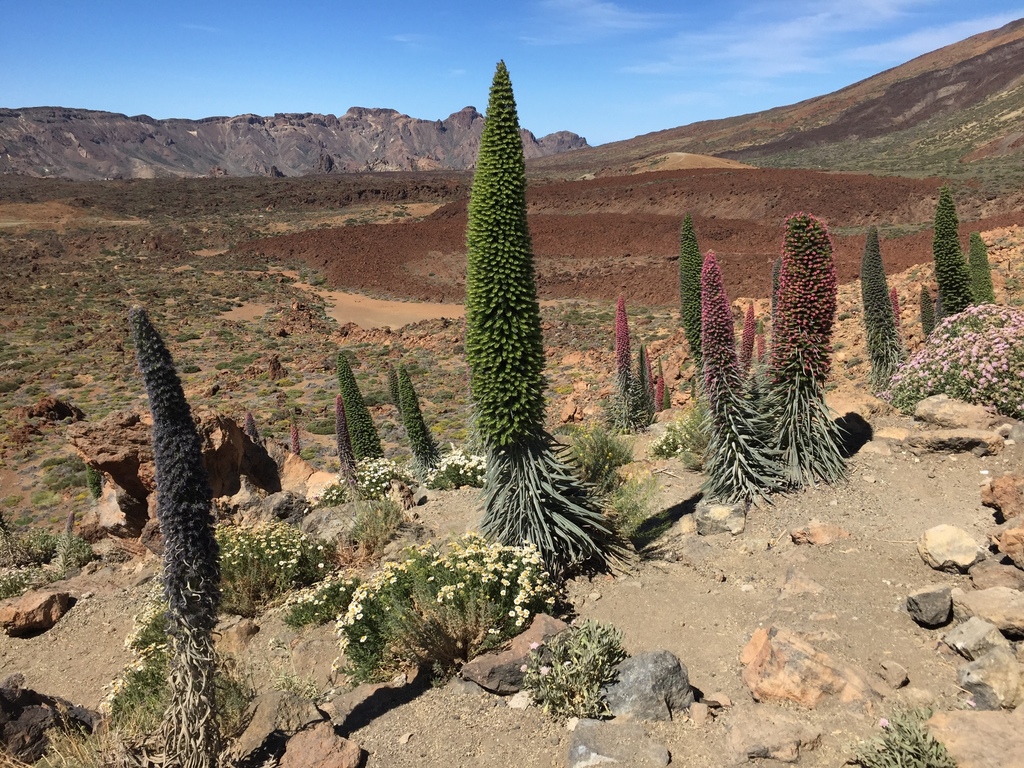
Red Mount Teide Bugloss
Echium wildpretii
Echium wildpretii is a species of flowering plant in the family Boraginaceae. It is an herbaceous biennial plant that grows up to 3 m (10 ft) in height. The species is endemic to the Canary Islands, and is found mainly in the national park surrounding Mount Teide in Tenerife. A similar species, Echium perezii, occurs at high altitudes on the island of La Palma. Other common names are tower of jewels, red bugloss, Tenerife bugloss, Mount Teide bugloss or red tajinaste.
From the article Echium wildpretii on Wikipedia (CC BY-SA), quoted section by section
Description
It is a biennial, producing a dense rosette of leaves during the first year, flowers in the second year, and then dies. The red flowers are borne on an erect inflorescence, 1–3 m (3 ft 3 in – 9 ft 10 in). The plant blooms from late spring to early summer in Tenerife.
Range & habitat
The plant grows in the subalpine zone of the ravines of Mount Teide, a volcano on Tenerife in the Canary Islands, Spain. It requires a lot of sun and is found in arid and dry conditions, but it tolerates frost down to −5 °C (23 °F). As a sub-alpine endemic plant with a narrow climatic niche and small distribution, the species is likely to be negatively impacted by climate change.
Wikipedia: “Habitat”
At the table
This plant can be found as a garden ornamental but is intolerant of low temperatures, thus some winter protection is required in frost-prone areas. It has gained the Royal Horticultural Society's Award of Garden Merit. As with most buglosses, it is valued by bee-keepers for its high nectar content.
Wikipedia: “Uses”
In human culture
The Latin specific epithet wildpretii honours the 19th-century Swiss botanist Hermann Josef Wildpret.
Wikipedia: “Etymology”
Where it lives
Recorded sightings
—
geo-referenced records in GBIF, from museums, herbaria and field observers.
Drag the globe to turn it. Dots are where records exist, not a range map; darker means more records.
In the stacks
Searching the stacks…
Every page naming Echium wildpretii in the Biodiversity Heritage Library →
This page is assembled live from iNaturalist, GBIF, Wikipedia, the Source Library and the Internet Archive. It is not yet part of the hand-edited codex. iNaturalist taxon 147196.