- Plants
- ›Vascular Plants
- ›flowering plants
- ›Dicots
- ›Woodsorrels, Quandongs, and Allies
- ›Woodsorrel Family
- ›Oxalis
- ›Oxalis
- ›Oxalis
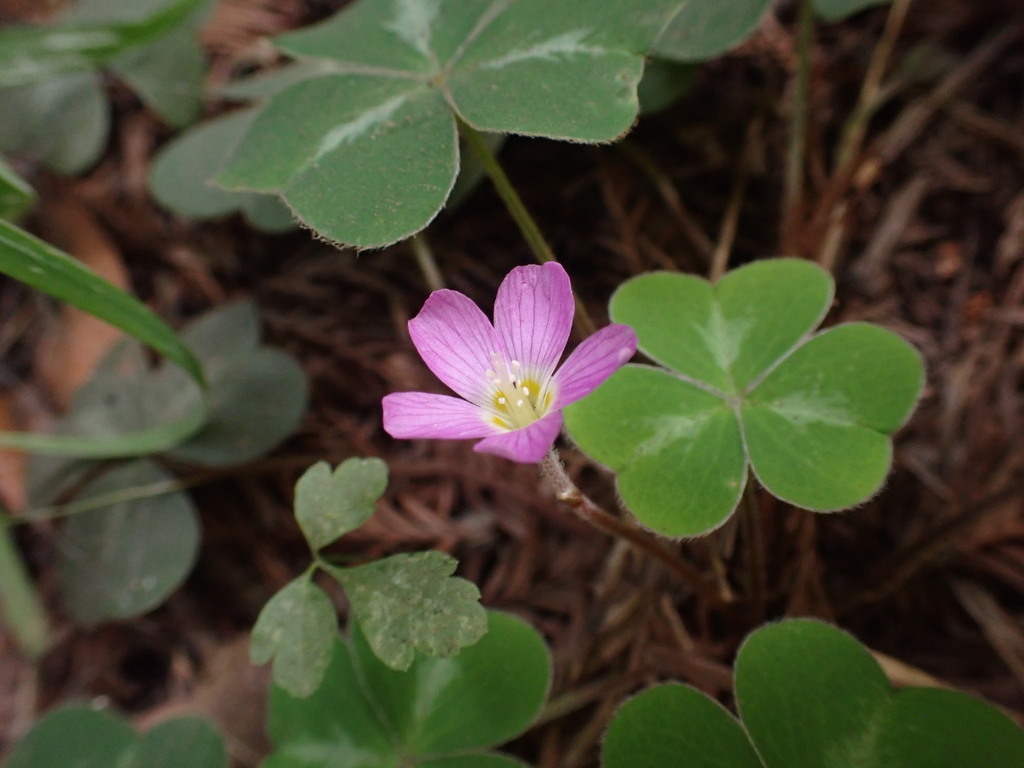
Redwood Sorrel
Oxalis smalliana
Oxalis smalliana, commonly known as redwood sorrel or California wood sorrel, is a species of the wood sorrel family, Oxalidaceae, in the genus Oxalis native to moist coast redwood forests of western North America from Monterey County, California to Curry County, Oregon.
The name O. smalliana was proposed over a century ago to describe a primarily Californian wood sorrel species distinguishable from the O. oregana type by flower size and color, but recognition of the taxon faded over time. A 2022 study by Brinegar provided substantial genetic, morphological, and phenological support for its reinstatement as a separate species from Oxalis oregana.
From the article Oxalis smalliana on Wikipedia (CC BY-SA), quoted section by section
Description
Oxalis smalliana is a short, herbaceous perennial with erect flowering stems. The three leaflets are heart-shaped with purplish undersides. Like O. oregana, the leaves fold downwards when direct sunlight strikes them and reopen when shade returns, a movement observable to the eye. The flowers of O. smalliana are generally larger than those of O. oregana, with the petals measuring at least 15 mm in length. The flowers range in color from white to pink, purple, or blue, in contrast to O. oregana which has only white flowers. The plant spreads by scaly rhizomes and can form extensive patches in favorable conditions. The seed capsules are egg-shaped and hairy.
Range & habitat
Oxalis smalliana has a southern distribution ranging from Monterey County, California to Curry County, Oregon. It grows primarily in the understory of coast redwood forests and other moist, shaded environments. In northwestern California and southwestern Oregon in the Klamath Range, its range overlaps with O. oregana, with both species sometimes found growing together in sympatric populations.
Wikipedia: “Distribution and habitat”
What it does
In areas where O. smalliana and O. oregana coexist, they show different flowering phenology, with white-flowered O. oregana reaching peak flowering approximately one month later than purple-flowered O. smalliana. This temporal separation in flowering may contribute to reproductive isolation between the two species.
Wikipedia: “Ecology”
At the table
Like O. oregana, the leaves of O. smalliana are edible but contain oxalic acid, which is mildly toxic in large quantities. They are safe to eat in small amounts for those with no oxalate-related conditions. Oxalis smalliana can be used as a groundcover in cultivated landscapes under shady and cool conditions.
Wikipedia: “Uses”
Where it lives
Recorded sightings
—
geo-referenced records in GBIF, from museums, herbaria and field observers.
Drag the globe to turn it. Dots are where records exist, not a range map; darker means more records.
In the stacks
Searching the stacks…
Every page naming Oxalis smalliana in the Biodiversity Heritage Library →
This page is assembled live from iNaturalist, GBIF, Wikipedia, the Source Library and the Internet Archive. It is not yet part of the hand-edited codex. iNaturalist taxon 1464017.