- Plants
- ›Vascular Plants
- ›flowering plants
- ›monocots
- ›Agaves, Orchids, Irises, and Allies
- ›Aloe family
- ›Grasstrees
- ›Xanthorrhoea
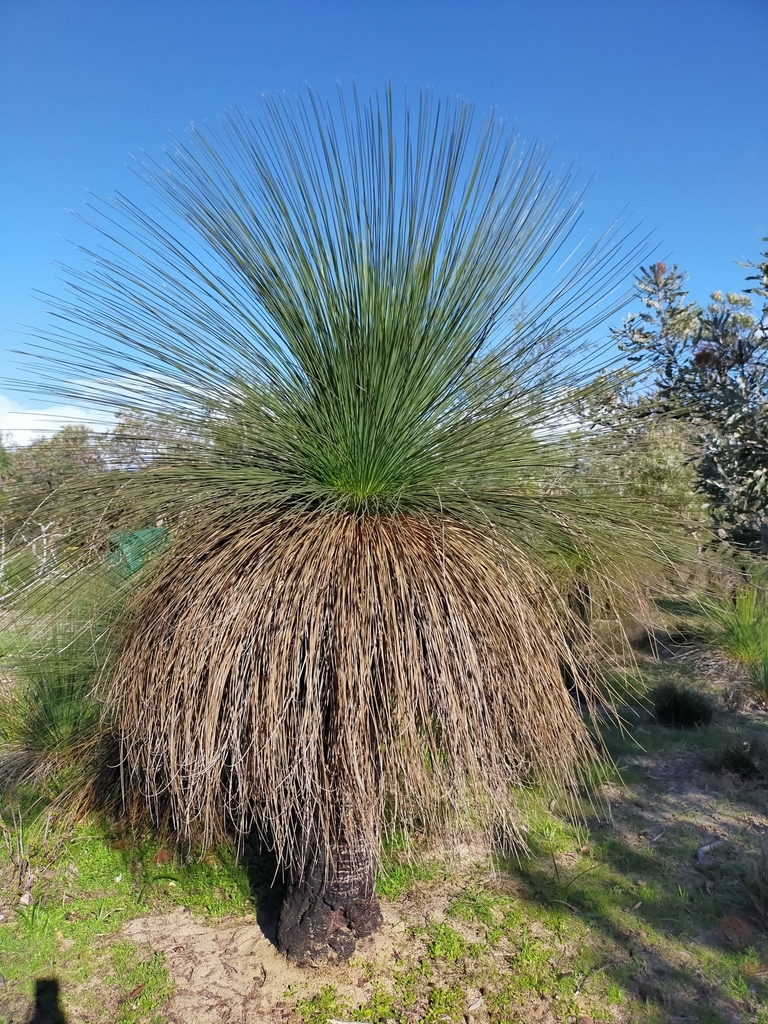
Balga
Xanthorrhoea preissii
Xanthorrhoea preissii (synonyms X. pecoris, X. reflexa), with the common name balga, is a widespread species of perennial monocot in Southwest Australia. This plant, and other members of the genus Xanthorrhoea, are also known as blackboys or grasstrees. The form of the plant resembles a tree, with very long and bunched, grass-like, leaves that emerge from a central base.
From the article Xanthorrhoea preissii on Wikipedia (CC BY-SA), quoted section by section
Description
The form of the plant resembles a tree, with very long and bunched, grass-like, leaves that emerge from a central base. The trunk may grow over 3 metres (9.8 ft) tall, and the often blackened appearance is evidence of its ability to withstand fire. The remains of the flammable leaves and the annual regrowth produce banding, allowing the age of the plant to be determined, and giving a record of previous fires in its habitat. The inflorescence appears on an upright spike, 1.5 to 2.5 metres (4 ft 11 in to 8 ft 2 in) long, between June and December. The sessile flowers, creamy or white, appear more profusely when stimulated by bushfire.
Range & habitat
It is found throughout coastal plains, near watercourses, and inland forest regions, in a range extending from Geraldton to Albany and in the Avon Wheatbelt. It occurs on a wide variety of soil types and is sometimes associated with laterite and granite.
Wikipedia: “Distribution”
What it does
The species is named as one of the dominant taxa in Corymbia calophylla – Xanthorrhoea preissii woodlands and shrublands of the Swan Coastal Plain, a critically endangered ecological community, once widespread and now restricted to a narrow range. Its occurrence is a characteristic of two other marri (Corymbia calophylla) communities, but the marri/Xanthorrhoea community is distinguished by the drier soils of the communities range along the eastern edge of the Swan Coastal Plain.
Wikipedia: “Ecology”
At the table
The species had a high economic importance to the Noongar people, who named it balga, utilising the gum it contains, the spike for fish spears, and the bardi grub as a source of food. Anecdotal information on the species refers to an association with fire in the culture of those people.
Wikipedia: “Uses”
Where it lives
Recorded sightings
—
geo-referenced records in GBIF, from museums, herbaria and field observers.
Drag the globe to turn it. Dots are where records exist, not a range map; darker means more records.
In the stacks
Searching the stacks…
Every page naming Xanthorrhoea preissii in the Biodiversity Heritage Library →
This page is assembled live from iNaturalist, GBIF, Wikipedia, the Source Library and the Internet Archive. It is not yet part of the hand-edited codex. iNaturalist taxon 145461.