- Plants
- ›Vascular Plants
- ›flowering plants
- ›Dicots
- ›Sunflowers, Bellflowers, Fanflowers, and Allies
- ›fanflower family
- ›Dampiera
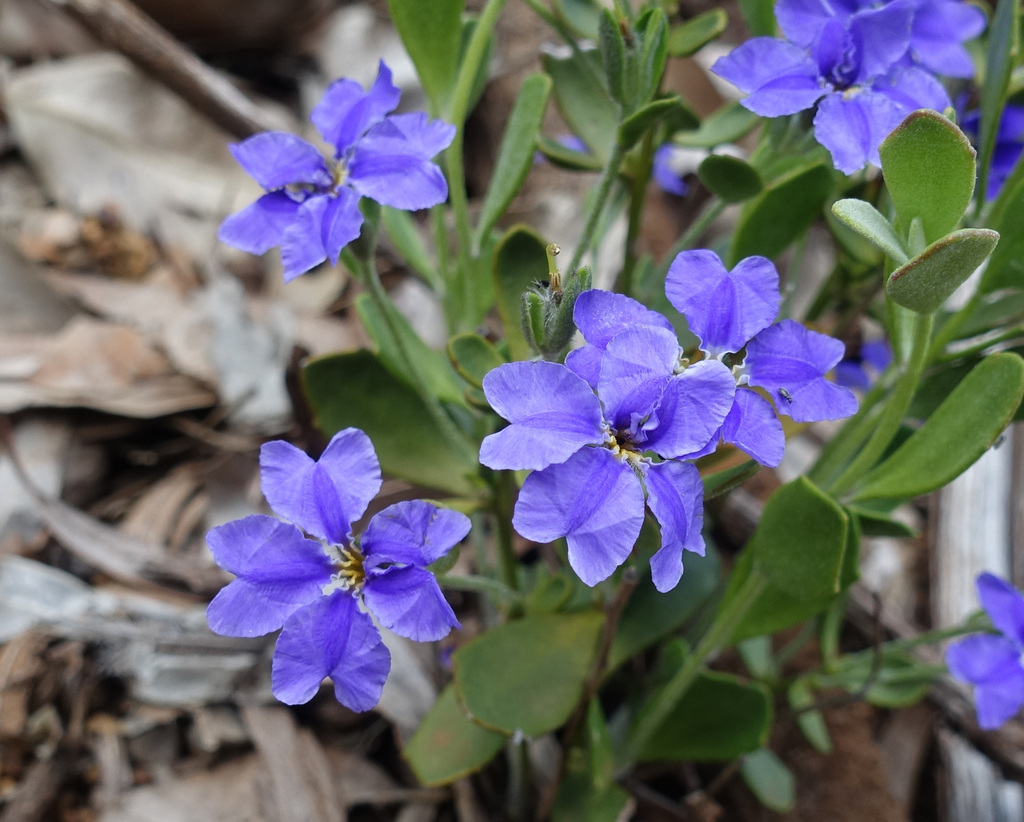
Common Dampiera
Dampiera linearis
Dampiera linearis, commonly known as common dampiera or wedge-leaved dampiera, is an erect perennial herb in the family Goodeniaceae. The species, which is endemic to the south-west of Western Australia, grows to between 15 and 60 cm (6 in–2 ft) high, with its blue to purple flowers appearing between July and December. It adapts readily to cultivation, particularly containers such as hanging baskets.
From the article Dampiera linearis on Wikipedia (CC BY-SA), quoted section by section
Description
An erect shrub, Dampiera linearis grows to between 15 and 60 cm (6 in–2 ft) in height, with a suckering habit. New growth is hairy and becomes smooth with maturity. The leaves are obovate to elliptical and can be entire or lobed, measuring 1–4 cm long by 1–10 mm wide. It produces flowers between July and December in its native range. These are 1.5–2 cm wide, and light blue to purple with a yellow or white centre. The outer- or undersurface of the flowers is covered with fine hair. The flowers arise in groups of 1 to 3 from a peduncle that is also covered in hair.
Range & habitat
Dampiera linearis is found across the southwest corner of Western Australia from Geraldton in the north to Esperance in the south east. It grows on sand- or clay-based soils over laterite, on ridges, or flat areas.
Wikipedia: “Distribution and habitat”
What it does
Plants of Dampiera linearis can survive bushfire and resprout and put on new growth quickly. Fieldwork on the Swan Coastal Plain indicated it was probably resistant to Phytophthora cinnamomi.
Wikipedia: “Ecology”
How it is grown
Some forms of Dampiera linearis are cultivated and sold for their colourful flowers, while others have attractive grey foliage. In cultivation, the species prefers a well-drained situation in full sun or light shade. It tolerates some dryness and moderate frost. It does not tolerate waterlogged soils. It makes an attractive plant for hanging baskets. Dampiera linearis is readily propagated by cuttings; trials at Kings Park indicate that semi-hardened material is best and the average time to strike is 48 days.
== References ==
Wikipedia: “Cultivation”
Where it lives
Recorded sightings
—
geo-referenced records in GBIF, from museums, herbaria and field observers.
Drag the globe to turn it. Dots are where records exist, not a range map; darker means more records.
In the stacks
Searching the stacks…
Every page naming Dampiera linearis in the Biodiversity Heritage Library →
This page is assembled live from iNaturalist, GBIF, Wikipedia, the Source Library and the Internet Archive. It is not yet part of the hand-edited codex. iNaturalist taxon 145407.