- Animals
- ›Chordates
- ›Vertebrates
- ›Mammals
- ›Therians
- ›Placental Mammals
- ›Ungulates, Carnivorans, and Allies
- ›Even-toed Ungulates and Cetaceans
- ›Cetaceans and Hippopotamuses
- ›Cetaceans
- ›Toothed Whales
- ›Oceanic Dolphins and Porpoises
- ›Porpoises
- ›Neophocaena
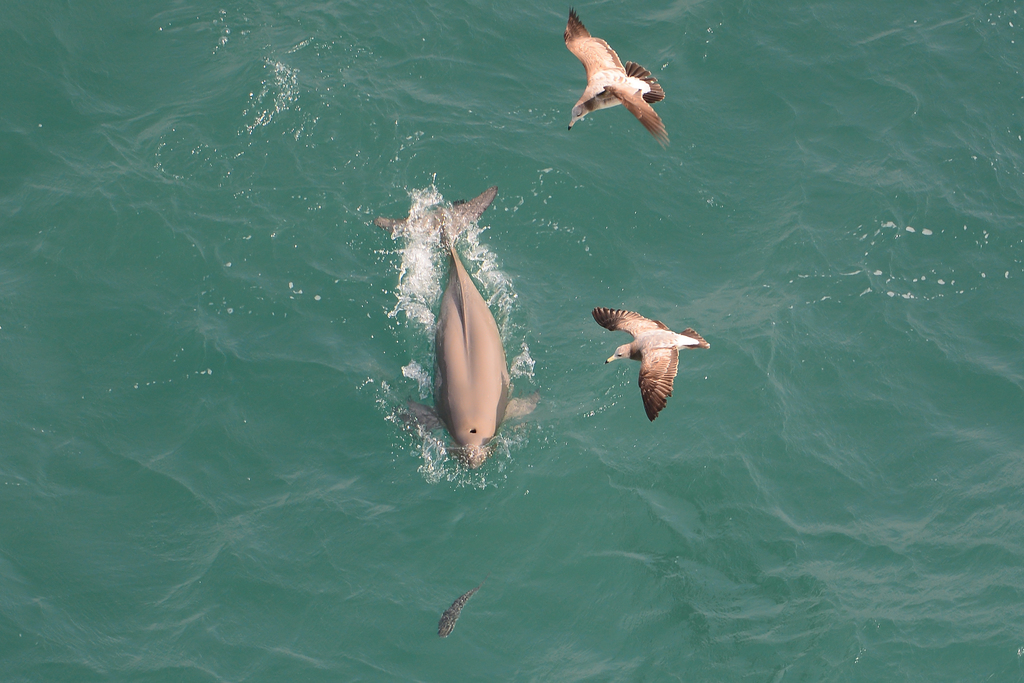
East Asian finless porpoise
Neophocaena sunameri
The East Asian finless porpoise (Neophocaena sunameri) is a species of porpoise native to the East China Sea, Yellow Sea, and the seas around Japan. The Yangtze finless porpoise (N. asiaeorientalis) was formerly considered a subspecies but is now thought to be a distinct species.
From the article East Asian finless porpoise on Wikipedia (CC BY-SA), quoted section by section
Description
Finless porpoises can grow to as much as 2.27 m (7 ft 5 in) in length, and can weigh up to 72 kg (159 lb), although most are smaller. Adults grow more than 1.55 m (5 ft) in length and up to 30–45 kg (65–100 lb) in weight. The flippers are moderately large, reaching up to 20% of the total body length. Adults are typically a uniform, light grey color, although some may have lighter patches of skin around the mouth, or darker patches in front of the flippers. Newborn calves of the central and eastern subspecies are mostly black with grey around the dorsal ridge area, becoming fully grey after four to six months. However, newborn calves of the western subspecies are a light creamy grey and become darker as they age.
Anatomy. The anatomy of finless porpoises has been relatively well studied, compared with that of some other cetacean species. The tubercles along the dorsal ridge are known to contain numerous nerve endings that have a sensory function. The auditory system also appears well-developed, with numerous nerve fibers specialized for rapid communication between the ears and the brain. Sight is relatively poor, however, due to the overall cloudiness of the Yangtze River; they have a reduced lens and a limited number of fibers in the optic nerve and to the muscles moving the eyes compared to the Indo-Pacific finless porpoise. …
Range & habitat
The species inhabits the coastal areas off mainland China (e.g., Chongming Island) south to the Penghu Islands. The Matsu Islands are thought to be their northern limit, and the local population in this area is physically smaller than the Indo-Pacific finless porpoise. These two species overlap in the Matsu region. The population in coastal waters around Japan is geographically isolated by the deep waters between Japan and continental Asia. Vagrant animals can reach the Ryukyu Islands.
Wikipedia: “Distribution”
What it does
In Chinese coastal waters, finless porpoises are generally found in groups of three to six, although aggregations of up to about 50 have been reported. In Japanese waters, groups appear to be smaller, with pairs being typical, and even rare aggregations being no larger than 13 individuals.
Wikipedia: “Behavior”
Listen
Looking for field recordings…
Where it lives
Recorded sightings
—
geo-referenced records in GBIF, from museums, herbaria and field observers.
Drag the globe to turn it. Dots are where records exist, not a range map; darker means more records.
In the stacks
Searching the stacks…
Every page naming Neophocaena sunameri in the Biodiversity Heritage Library →
This page is assembled live from iNaturalist, GBIF, Wikipedia, the Source Library and the Internet Archive. It is not yet part of the hand-edited codex. iNaturalist taxon 1453470.