- Animals
- ›Chordates
- ›Vertebrates
- ›Mammals
- ›Therians
- ›Marsupials
- ›Kangaroos, Possums, Wombats, and Allies
- ›Macropods
- ›Kangaroos, Wallabies and Allies
- ›Kangaroos, Wallabies, Pademelons, and Dorcopsises
- ›Kangaroos and Wallabies
- ›Notamacropus
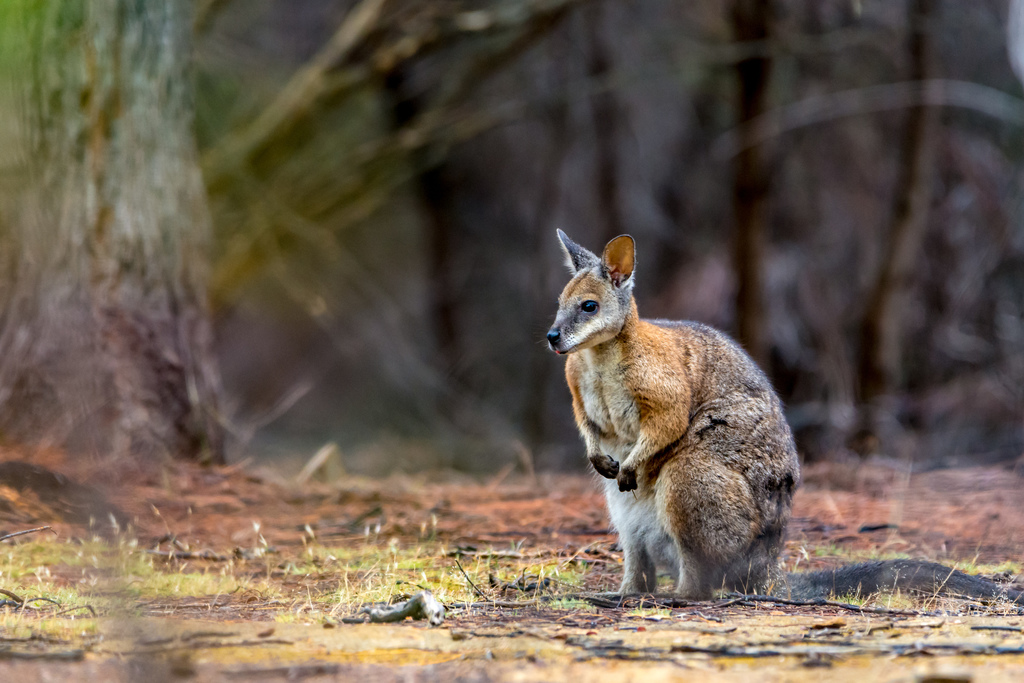
Tammar Wallaby
Notamacropus eugenii
The tammar wallaby (Notamacropus eugenii), also known as the dama wallaby or darma wallaby, is a small macropod native to South and Western Australia. Though its geographical range has been severely reduced since European colonisation, the tammar wallaby remains common within its reduced range and is listed as "Least Concern" by the International Union for Conservation of Nature (IUCN). It has been introduced to New Zealand and reintroduced to some areas of Australia where it had been previously extirpated. Skull variations differentiate between tammar wallabies from Western Australia, Kangaroo Island, and mainland South Australia, making them distinct population groups.
The tammar wallaby is among the smallest of the wallabies in the genus Notamacropus. Its coat colour is largely grey. The tammar wallaby has several notable adaptations, including the ability to retain energy while hopping, colour vision, and the ability to drink seawater. A nocturnal species, it spends the nighttime in grassland habitat and the daytime in shrubland. It is also very gregarious and has a seasonal, promiscuous mating pattern. A female tammar wallaby can nurse a joey in her pouch while keeping an embryo in her uterus. The tammar wallaby is a model species for research on marsupials, and on mammals in general. Its genome was sequenced in 2011.
From the article Tammar wallaby on Wikipedia (CC BY-SA), quoted section by section
Description
One of the smallest wallaby species, the tammar wallaby features a proportionally small head with large ears, and an elongated tail, with a thick base. It has dark greyish upperparts with a paler underside and rufous-coloured sides and limbs. The tammar wallaby exhibits great sexual dimorphism, males reaching 9.1 kg (20 lb) in weight compared to 6.9 kg (15 lb) for females. Males are 59 to 68 cm (23–27 in) long while females are 52 to 63 cm (20–25 in), while both sexes stand 45 cm (18 in) tall. The tail has a length of 34 to 45 cm (13–18 in) for males and 33 to 44 cm (13–17 in) for females.
Locomotion. As with most macropods, the tammar wallaby moves around by hopping. This species typically leaps 0.8 to 2.4 m (2.6–7.9 ft) with 3.5 landings per second. Proximal muscles at the knee and hip joints provide the power for each leap, which shifts to the ankle muscles as the animal pushes off. As it lands, the energy of the jump is converted into strain energy made when its leg tendons are stretched. As it leaps back off the ground, the tammar wallaby can recover much of this energy for reuse through elastic recoil. When on the move, animal's respiration is tied to its hopping cycle, inhaling when leaping and exhaling when landing. …
Wikipedia: “Characteristics and adaptations”
What it does
During the day, tammar wallabies stay close to scrub for shade and move out to more open grassland by nightfall.In winter their home ranges are about 16 ha (40 acres), but in the dry summers they range further afield to search for quality food, needing about 42 ha (100 acres) of space. Tammar wallaby home ranges overlap with those of conspecifics. Like all macropods, the tammar wallaby is herbivorous. They are known to both graze and browse, but the latter is less effective, as they commonly drop leaves when chewing on them. When eating large leaves, tammar wallabies handle them with their fingers. Tammar wallabies consume several plant species such as heart-leaved poison (Gastrolobium bilobum), small-flowered wallaby grass (Austrodanthonia setacea), and marri (Corymbia calophylla). They survive on several islands that have no fresh water, subsisting on seawater.
Tammar wallabies gather into groups which lessens the chance of an individual being taken by a predator. As the group increases in size, tammar wallabies spend more time feeding, grooming, and interacting and less time being vigilant and moving around. They are also more likely to rest on their sides rather than in a more alert posture where their head is held up. Predators of the tammar wallaby include dingoes, feral cats, red foxes and wedge-tailed eagles. They may also have been preyed upon by the extinct thylacine. …
Wikipedia: “Ecology and life history”
Listen
Looking for field recordings…
Where it lives
Recorded sightings
—
geo-referenced records in GBIF, from museums, herbaria and field observers.
Drag the globe to turn it. Dots are where records exist, not a range map; darker means more records.
In the stacks
Searching the stacks…
Every page naming Notamacropus eugenii in the Biodiversity Heritage Library →
This page is assembled live from iNaturalist, GBIF, Wikipedia, the Source Library and the Internet Archive. It is not yet part of the hand-edited codex. iNaturalist taxon 1453434.