- Plants
- ›Vascular Plants
- ›flowering plants
- ›Dicots
- ›Guinea-flowers and allies
- ›Guinea-flower family
- ›Hibbertia
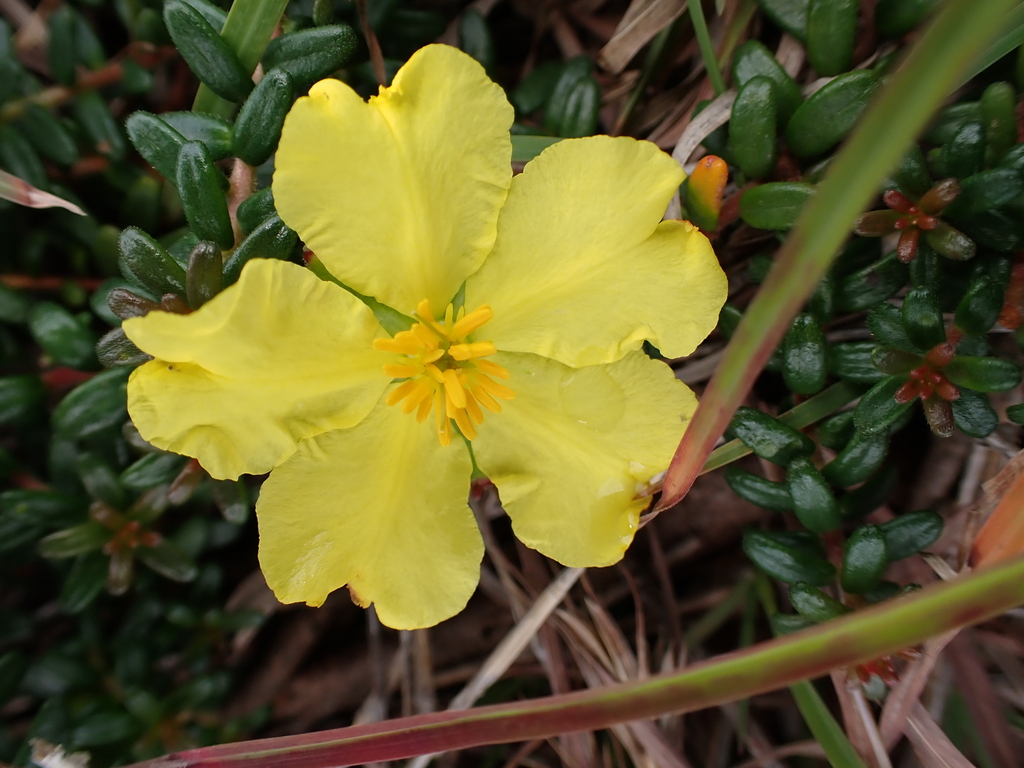
Hairy Guinea-flower
Hibbertia vestita
Hibbertia vestita, commonly known as hairy guinea-flower, is a species of flowering plant in the family Dilleniaceae and is endemic to eastern Australia. It is a small shrub with foliage covered with simple hairs, usually linear leaves, and yellow flowers with 22 to 43 stamens with many staminodes arranged around three hairy carpels.
From the article Hibbertia vestita on Wikipedia (CC BY-SA), quoted section by section
Description
Hibbertia vestita is a prostrate shrub that typically grows to a height of up to 30 cm (12 in) and has foliage covered with simple hairs, the leaves sometimes becoming glabrous as they age. The leaves are linear to more or less oblong or lance-shaped, 3.5–8 mm (0.14–0.31 in) long and 0.6–2.0 mm (0.024–0.079 in) wide on a petiole 0.2–0.6 mm (0.0079–0.0236 in) long. The flowers are arranged on the ends of branchlets and are sessile or on a peduncle up to 4 mm (0.16 in) long, with lance-shaped, leaf-like bracts 2.5–4.0 mm (0.098–0.157 in) long at the base. The five sepals are joined at the base, the three outer sepal lobes 6–8 mm (0.24–0.31 in) long and 3.0–4.5 mm (0.12–0.18 in) wide, and the inner lobes slightly shorter. The five petals are broadly egg-shaped with the narrower end towards the base, yellow, up to 12.5 mm (0.49 in) long with two lobes on the end. There are 22 to 43 stamens and many staminodes arranged around three hairy carpels, each carpel with four to six ovules. Flowering occurs in most months.
Range & habitat
Hairy guinea-flower grows in heath in near-coastal area and in forest in areas further inland in south-east Queensland and north-eastern New South Wales. Variety thymifolia is restricted to exposed headlands in the same area.
== References ==
Wikipedia: “Distribution and habitat”
Where it lives
Recorded sightings
—
geo-referenced records in GBIF, from museums, herbaria and field observers.
Drag the globe to turn it. Dots are where records exist, not a range map; darker means more records.
In the stacks
Searching the stacks…
Every page naming Hibbertia vestita in the Biodiversity Heritage Library →
This page is assembled live from iNaturalist, GBIF, Wikipedia, the Source Library and the Internet Archive. It is not yet part of the hand-edited codex. iNaturalist taxon 144140.