- Plants
- ›Vascular Plants
- ›flowering plants
- ›Dicots
- ›proteas, lotuses, planes, and allies
- ›Protea family
- ›Paired Proteas
- ›Banksieae
- ›Banksiinae
- ›Banksia
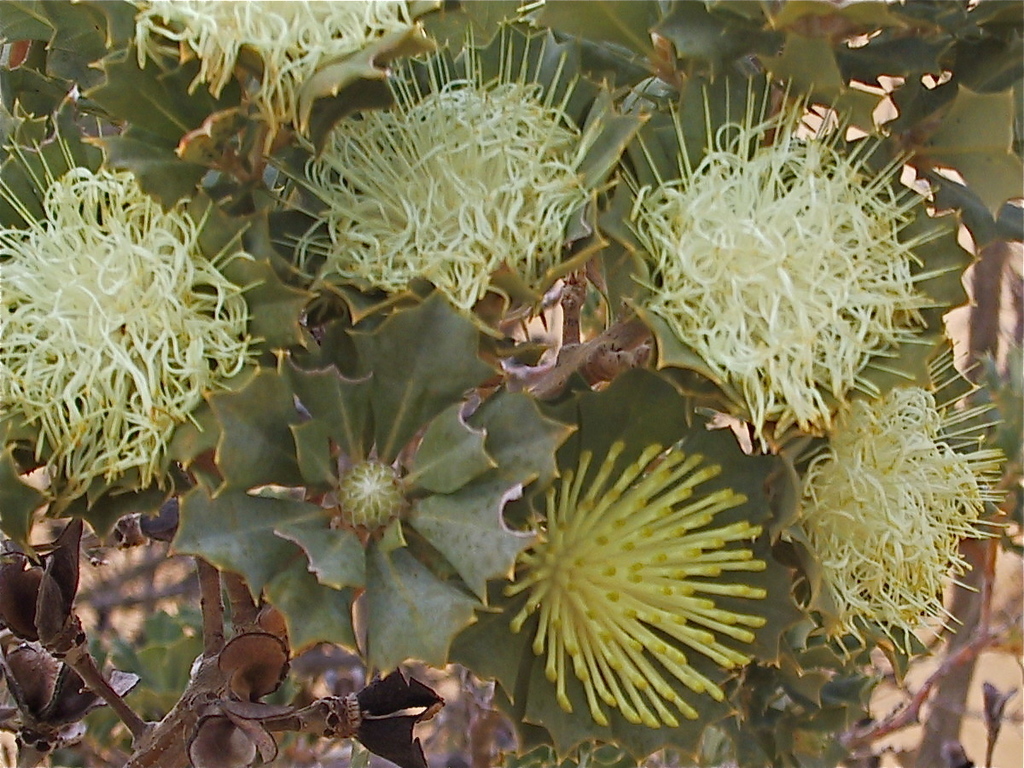
Parrot Bush
Banksia sessilis
Banksia sessilis, commonly known as parrot bush, is a species of shrub or tree in the plant genus Banksia of the family Proteaceae. It had been known as Dryandra sessilis until 2007, when the genus Dryandra was sunk into Banksia. The Noongar peoples know the plant as budjan or butyak. Widespread throughout southwest Western Australia, it is found on sandy soils over laterite or limestone, often as an understorey plant in open forest, woodland or shrubland. Encountered as a shrub or small tree up to 6 m (20 ft) in height, it has prickly dark green leaves and dome-shaped cream-yellow flowerheads. Flowering from winter through to late spring, it provides a key source of food—both the nectar and the insects it attracts—for honeyeaters in the cooler months, and species diversity is reduced in areas where there is little or no parrot bush occurring. Several species of honeyeater, some species of native bee, and the European honey bee seek out and consume the nectar, while the long-billed black cockatoo and Australian ringneck eat the seed. The life cycle of Banksia sessilis is adapted to regular bushfires. Killed by fire and regenerating by seed afterwards, each shrub generally produces many flowerheads and a massive amount of seed. It can recolonise disturbed areas, and may grow in thickets.
Banksia sessilis has a somewhat complicated taxonomic history. It was collected from King George Sound in 1801 and described by Robert Brown in 1810 as Dryandra floribunda, a name by which it was known for many years.
From the article Banksia sessilis on Wikipedia (CC BY-SA), quoted section by section
Description
Banksia sessilis grows as an upright shrub or small tree up to 6 m (20 ft) high, without a lignotuber. In most varieties, new stems are covered in soft, fine hairs that are lost with maturity; but new stems of B. sessilis var. flabellifolia are usually hairless. Leaves are blue-green or dark green. Their shape differs by variety: in var. cygnorum and var. flabellifolia they are wedge-shaped, with teeth only near the apex; in var. cordata they are wedge-shaped, but with teeth along the entire margin; and in var. sessilis they are somewhat broader at the base, sometimes almost oblong in shape. Leaf size ranges from 2 to 6 cm (1 to 2.5 in) in length, and 0.8–4 cm (0.3–1.6 in) in width. They may be sessile (that is, growing directly from the stem without a petiole) or on a petiole up to 0.5 cm (0.20 in) long. The inflorescences are cream or yellow, and occur in domed heads 4 to 5 cm (1.6 to 2.0 in) wide, situated at the end of a stem. Each head contains from 55 to 125 individual flowers, surrounded at the base by a whorl of short involucral bracts. As with most other Proteaceae, individual flowers consist of a tubular perianth made up of four united tepals, and one long wiry style. The style end is initially trapped inside the upper perianth parts, but breaks free at anthesis. In B. sessilis the perianth is straight, 20 to 32 mm (0.8 to 1.3 in) long, and pale yellow. …
Range & habitat
Banksia sessilis is endemic to the Southwest Botanical Province, a floristic province renowned as a biodiversity hotspot, located in the southwest corner of Western Australia. This area has a Mediterranean climate, with wet winters and hot, dry summers. B. sessilis occurs throughout much of the province, ranging from Kalbarri in the north, south to Cape Leeuwin, east along the south coast as far as Bremer Bay, and inland to Wongan Hills and Kulin. It thus spans a wide range of climates, occurring in all but the semi-arid areas well inland. It is also absent from the Karri forest in the cool, wet, southwest corner of the province, but even there, B. sessilis var. cordata occurs along the coast. The species tolerates a range of soils, requiring only that its soil be well-drained. Like most dryandras, it grows well in lateritic soils and gravels; this species is also found in deep sand, sand over laterite, and sand over limestone. It also occurs in a range of vegetation complexes, including coastal and kwongan heath, tall shrubland, woodland and open forest. It is a common understorey plant in drier areas of Jarrah forest, and forms thickets on limestone soils of the Swan Coastal Plain. …
Wikipedia: “Distribution and habitat”
What it does
Honeyeaters are clearly the most important pollination vector, as inflorescences from which honeyeaters are excluded generally do not set any fruit. Moreover, honeyeaters have been observed moving from tree to tree with significant loads of B. sessilis pollen on their foreheads, beaks and throats, having acquired it by brushing against pollen presenters while foraging for nectar; experiments have shown that some of this pollen may be subsequently deposited on stigmas during later foraging. The flowers of B. sessilis have adaptations that encourage outcrossing. Firstly, they are protandrous: a flower's pollen is released around 72 hours before it becomes itself receptive to pollen, by which time around half of its pollen has lost its viability. Secondly, the period of maximum nectar production closely matches the period during which the flower is sexually active, so honeyeaters are enticed to visit at the most opportune time for pollination. This has proven an effective strategy: almost all pollen is removed within two to three hours of presentation. In addition, honeyeaters tend to move between inflorescences on different plants, rather than between inflorescences on the same plant, at least in high density sites. These factors combine to make it fairly unusual for a flower to be fertilised by its own pollen. …
Wikipedia: “Life cycle”
At the table
The nectar of B. sessilis is an important component of the diet of several species of honeyeater. In one study, B. sessilis was found to be the main source of nectar for all six species studied, namely the tawny-crowned honeyeater (Gliciphila melanops), white-cheeked honeyeater (Phylidonyris niger), western spinebill (Acanthorhynchus superciliosus), brown honeyeater (Lichmera indistincta), brown-headed honeyeater (Melithreptus brevirostris), and black honeyeater (Sugomel nigrum). Moreover, B. sessilis played an important role in their distributions, with species that feed only on nectar occurring only where B. sessilis occurs, and remaining for longest at sites where B. sessilis is most abundant. Other honeyeaters that have been recorded feeding on B. sessilis include the red wattlebird (Anthochaera carunculata), western wattlebird (A. lunulata), and New Holland honeyeater (Phylidonyris novaehollandiae). Furthermore, a study of bird species diversity in wandoo woodland around Bakers Hill found that honeyeater species and numbers were much reduced in forest that lacked a Banksia sessilis understory; the plant is a key source of nectar and insects during the winter months. A field study in jarrah forest 9 km south of Jarrahdale, where B. …
Wikipedia: “As food”
In human culture
It is not known whether the seed collection sent to the Royal Botanic Gardens, Kew, by Menzies in 1793 included seeds of B. sessilis, but if it did they didn't germinate. The species was successfully germinated, however, from Good's seed, which was sent from Sydney on 6 June 1802 and arrived at Kew the following year. According to Brown's notes it was flowering at Kew by May 1806, and in 1810 it was reported in the second edition of Hortus Kewensis as flowering "most part of the Year". In 1813 a flowering specimen from the nursery of Malcolm and Sweet was featured as Plate 1581 in Curtis's Botanical Magazine.
By the 1830s the species was in cultivation in continental Europe. It was recorded as being cultivated in the garden of Karl von Hügel in Vienna, Austria in 1831, and in 1833 it was listed amongst the rare plants that had been introduced into Belgium. Along with several hundred other native Australian plants, it was exhibited at plant shows held at Utrecht and Haarlem in the Netherlands in the 1840s and 1850s. …
Wikipedia: “History”
Where it lives
Recorded sightings
—
geo-referenced records in GBIF, from museums, herbaria and field observers.
Drag the globe to turn it. Dots are where records exist, not a range map; darker means more records.
In the stacks
Searching the stacks…
Every page naming Banksia sessilis in the Biodiversity Heritage Library →
This page is assembled live from iNaturalist, GBIF, Wikipedia, the Source Library and the Internet Archive. It is not yet part of the hand-edited codex. iNaturalist taxon 144086.