- Plants
- ›Vascular Plants
- ›Ferns
- ›Leptosporangiate Ferns
- ›Tree Ferns and Allies
- ›hairy tree ferns
- ›Lophosoria
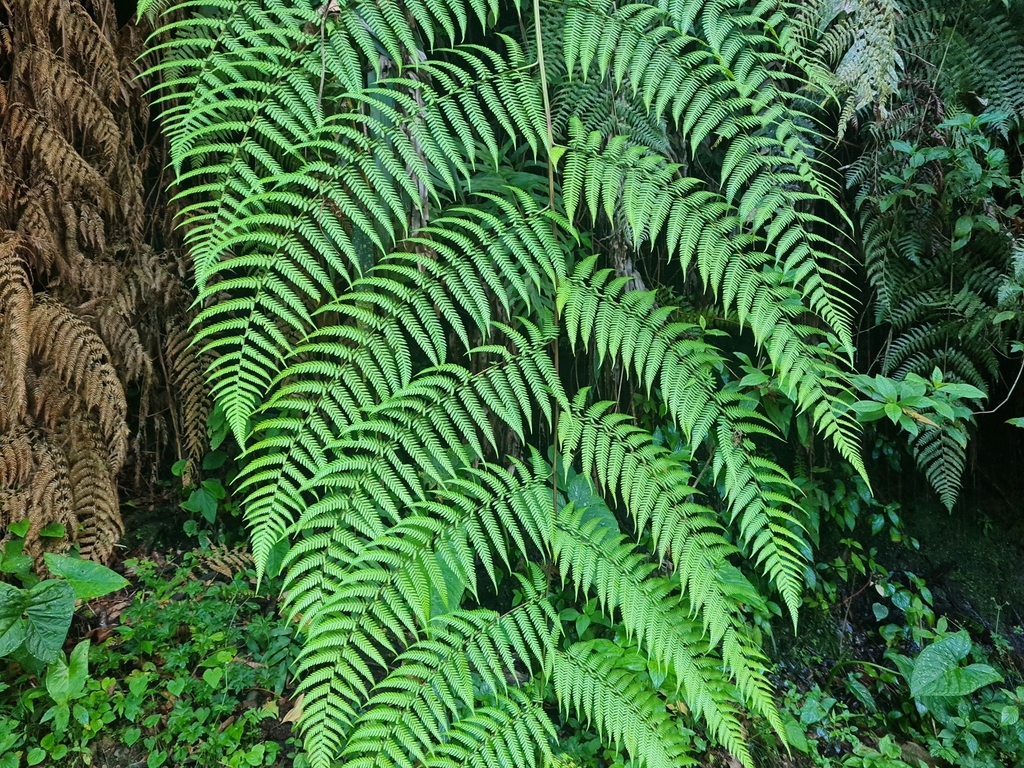
diamondleaf fern
Lophosoria quadripinnata
Lophosoria quadripinnata (J.F.Gmel.) C.Chr. is a species of fern that, according to DNA molecular analysis, belongs to the family Dicksoniaceae, where it is placed in the genus Lophosoria. It is found in the Americas spanning from Cuba and Mexico to Chile. In Chile it is present in the area between Talca and Aysén including Juan Fernández Islands. In Argentina it grows only in the humid valleys of western Neuquén and Río Negro Province. Diamondleaf fern is a common name. In Spanish it is known as 'ampe' (from the Mapudungun añpe) or palmilla, but one has to remember that there are several species of ferns called "palmillas" that have larger or smaller fronds, and which grow in colder climates. It is a medium-sized plant, growing to about 4–5 feet (though 10–12 feet in a sheltered place at Arduaine Garden in Argyll, Scotland) and even though the rhizome does not grow a trunk, it is clearly related to the other tree ferns due to features that were apparently already present in their common ancestor, like 'pneumathodes', and the rhizome which changed from the dorsiventral symmetry typical of the other ferns, to a radial symmetry typical of tree ferns. Their large and multiple pinnate fronds, with the petiole raised adaxially, and the hairs on the rhizome and lower part of the petioles, also resemble those of tree ferns. To identify the species, use the position and characteristics of the spores found on the fertile fronds. The genus already existed in the Cretaceous Period in southern Gondwana according to fossil remains found in Antarctica.
From the article Lophosoria quadripinnata on Wikipedia (CC BY-SA), quoted section by section
Description
Lophosoria quadripinnata is a vascular plant with two alternating generations, a sporophyte and a gametophyte, multicellular and independent; with spores as a means of dispersion and survival. The gametophyte is a "thallus" (undifferentiated tissue), and the sporophyte is a "corm" (with roots, shoots, and a vascular system). Due to these characteristics it is usually classified as a "pteridophyte". They have sporophytes with megaphylls or "fronds" (Euphyllophytina). The rhizome is massive, with hairs, not growing a trunk (not arborescent), and with radial symmetry instead of horizontal; a characteristic apparently originating in the ancestor of the tree ferns. The fronds are large in size, 2-3 pinnations, with hairs on the under side of the petioles, and they are high on its abaxial part, all common characteristics of the Cyatheales order (the tree ferns clade). Also present are the pneumathodes (discrete vent lines, or patches, present on the rachis, petiole and rhizome, whose function is facilitating gas exchange in the dense tissue), which are characteristic of the tree fern clade.
The sori, without indusia (covering), are located on the abaxial (lower) surface, on the veins of the last pinnae. The leaf margin does not form part of an indusium, as in other Dicksoniaceae. The sori have numerous hairs (called "filiform paraphyses") between the sporangia. …
Where it lives
Recorded sightings
—
geo-referenced records in GBIF, from museums, herbaria and field observers.
Drag the globe to turn it. Dots are where records exist, not a range map; darker means more records.
In the stacks
Searching the stacks…
Every page naming Lophosoria quadripinnata in the Biodiversity Heritage Library →
This page is assembled live from iNaturalist, GBIF, Wikipedia, the Source Library and the Internet Archive. It is not yet part of the hand-edited codex. iNaturalist taxon 142803.