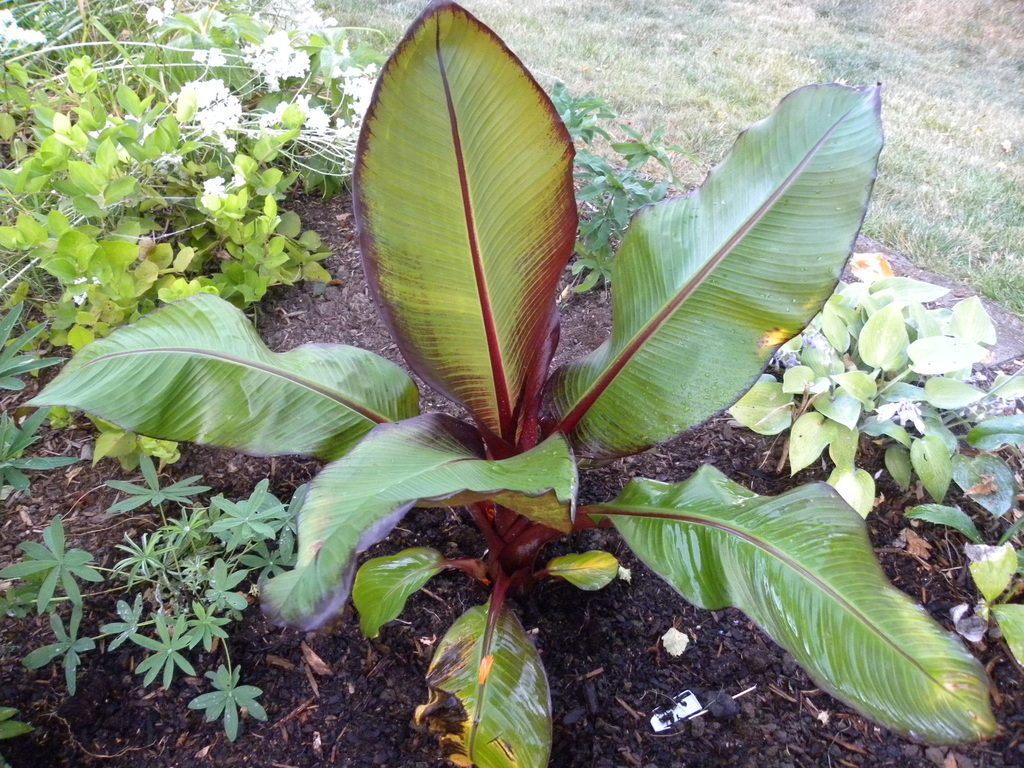
Abyssinian banana
Ensete ventricosum
Ensete ventricosum, commonly known as enset or ensete, Ethiopian banana, Abyssinian banana, pseudo-banana, false banana, and wild banana, is a species of flowering plant in the banana family Musaceae. The only country where the domesticated form of the plant is cultivated is Ethiopia, where it provides the staple food for approximately 20 million people. The name Ensete ventricosum was first published in 1947 in the Kew Bulletin.. Its synonyms include Musa arnoldiana, Musa ventricosa, and Musa ensete. In its wild form, it is native to the eastern edge of the Great African Plateau, extending northwards from South Africa through Mozambique, Zimbabwe, Malawi, Kenya, Uganda, and Tanzania to Ethiopia, and west to the Congo, being found in high-rainfall forests on mountains, and along forested ravines and streams.
From the article Ensete ventricosum on Wikipedia (CC BY-SA), quoted section by section
Description
Like the banana, Ensete ventricosum is a large non-woody plant—a large monocarpic evergreen perennial—up to 6 m (20 ft) tall. The tallest to be reported was 13 m (43 ft). It has a stout pseudostem of tightly overlapping leaf bases, and large banana-like leaf blades of up to 5 m (16 ft) tall by 1 m (3 ft 3 in) wide; leaves up to 6 m (20 ft) long and up to 1.5 m (4 ft 11 in) wide have been reported. The flowers, which occur only once from the centre of the plant at the end of that plant's life, are in large pendant thyrses up to 3 m (9.8 ft) long, bearing 30 or more "hands" of young bananas which are covered by large pink bracts. The roots are an important foodstuff, but the fruits are inedible and have hard, black, rounded seeds.
Etymology. The Latin specific epithet ventricosum means "with a swelling on the side, like a belly".
Pests. The most common pest that threatens the enset plant is the Cataenococcus enset, which is a root mealybug. C. enset feeds on the roots and corm of plant, which leads to slower growth and easier uprooting. Even though enset can be infested at all ages, the highest risk is between the second and fourth growth years. The dispersion of the mealybug occurs through multiple vectors. First, the larvae can crawl short distances before settling down; adult mealybugs tend to move only after being disturbed. …
At the table
Enset is an important local food source, especially in Ethiopia. In 1995, the Food and Agriculture Organization of the United Nations reported that "enset provides more food per unit area than most cereals. It is estimated that 40 to 60 enset plants occupying 250–375 square metres (2,700–4,000 sq ft) can provide enough food for a family of 5 to 6 people." Enset is Ethiopia's most important root crop, a traditional staple in the densely populated south and southwestern parts of Ethiopia. Its importance to the diet and economy of the Gurage and Sidama peoples was first recorded by Jerónimo Lobo in the seventeenth century. Each plant takes four to five years to mature, at which time a single root will yield about 40 kg (88 lb) of food. Because of the long period of time from planting to harvest, plantings need to be staggered over time to ensure that there is enset available for harvest in every season. Enset will tolerate drought better than most cereal crops. Wild enset plants are produced from seeds, while most domesticated plants are propagated from suckers. Up to 400 suckers can be produced from just one mother plant. In 1994, 3,000 km2 (1,200 sq mi) of enset were grown in Ethiopia, with a harvest estimated to be almost 10 tonnes per hectare (4.0 long ton/acre; 4.5 short ton/acre). …
Wikipedia: “Food”
How it is grown
Gender roles in enset cultivation are of high importance, as a strong division of work exists. Men are generally responsible for the propagation, cultivation, and transplanting of enset, while women are in charge of manuring, hand-weeding, thinning, and landrace selection. Additionally, women process enset plants, which is a tedious work (transformation of the plant into useful material, principally food and fibres) for which they generally come together. Men are disallowed to be on the field during this process. As women are responsible for providing sufficient food to their family, they are the ones who choose when and which plant to harvest and what quantity to sell. Several studies state the importance of women's knowledge of the different crop varieties. Women are more likely than men to recognize precisely the different varieties of the plant. Nevertheless, women's work is often neglected or considered of lesser importance than men's by researchers and farmers and women are less likely to get access to extension services and quality services than are men. Another important aspect in which gender plays a role is in the classification of enset varieties. There are differentiated "male" and "female" varieties, according to the preferences of men and women who harvest them. …
Wikipedia: “Gender in enset cultivation”
In human culture
Enset cultivation in Ethiopia is reported to be 10,000 years old, though there is little empirical evidence to support this. The plant has major economic, social, cultural, and environmental functions related to trade, medicine, cultural identity, rituals, or settlement patterns. The Enset-planting complex is one of the four farming systems of Ethiopia together with pastoralism, shifting cultivation, and the seed-farming complex. It is widely used by around 20 million people, representing 20-25% of the population that mainly live in the densely populated highlands of south and southwest Ethiopia. The plant is integral to food security due to its resistance to droughts, during which the growth stops for only a short time; and the fact that it can be harvested at any development stage. However, in recent years, the population growth has put pressure on enset cultivation systems, mainly because of a decrease of fertilization through manure and an increase in demand, especially during droughts. At such times, enset becomes the only resource available.
Gender in enset cultivation. Gender roles in enset cultivation are of high importance, as a strong division of work exists. Men are generally responsible for the propagation, cultivation, and transplanting of enset, while women are in charge of manuring, hand-weeding, thinning, and landrace selection. …
Wikipedia: “Socio-cultural importance of enset in Ethiopia”
Where it lives
Recorded sightings
—
geo-referenced records in GBIF, from museums, herbaria and field observers.
Drag the globe to turn it. Dots are where records exist, not a range map; darker means more records.
In the stacks
Searching the stacks…
Every page naming Ensete ventricosum in the Biodiversity Heritage Library →
This page is assembled live from iNaturalist, GBIF, Wikipedia, the Source Library and the Internet Archive. It is not yet part of the hand-edited codex. iNaturalist taxon 140998.