- Plants
- ›Vascular Plants
- ›Ferns
- ›Adder's-tongues, Fork Ferns, and Allies
- ›adder's-tongues and allies
- ›adder's-tongue family
- ›Ophioglossoideae
- ›Ophioglossum
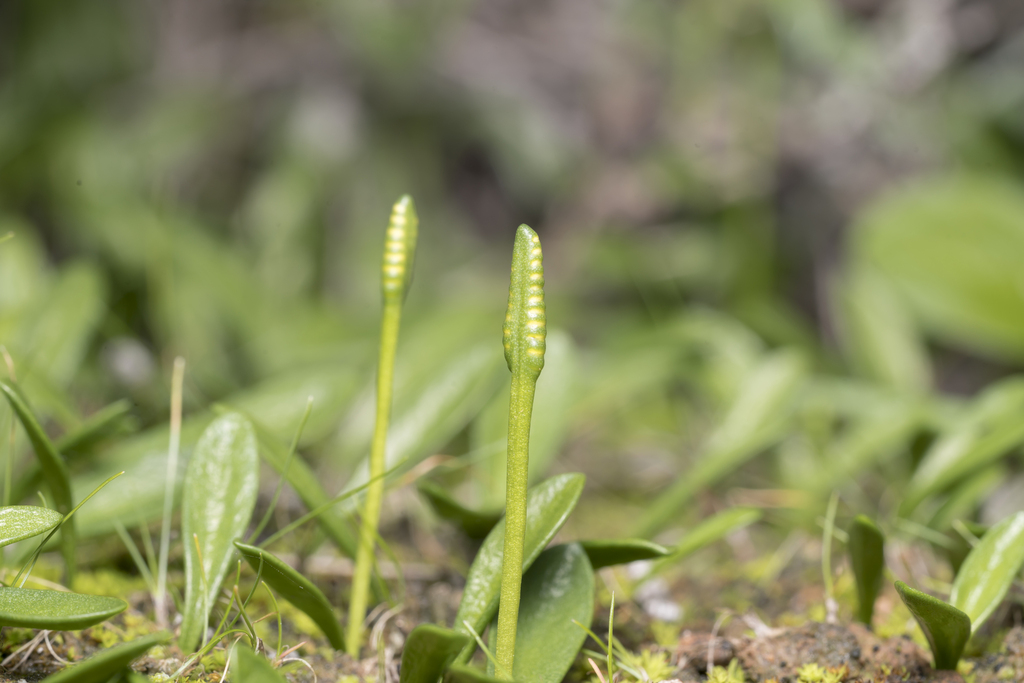
least adder's-tongue
Ophioglossum lusitanicum
Ophioglossum lusitanicum, the least adder's-tongue, is a small fern of the family Ophioglossaceae. It is a pan-tropically species categorised as least concern by the IUCN (2001).
From the article Ophioglossum lusitanicum on Wikipedia (CC BY-SA), quoted section by section
Description
Ophioglossum lusitanicum is a small winter annual fern, and consists of a simple sterile blade attached to a spike-like fertile blade with between three and eight sunken sporangia on either side. The whole plant rarely exceeds a height of 2 cm (0.8 in). This species has a chromosome number of 2n = 250–260.
Range & habitat
Ophioglossum lusitanicum is native to regions bordering the eastern North Atlantic Ocean in Mauritania, Macaronesia (excluding Cape Verde), Morocco, Portugal, France up to the Isles of Scilly and Channel Islands; all countries bordering the Mediterranean; the Caucasus region and has some records in India and Vietnam. The distribution in Britain is restricted to one small area of coastal heath on St Agnes, Isles of Scilly where it was discovered by John Raven in 1950. It grows in short turf on Wingletang Down where some of the colonies are suffering from an increase of competitive grasses, gorse (Ulex europaeus) and bramble (Rubus fruticosus). Ophioglossum lusitanicum is listed on Schedule 8 of the Wildlife and Countryside Act 1981, and is within a Site of Special Scientific Interest (SSSI). The naturalist Rosemary Parslow was a fan of the fern and she would spend Christmas on St Agnes so she could see the fern. Her daughter joked that she didn't know about plants but she could identify Ophioglossum lusitanicum.
Ecology. As this species is a winter annual, it requires a warm winter environment. In its British populations, it favours thin, unshaded, peaty soils in south-facing localities.
Wikipedia: “Distribution”
Where it lives
Recorded sightings
—
geo-referenced records in GBIF, from museums, herbaria and field observers.
Drag the globe to turn it. Dots are where records exist, not a range map; darker means more records.
In the stacks
Searching the stacks…
Every page naming Ophioglossum lusitanicum in the Biodiversity Heritage Library →
This page is assembled live from iNaturalist, GBIF, Wikipedia, the Source Library and the Internet Archive. It is not yet part of the hand-edited codex. iNaturalist taxon 137254.